
Biggest Unsolved Mysteries in History: Ancient Enigmas & Modern Puzzles
Dive into history's most baffling unsolved mysteries, from ancient civilizations to perplexing modern vanishing acts. Explore enigmas that continue to challenge experts.
Unraveling the Enigma: Exploring the Biggest Unsolved Mysteries in History
Welcome to TrendSeek, your premier destination for exploring the frontiers of knowledge and understanding. Today, we embark on a thrilling journey into the heart of the unknown, delving into some of the biggest unsolved mysteries in history. From ancient civilizations to modern vanishing acts, the human story is punctuated by perplexing enigmas that continue to baffle experts and ignite our collective imagination. These aren’t just forgotten footnotes; they are enduring puzzles that challenge our perceptions, push the boundaries of scientific inquiry, and remind us that even in an age of unprecedented information, some secrets remain stubbornly hidden. Join us as we shine a light on these captivating conundrums, examining the facts, the theories, and the sheer enduring power of the unexplained.
Ancient Wonders and Lingering Questions
History’s earliest chapters are rich with accomplishments that defy simple explanation, leaving behind monuments and artifacts that are among the biggest unsolved mysteries in history. How were these monumental feats achieved, and what secrets do their creators still guard?
The Construction of the Great Pyramid of Giza
One of the Seven Wonders of the Ancient World, the Great Pyramid of Giza stands as a testament to ancient Egyptian ingenuity, yet its construction remains a source of intense debate. Built for Pharaoh Khufu around 2580–2560 BC, this colossal structure comprises an estimated 2.3 million stone blocks, each weighing an average of 2.5 to 15 tons. The precision of its alignment with true north, the sheer scale of the undertaking, and the methods used to hoist and place such massive stones with pre-industrial tools continue to astound engineers and archaeologists alike.
Key Theories:
- External Ramps: The most widely accepted theory posits the use of massive external ramps, either straight or spiraling, to haul blocks up the pyramid. However, no conclusive archaeological evidence of such ramps exists, and their construction would have been almost as monumental as the pyramid itself.
- Internal Ramps: French architect Jean-Pierre Houdin proposed an intriguing theory of an internal ramp system, spiraling upwards within the pyramid’s core. This theory is supported by some seismic and microgravimetric data, but direct access to confirm it is impossible without damaging the structure.
- Lever Systems: Other theories suggest the use of complex lever and pulley systems to lift and position blocks, though the scale of such an operation would be immense.
- Water-Based Transport: Some fringe theories even suggest the use of water locks or buoyancy to move stones, although evidence for this is lacking.
Despite millennia of study, the definitive method remains elusive, making the Great Pyramid a symbol of human ambition and an enduring puzzle.

The Voynich Manuscript
Discovered in 1912 by antique book dealer Wilfrid Voynich, the Voynich Manuscript is a medieval codex written in an entirely unknown script and illustrated with perplexing diagrams of plants, astronomical charts, and human figures engaged in what appear to be bathing rituals. Dating back to the early 15th century (carbon-14 dating confirms a period between 1404 and 1438), this 240-page book has resisted all attempts at decipherment by cryptographers, linguists, and codebreakers over the past century, including experts from both World Wars.
Mysteries and Theories:
- Unknown Language: The script, dubbed “Voynichese,” doesn’t resemble any known language. Its statistical properties are similar to natural languages (e.g., word frequencies follow Zipf’s law), but no single character or word has been definitively translated.
- Illustrations: The intricate drawings depict plants that don’t match known species, celestial diagrams that don’t align with observed astronomy, and nude figures in bizarre, often interconnected, pools.
- Authorship and Purpose: Who wrote it, and why? Theories range from an elaborate hoax designed to defraud Emperor Rudolf II (one of its early owners), to a lost natural language, a coded message, an early scientific or medical text, or even a work of pure fantasy.
The Voynich Manuscript remains a tantalizing glimpse into a lost world of thought, an unparalleled challenge to human intellect, and a truly unique entry among the biggest unsolved mysteries in history.
Vanishing Acts: Among the Biggest Unsolved Mysteries in History
Some of history’s most chilling enigmas involve people and communities simply disappearing without a trace, leaving behind only questions and speculation. These sudden vanishings are deeply unsettling and represent some of the biggest unsolved mysteries in history.
The Lost Colony of Roanoke
In 1587, a group of about 115 English colonists, led by John White, established a settlement on Roanoke Island, off the coast of present-day North Carolina. White soon returned to England for supplies but was delayed for three years due to war with Spain. When he finally returned in August 1590, the entire colony had vanished. There was no sign of struggle, no bodies, and no clues beyond the word “CROATOAN” carved into a fence post and “CRO” carved into a tree.
Theories and Speculation:
- Assimilation with Native Americans: White had instructed the colonists to carve a Maltese cross if they were forced to leave under duress. The absence of this cross led him to believe they had simply moved to Croatoan Island (now Hatteras Island), home to a friendly Native American tribe. Historical and archaeological evidence suggests some interaction and potential integration.
- Massacre by Native Americans: Relations with some local tribes were hostile, making a massacre a plausible, though unproven, scenario.
- Starvation or Disease: The harsh conditions and lack of supplies could have led to a slow demise, with survivors perhaps attempting to relocate.
- Severe Weather: A powerful hurricane or storm could have wiped out the colony or forced them to sea, never to return.
The fate of the “Lost Colonists” remains a cornerstone of American folklore, a testament to the unforgiving nature of early colonial life, and a haunting question mark in the annals of history.
Amelia Earhart’s Final Flight
On July 2, 1937, pioneering American aviator Amelia Earhart and her navigator Fred Noonan disappeared over the central Pacific Ocean near Howland Island during an attempt to circumnavigate the globe. Despite extensive search efforts by the U.S. Navy and Coast Guard, no trace of their Lockheed Electra 10E aircraft or its occupants was ever found. Their last known position report indicated they were near Howland Island, but radio contact was lost shortly after.
Leading Theories:
- Crash and Sink: The official conclusion is that they ran out of fuel and crashed into the ocean, sinking to an unreachable depth. This is the most straightforward explanation, given the vastness of the Pacific.
- Gardner Island Landing: The International Group for Historic Aircraft Recovery (TIGHAR) proposes that Earhart and Noonan landed on Gardner Island (now Nikumaroro), an uninhabited coral atoll, and survived for a short period as castaways. Evidence includes artifacts found on the island, potential bones, and distress signals that could be attributed to their radio.
- Captured by the Japanese: A persistent, though largely unsubstantiated, theory suggests they were captured by Japanese forces, perhaps as spies, and either executed or held captive.
Earhart’s disappearance remains one of the most famous unsolved mysteries of the 20th century, fueling endless books, documentaries, and expeditions, driven by the enduring fascination with her bravery and the tragic abruptness of her final journey.

The Shadow of the Unknown: Jack the Ripper
In the autumn of 1888, the impoverished Whitechapel district of London was gripped by terror as a series of brutal murders targeted female prostitutes. The perpetrator, known only as Jack the Ripper, became an infamous figure in criminal history, his identity remaining one of the biggest unsolved mysteries in history. Between August and November, at least five women—Mary Ann Nichols, Annie Chapman, Elizabeth Stride, Catherine Eddowes, and Mary Jane Kelly—were savagely murdered and mutilated.
The Enduring Mystery:
- Modus Operandi: The Ripper’s victims were typically strangled and then had their throats cut. Many suffered severe abdominal mutilations, suggesting surgical knowledge or extreme brutality.
- Lack of Forensic Science: In 1888, forensic science was in its infancy. DNA analysis, fingerprinting, and advanced ballistics were decades away, leaving investigators with limited tools.
- Countless Suspects: Over the years, hundreds of suspects have been proposed, ranging from members of the British aristocracy (Prince Albert Victor, Duke of Clarence) to doctors, barristers, and even ordinary citizens. Notable suspects include Aaron Kosminski (identified by some through modern DNA analysis of a shawl, though this is heavily disputed), George Chapman, and Francis Tumblety.
- Letters to the Police: Several letters purportedly from the Ripper were sent to police and newspapers, most notably the “Dear Boss” letter (which coined the name “Jack the Ripper”) and the “From Hell” letter (containing a kidney fragment). Most are considered hoaxes, but they added to the hysteria.
The inability to identify Jack the Ripper has allowed his legend to grow, making him the archetype of the anonymous serial killer and a chilling reminder of the limits of justice in a bygone era.
Phenomenal Puzzles: Natural and Cosmic Entries in the Biggest Unsolved Mysteries in History
Not all mysteries are man-made or involve human disappearance. Some of the most intriguing puzzles arise from the natural world and even the cosmos, challenging our understanding of physics, geology, and the universe itself. These are truly among the biggest unsolved mysteries in history.
The Bermuda Triangle
The Bermuda Triangle, also known as the Devil’s Triangle, is a loosely defined region in the western part of the North Atlantic Ocean where numerous aircraft and ships are said to have disappeared under mysterious circumstances. The boundaries of the triangle are typically drawn between Miami, Bermuda, and San Juan, Puerto Rico. While the U.S. Navy and Coast Guard do not recognize the existence of the Bermuda Triangle as a specific area of increased danger beyond normal maritime hazards, the legend persists.
Notable Incidents and Theories:
- Flight 19 (1945): Perhaps the most famous incident, five U.S. Navy torpedo bombers disappeared during a training mission. Their last radio transmissions indicated compass malfunctions and confusion about their position. A search plane sent to find them also vanished.
- USS Cyclops (1918): A massive U.S. Navy collier with 306 crew and passengers disappeared without a trace, with no distress signal.
- Natural Explanations:
- Unpredictable Weather: The region is prone to sudden, violent storms, including hurricanes, which can quickly overwhelm vessels and aircraft.
- Geomagnetic Anomalies: Some theories suggest unusual magnetic conditions interfere with navigation equipment, though there’s no scientific consensus on this.
- Methane Hydrates: The release of vast pockets of methane gas from the seabed could reduce water density, causing ships to sink rapidly, or affect aircraft engines.
- Human Error: Many disappearances can be attributed to pilot/captain error, inexperienced crews, or poor decision-making in challenging conditions.
- Supernatural/Extraterrestrial: Fringe theories include alien abduction, vortexes to other dimensions, or the lingering influence of the mythical lost city of Atlantis.
Despite rational explanations for most incidents, the clustering of disappearances in this region has cemented the Bermuda Triangle’s place as a modern myth and a truly enduring puzzle.
The Tunguska Event
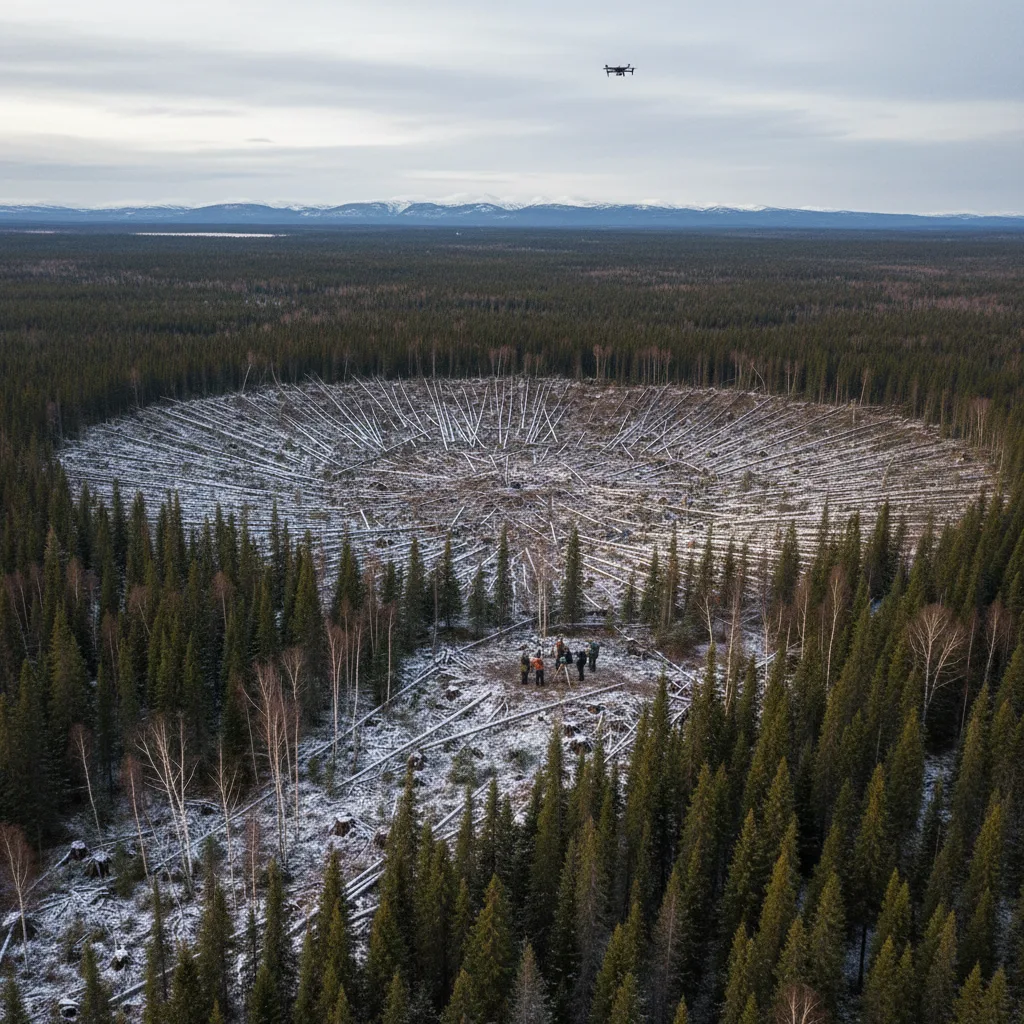
On June 30, 1908, a massive explosion occurred near the Podkamennaya Tunguska River in Siberia, Russia. The Tunguska Event flattened an estimated 80 million trees over an area of 2,150 square kilometers (830 square miles) and produced an airburst equivalent to 3–30 megatons of TNT, roughly 1,000 times more powerful than the atomic bomb dropped on Hiroshima. Eyewitnesses reported a bright light in the sky, a searing heat, and a shockwave that knocked people off their feet hundreds of kilometers away. Yet, remarkably, no impact crater was ever found.
Theories for the Craterless Explosion:
- Airburst Meteoroid/Comet: The prevailing scientific theory is that a large meteoroid or comet (tens of meters in diameter) entered Earth’s atmosphere and exploded several kilometers above the surface before hitting the ground. A stony asteroid would have left fragments, while a fragile comet (composed of ice and dust) would have disintegrated completely, explaining the lack of a crater and fragments.
- Black Hole: Early, more speculative theories included a miniature black hole passing through Earth.
- Alien Spaceship: Some fringe theories suggest an alien spacecraft exploding or crashing.
- Antimatter: Another exotic theory proposed an antimatter meteoroid.
While the airburst theory is widely accepted, the exact nature of the object (comet vs. asteroid) and the precise mechanism of its disintegration remain subjects of ongoing research, making the Tunguska Event one of the most spectacular and perplexing cosmic mysteries on Earth.
A Whisper from the Cosmos: The Wow! Signal
On August 15, 1977, astronomer Jerry Ehman was monitoring radio signals from space using the Big Ear radio telescope at Ohio State University, searching for signs of extraterrestrial intelligence. He detected an extraordinary 72-second long radio signal that was so strong and unusual, he circled it on a printout and wrote “Wow!” next to it. The Wow! Signal remains the strongest candidate for an extraterrestrial radio transmission ever detected, and one of the most intriguing of the biggest unsolved mysteries in history.
Why the Wow! Signal is So Compelling:
- Narrowband Frequency: The signal was extremely narrowband (around 10 kHz), a characteristic expected from an artificial transmission rather than natural astrophysical phenomena, which typically produce broadband signals.
- Frequency: It occurred at 1420.4556 MHz, very close to the 21-centimeter hydrogen line (1420.4058 MHz), which is the frequency at which neutral hydrogen emits radiation. This frequency is often considered a “cosmic landmark” and a logical choice for interstellar communication.
- Strength: It was 30 times stronger than the background noise, a significant spike.
- Duration: The 72-second duration precisely matched the time the Big Ear telescope could observe a point in the sky due to Earth’s rotation. This suggests the source was stationary relative to the telescope’s tracking window.
- Lack of Repetition: Despite numerous subsequent attempts to detect it again, the signal has never been repeated, adding to its mystery.
Possible Explanations:
- Terrestrial Interference: Though carefully analyzed, no terrestrial source (aircraft, satellites, ground-based transmitters) could be definitively identified that matched the signal’s characteristics.
- Natural Astronomical Phenomenon: While unlikely due to its narrowband nature, some unknown astrophysical event cannot be completely ruled out.
- Extraterrestrial Intelligence (ETI): The signal’s characteristics align perfectly with what scientists hypothesize an intentional ETI transmission might look like, making it a compelling, albeit unconfirmed, whisper from another civilization.
The Wow! Signal stands as a tantalizing “what if” in the search for extraterrestrial life, a fleeting moment when the universe seemed to speak directly to us, leaving behind a profound question mark about our place in the cosmos.
Conclusion
From the meticulously placed stones of ancient pyramids to the chilling silence following a cosmic blast, and the enduring hope for a message from the stars, the biggest unsolved mysteries in history serve as powerful reminders of the vastness of the unknown. They challenge our assumptions, fuel our curiosity, and inspire generations of researchers, adventurers, and dreamers to seek answers.
These enigmas are more than just historical footnotes; they are active frontiers of inquiry, pushing the boundaries of archaeology, forensic science, astrophysics, and human ingenuity. While some may forever remain beyond our grasp, the very act of seeking their solutions enriches our understanding of the world, our past, and our potential future. As we continue to explore, innovate, and question, perhaps one day, some of these profound mysteries will finally yield their long-held secrets. Until then, they stand as monuments to the enduring power of the unexplained, inviting us all to ponder what else might lie hidden, just beyond the veil of our current knowledge.