Current Trends in International Trade: Navigating Shifting Global Tides
Explore the dynamic shifts in international trade, from supply chain disruptions to evolving globalization. Understand the forces reshaping global commerce and their impact on our modern world.
The Shifting Tides: Navigating Current Trends in International Trade
Remember the great toilet paper panic of 2020? Or perhaps the agonizing wait for a new car, stalled by a tiny, elusive semiconductor chip? These weren’t just fleeting inconveniences; they were glaring spotlights on the intricate, often fragile, web of international trade that underpins our modern world. For decades, the mantra was “globalization,” an ever-tightening embrace of interconnected supply chains and frictionless borders. But today, the currents are shifting, and fast. We’re witnessing a profound re-evaluation of how goods, services, and even data move across the planet, driven by geopolitical tremors, technological leaps, and an urgent demand for resilience. Forget what you thought you knew about global commerce; the game has changed, and understanding these current trends in international trade isn’t just for economists – it’s for anyone who wants to comprehend the future of our world.
The Great Re-evaluation: Reshaping Global Supply Chains
The tremors began long before the pandemic, but COVID-19 and subsequent geopolitical shocks truly cracked the foundation of “just-in-time” supply chains. For years, efficiency reigned supreme, pushing companies to source from the cheapest, most specialized producers, often thousands of miles away. But when ports snarled, factories shuttered, and ships ran aground in the Suez Canal in March 2021, the vulnerability became undeniable. The consequence? A massive push towards reshoring, nearshoring, and friend-shoring.
Companies are now actively diversifying their manufacturing bases, bringing production closer to home or relocating to politically allied nations. Take Intel’s multi-billion-dollar investments in new semiconductor fabrication plants in Arizona and Ohio, announced in 2022 and 2023, respectively. This isn’t just about jobs; it’s about national security and supply chain resilience, reducing reliance on single, potentially volatile, regions. Similarly, TSMC, the Taiwanese chip giant, is building advanced foundries in Arizona and Japan, echoing a broader sentiment that strategic industries cannot afford distant dependencies. This shift isn’t cheap, nor is it simple, but the cost of disruption has proven far greater, forcing businesses to prioritize robustness over pure cost efficiency. What does this mean for the global manufacturing landscape, and where will the next wave of factories emerge?

Digital Highways: E-commerce’s Global Dominance in International Trade
While physical supply chains were snarling, a parallel universe of commerce exploded: cross-border e-commerce. The pandemic accelerated what was already a formidable trend, transforming how consumers shop and how businesses reach them. Platforms like Amazon Global Selling, Alibaba.com, and Shopify’s international tools have democratized global retail, allowing even small and medium-sized enterprises (SMEs) to tap into markets far beyond their national borders.
 A Zipline drone delivering medical supplies in Rwanda, an example of advanced logistics transforming cross-border commerce.
Consider the growth of direct-to-consumer (DTC) brands, for instance, which can now leverage sophisticated digital marketing and streamlined logistics to sell unique products from a workshop in Brooklyn to a customer in Berlin. This isn’t just about selling clothes or gadgets; it’s about a complete re-imagining of the retail value chain. Innovations in AI-driven logistics, predictive analytics for inventory management, and even drone delivery trials (as seen with companies like Zipline in Rwanda) are making cross-border shipping faster, cheaper, and more transparent. The friction of traditional customs and duties is slowly being eroded by integrated digital solutions, paving the way for a truly global marketplace. But how will governments regulate this torrent of digital transactions and protect local economies?

Geopolitical Fault Lines: Reshaping Trade Alliances
The geopolitical landscape is arguably the most potent force reshaping current trends in international trade. The simmering US-China trade war, which began in earnest in 2018 with tariffs on billions of dollars worth of goods, has evolved into a broader strategic competition, particularly in critical technologies like semiconductors and artificial intelligence. This rivalry isn’t just about tariffs; it’s about controlling the future of technology and global influence.
This era of “decoupling” or “de-risking” sees nations actively seeking to reduce strategic dependencies on potential adversaries. Simultaneously, we’re witnessing the strengthening of regional trade blocs and the formation of new alliances. The Comprehensive and Progressive Agreement for Trans-Pacific Partnership (CPTPP), reactivated after the US withdrawal, and the Regional Comprehensive Economic Partnership (RCEP), the world’s largest free trade agreement involving 15 Asia-Pacific nations, are powerful examples. Africa, too, is moving towards greater integration with the African Continental Free Trade Area (AfCFTA), aiming to create a single market for goods and services across 54 nations. These blocs represent a strategic pivot, prioritizing regional stability and collective bargaining power. But what does this fragmentation mean for the dream of a truly globalized economy, and who stands to win or lose in this new game of trade chess?
The Green Imperative: Sustainability in Global Commerce
Beyond geopolitics and digital transformation, an undeniable force is reshaping international trade: the urgent demand for sustainability. Consumers, investors, and governments are increasingly pushing for greener, more ethical supply chains. This isn’t just about corporate social responsibility; it’s becoming a fundamental requirement for market access and competitive advantage.
The European Union’s Carbon Border Adjustment Mechanism (CBAM), set to fully implement by 2026, is a groundbreaking example. It levies a carbon price on imports of certain carbon-intensive goods (like steel, cement, and fertilizers) to prevent “carbon leakage” – where companies move production to countries with weaker climate policies. This mechanism will compel exporters worldwide to measure and reduce their carbon footprint or face significant financial penalties. Furthermore, demand for circular economy principles, ethical sourcing (e.g., sustainable cocoa or conflict-free minerals), and transparent reporting on environmental, social, and governance (ESG) factors are becoming non-negotiable. Companies that cannot demonstrate a commitment to sustainability risk losing market share, investment, and reputation. How quickly will this green wave transform global production practices, and what new innovations will it unleash?
Data as the New Oil: Governing Cross-Border Flows
In the digital age, data has become an invaluable commodity, fueling everything from targeted advertising to AI development. Consequently, the flow of cross-border data is now a critical, yet highly contentious, aspect of international trade. As businesses increasingly rely on cloud computing, global databases, and digital services, the rules governing where data can be stored, processed, and transferred are becoming paramount.
Nations are enacting increasingly stringent data localization laws and privacy regulations. The EU’s General Data Protection Regulation (GDPR), implemented in 2018, set a global benchmark for data privacy, impacting any company that handles data of EU citizens. China’s Personal Information Protection Law (PIPL), effective since 2021, is another formidable example, imposing strict requirements on data transfers out of the country. These regulations often create complex legal and operational challenges for multinational corporations, forcing them to build costly regional data centers or navigate intricate consent mechanisms. The lack of a unified global framework for data governance creates friction, raising questions about digital sovereignty versus the free flow of information essential for innovation. How will the world balance national security concerns with the economic imperative of seamless data exchange?
Automation’s Ascent: Redefining Logistics and Labor
The relentless march of automation and artificial intelligence is fundamentally reshaping the logistics and manufacturing sectors that underpin international trade. Faced with persistent labor shortages, rising wages, and the need for greater efficiency, companies are investing heavily in robotics, AI-driven systems, and autonomous technologies.
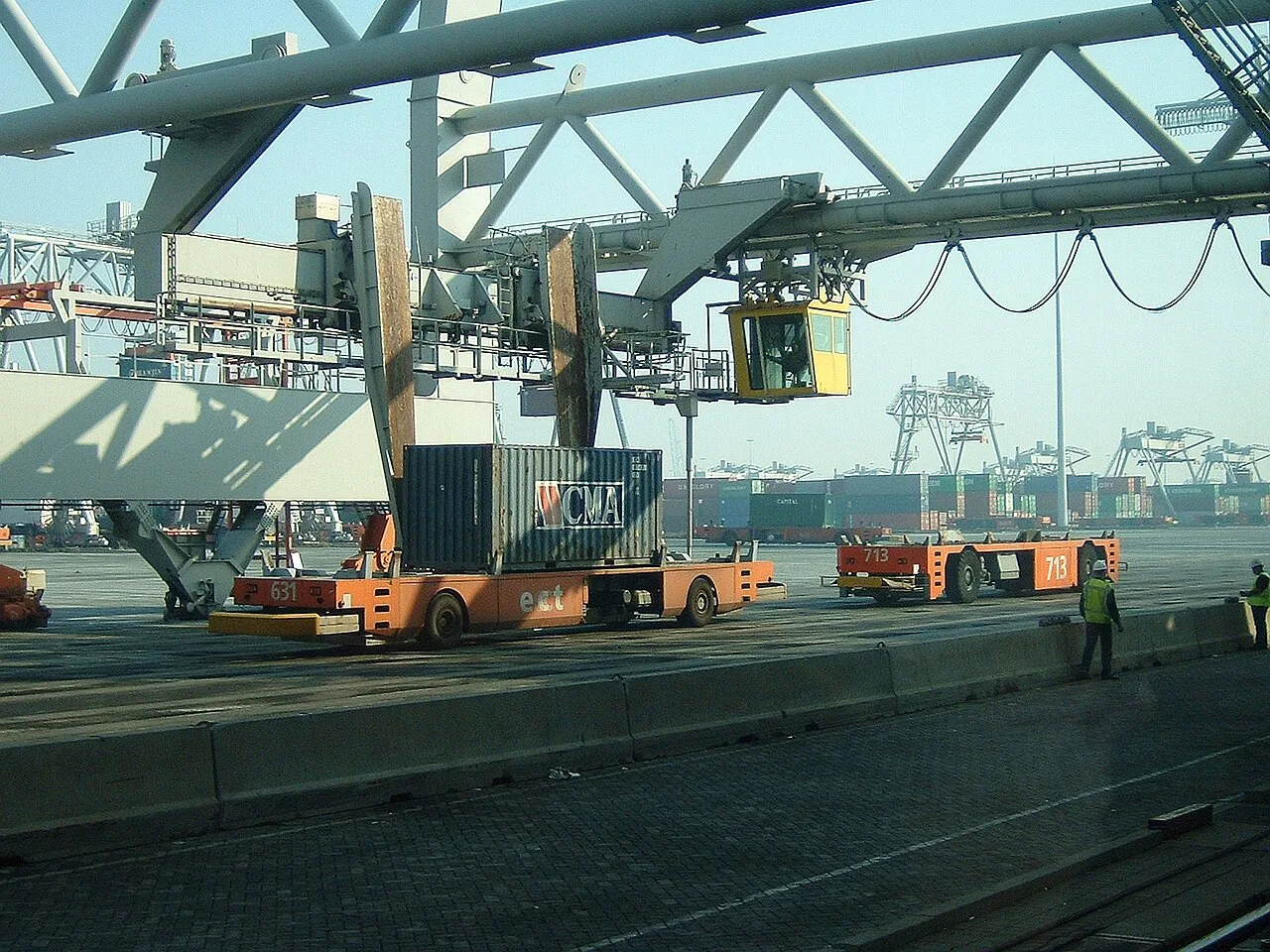 Automated container terminals at the Port of Rotterdam, utilizing robotic cranes and vehicles for efficient cargo handling. (Wikimedia Commons, CC BY 1.0)
In ports, automated container terminals like those in Rotterdam or Singapore use driverless cranes and robotic vehicles to load and unload ships with unprecedented speed and precision. Inside warehouses, automated guided vehicles (AGVs) and robotic arms are managing inventory, picking orders, and preparing shipments, reducing human error and increasing throughput. This transformation extends to the “last mile” with trials of delivery robots and drones. While automation promises to boost productivity and resilience, it also raises significant questions about the future of work. The demand for low-skilled labor in logistics may decrease, but the need for highly skilled technicians, data scientists, and AI specialists will skyrocket. How will global workforces adapt to this seismic shift, and what new industries will emerge from this technological revolution?
Conclusion: Charting the Course for Future International Trade
The landscape of international trade is in constant flux, a complex interplay of economic forces, technological breakthroughs, and geopolitical maneuvering. From the imperative of supply chain resilience and the explosion of cross-border e-commerce to the greening of global commerce and the intricate governance of data flows, the picture is one of dynamic transformation. The old paradigms of frictionless globalization are giving way to a more fragmented, yet potentially more robust, system.
For businesses and nations alike, the key takeaways are clear: adaptability, diversification, and strategic foresight are no longer optional but essential for survival and success. Those who embrace technological innovation, commit to sustainable practices, and navigate the shifting geopolitical currents with agility will be the ones that thrive. The future of global commerce demands a new playbook, one that prioritizes resilience and responsibility as much as efficiency and profit. The journey ahead promises to be challenging, but also ripe with unprecedented opportunities for those willing to chart a new course.