
Mind-Blowing Facts: Unveiling the Universe's Staggering Scale
Explore the universe's mind-blowing scale with TrendSeek. Discover staggering facts about cosmic vastness and humanity's place in the infinite expanse beyond Earth.
Mind-Blowing Facts About the Universe’s Staggering Scale: A TrendSeek Guide
From the moment humanity first gazed at the night sky, we’ve been captivated by the seemingly infinite expanse above. What truly lies beyond our blue planet? How vast is “vast,” and what does it mean for our place in the cosmos? At TrendSeek, we delve into the wonders of knowledge, and today, we’re embarking on an extraordinary journey to uncover some truly mind-blowing facts about the size of the universe. Prepare to have your perception of scale irrevocably altered as we navigate the unimaginable distances, countless celestial bodies, and the very fabric of space and time that define our cosmic home. It’s a tale of numbers so grand they become abstract, distances so immense they defy comprehension, and phenomena so powerful they sculpt galaxies.
The Observable Universe: A Cosmic Bubble We Can See
Before we plunge into the truly mind-blowing facts about cosmic dimensions, it’s crucial to understand a fundamental distinction: the difference between the observable universe and the entire universe. The observable universe is essentially a cosmic sphere, centered on Earth, encompassing all the matter and energy whose light has had time to reach us since the Big Bang. Think of it as our cosmic horizon.
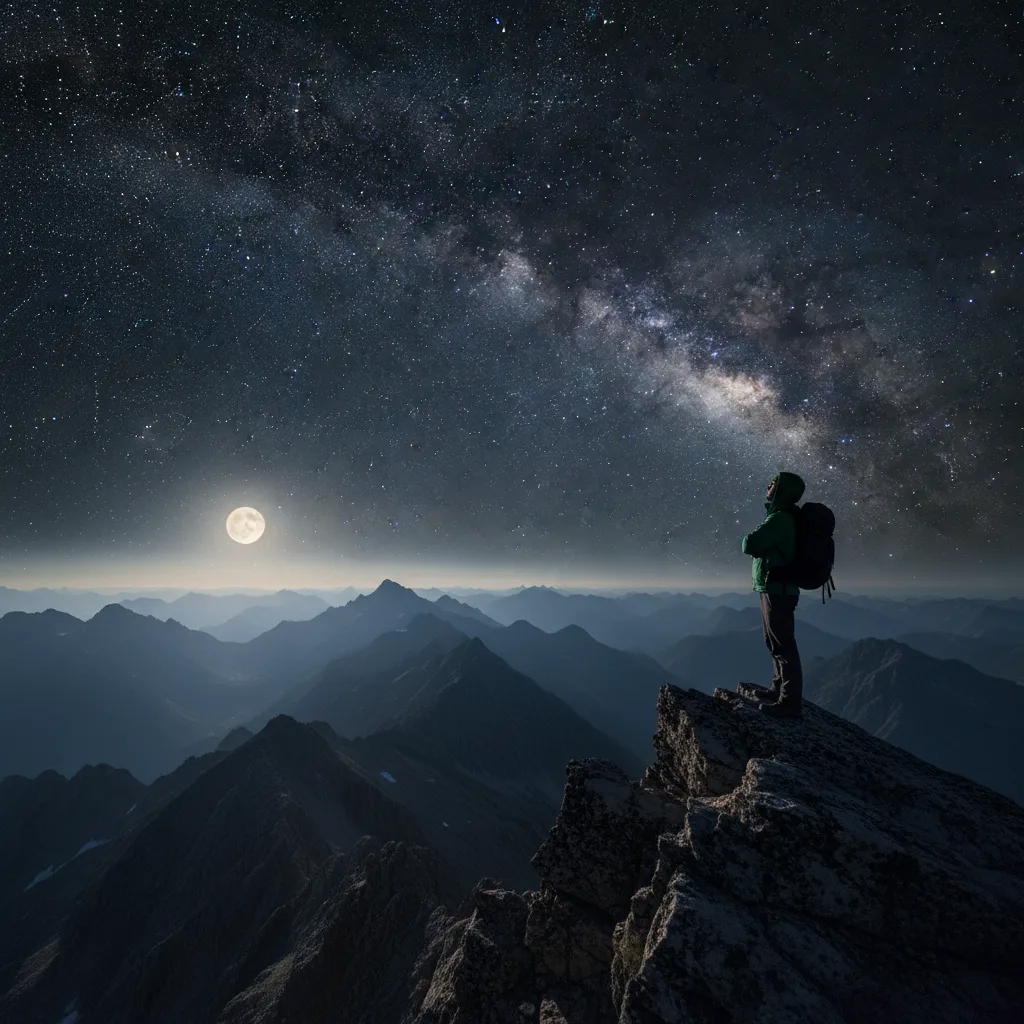
- Diameter: The observable universe stretches approximately 93 billion light-years across. To put that into perspective, a light-year is the distance light travels in one Earth year – roughly 9.46 trillion kilometers (about 5.88 trillion miles). This means the light from the most distant objects we can detect has traveled for 13.8 billion years (the age of the universe) to reach us.
- The “Why 93 Billion?” Conundrum: You might wonder why the diameter is 93 billion light-years if the universe is only 13.8 billion years old. This isn’t a paradox, but a consequence of the universe’s continuous expansion. As light travels towards us from distant galaxies, the space between us and those galaxies is simultaneously stretching. So, a galaxy whose light took 13.8 billion years to reach us is now much, much farther away than 13.8 billion light-years.
- Our Cosmic Bubble: It’s important to remember that this “observable” bubble is unique to our location. An observer in a galaxy far, far away would have their own observable universe, potentially overlapping with ours but extending in different directions, encompassing different sets of galaxies. This concept alone hints at a universe far grander than our current view.
Distances That Defy Imagination: Mind-Blowing Facts About Cosmic Scale
To grasp the true scale of the universe, we must first appreciate the vastness of the “small” distances before escalating to the truly astronomical. Even within our own cosmic neighborhood, the numbers quickly become staggering.
- Earth to the Moon: A mere 1.3 light-seconds. If you could travel at the speed of light, you’d be there in just over a second. This is our closest celestial neighbor, yet it’s still a quarter of a million miles away – a journey that took Apollo astronauts three days.
- Earth to the Sun: Our life-giving star is about 8 light-minutes away. This means the sunlight you feel on your face left the Sun eight minutes ago. If the Sun were to suddenly vanish, we wouldn’t know for eight minutes.
- Our Solar System’s Edge: The Oort Cloud, a vast theoretical shell of icy objects believed to be the source of long-period comets, marks the outermost boundary of our solar system. It’s estimated to extend between 2,000 and 100,000 astronomical units (AU) from the Sun. One AU is the distance from Earth to the Sun. At its farthest, the Oort Cloud could be 1.5 to 3 light-years away – a journey of tens of thousands of years for our fastest spacecraft. Voyager 1, our most distant human-made object, is currently just over 24 billion kilometers (15 billion miles) from Earth, having traveled for over 45 years. It has only just entered interstellar space, and is nowhere near the Oort Cloud’s outer edge.
- Our Nearest Star: Proxima Centauri, part of the Alpha Centauri triple-star system, is the closest star to our Sun, located approximately 4.24 light-years away. If you could travel at the speed of light, it would still take you over four years to reach it. With current technology, a journey there would take tens of thousands of years.
- Our Milky Way Galaxy: Our home galaxy is a majestic spiral spanning an estimated 100,000 to 120,000 light-years in diameter. It’s thought to contain between 100 billion and 400 billion stars, along with an even greater number of planets. To traverse the Milky Way at light speed would take 100,000 years. Our solar system is located about 27,000 light-years from the galactic center.
- Our Galactic Neighbor: The Andromeda Galaxy (M31), our largest galactic neighbor, is a colossal spiral galaxy estimated to contain a trillion stars. It’s approximately 2.5 million light-years away from the Milky Way. Despite this immense distance, it’s actually visible to the naked eye on a clear, dark night as a faint smudge – meaning the light you see left Andromeda 2.5 million years ago, long before humans evolved. Fun fact: Andromeda and the Milky Way are on a collision course, destined to merge in about 4.5 billion years.
The Universe’s Expanding Fabric: More Than Just Moving Objects
One of the most profound and mind-blowing facts about the size of the universe isn’t just how big it is, but how it’s actively getting bigger. This isn’t merely objects moving through space; it’s the very fabric of space itself stretching and expanding.
- Hubble’s Law: In the 1920s, Edwin Hubble observed that galaxies are generally moving away from us, and the farther away they are, the faster they recede. This phenomenon, known as redshift, is the cosmic equivalent of the Doppler effect for sound, indicating that light waves from distant galaxies are stretched as they travel through expanding space.
- Dark Energy’s Accelerating Push: For a long time, scientists believed the universe’s expansion would slow down due to gravity. However, observations in the late 1990s revealed the opposite: the expansion is actually accelerating. This acceleration is attributed to a mysterious force called dark energy, which acts as a repulsive pressure, pushing space apart. Dark energy is believed to constitute about 68% of the total energy density of the universe, making it the dominant force shaping its ultimate fate and scale.
- Faster Than Light Expansion: While no object or information can travel through space faster than the speed of light, space itself is not bound by this rule. The expansion of the universe can cause very distant parts of the universe to recede from us at speeds greater than the speed of light. This doesn’t violate Einstein’s theory of relativity because it’s the space between objects that’s expanding, not the objects themselves moving locally through space faster than light. This means there are galaxies whose light will never reach us, even if they emitted it today, because the space between us expands too rapidly. They are forever beyond our observable horizon.
Counting the Uncountable: Stars, Galaxies, and Beyond
When we talk about the size of the universe, we’re not just talking about empty space. We’re talking about an incomprehensible number of celestial bodies, each a marvel in its own right.
- Galaxies Galore: Thanks to deep-field observations from telescopes like Hubble and the James Webb Space Telescope, astronomers estimate there are at least 2 trillion galaxies in the observable universe. Yes, that’s two thousand billion galaxies. And this number is likely a conservative estimate, as improved technology continues to reveal even fainter, more distant galaxies.
- Stars in the Septillions: If each of those 2 trillion galaxies contains, on average, a few hundred billion stars (like our Milky Way), the total number of stars in the observable universe easily enters the septillions – that’s a 1 followed by 24 zeros (1,000,000,000,000,000,000,000,000). To put that into perspective, there are roughly as many stars in the observable universe as there are grains of sand on all the beaches on Earth.
- Planets Everywhere: The Kepler Space Telescope mission revolutionized our understanding of exoplanets (planets outside our solar system). Its findings suggest that planets are incredibly common, with some estimates indicating there could be more planets than stars in our galaxy alone. This means the number of planets in the observable universe could be in the tens of septillions, significantly increasing the probability of life beyond Earth.
- Cosmic Structures: Galaxies aren’t randomly scattered; they form immense structures. Galaxies cluster together into galaxy clusters, which in turn form larger structures called superclusters. Our Milky Way is part of the Local Group, which is itself a small component of the vast Laniakea Supercluster, spanning over 500 million light-years and containing the mass of 100 million billion suns. These superclusters are arranged in a “cosmic web” of filaments and voids, revealing the largest known structures in the universe.
The Unseen Majority: Dark Matter and Dark Energy’s Role in Size
Paradoxically, much of the universe’s immense size and structure is governed by things we cannot see or directly detect. The universe is predominantly composed of mysterious entities known as dark matter and dark energy.
- The Universe’s Composition: Our current understanding suggests that only about 5% of the universe is made of “normal” matter – the atoms that make up stars, planets, and everything we can see and touch. The vast majority is unseen:
- Dark Matter (approx. 27%): This invisible substance doesn’t emit, absorb, or reflect light, making it incredibly difficult to detect. However, its gravitational effects are clearly observed. Dark matter acts as a cosmic “scaffolding,” providing the gravitational pull necessary to hold galaxies and galaxy clusters together. Without it, the universe’s grand structures would simply fly apart. Its gravitational influence plays a crucial role in the initial formation and continued stability of the structures that fill the vastness of space.
- Dark Energy (approx. 68%): As discussed earlier, dark energy is the mysterious force driving the accelerated expansion of the universe. It’s essentially the energy inherent in space itself. Its repulsive effect is continuously pushing galaxies farther apart, effectively increasing the “size” of the observable universe over time, even as it simultaneously pushes some galaxies beyond our future reach.
- Shaping the Cosmos: These unseen components don’t just add to the universe’s mass; they dictate its evolution and ultimate fate. Dark matter provides the gravitational glue for cosmic structures, while dark energy dictates the ever-increasing scale of the universe, ensuring that the distances between galaxies continue to grow at an accelerating rate. This profound imbalance means that the universe is not only vast but is actively becoming vaster, driven by forces we barely understand.
What Lies Beyond: The Edge of the Unknown
Even with all these mind-blowing facts about the size of the universe, there remains a fundamental question that continues to humble scientists and philosophers alike: Is the universe infinite? And what lies beyond our observable horizon?
- Is the Universe Infinite? We don’t know for certain. Current cosmological models suggest that the universe is either infinitely large or, if finite, it is so vast that its curvature is undetectable within our observable portion. If it is infinite, then the universe truly has no “edge” or “center.”
- The Entire Universe vs. Observable Universe: If the universe is infinite, then our observable universe – that 93-billion-light-year bubble – is just an infinitesimally small fraction of the whole. Even if the universe is finite but much larger than our observable part, it would still dwarf our current perception. Imagine a tiny speck on an enormous, boundless canvas. That speck is our observable universe.
- The Multiverse Hypothesis: Some theoretical physicists propose the concept of a multiverse, where our universe is just one of many, perhaps an infinite number, existing within a larger cosmic landscape. Each universe could have different physical laws, dimensions, and properties. While purely speculative, the multiverse concept pushes the boundaries of cosmic scale to an even more unimaginable extreme, suggesting an ultimate reality far grander than even our vast universe.
- The Limits of Perception: Ultimately, our understanding of the universe’s true scale is limited by the speed of light and the age of the universe. We can only see as far as light has had time to travel to us, and the accelerating expansion means that much of the universe will forever remain beyond our observable reach, shrouded in cosmic mystery.
Conclusion
The journey through these mind-blowing facts about the size of the universe is a humbling yet exhilarating experience. From the mere light-seconds to our Moon to the 93-billion-light-year span of the observable cosmos, and potentially an infinite expanse beyond, the numbers and concepts challenge our everyday intuition. We’ve explored the unimaginable distances between stars and galaxies, the staggering number of celestial bodies, and the powerful, unseen forces of dark matter and dark energy that sculpt its structure and drive its accelerating expansion.
The universe is not just big; it’s dynamically growing, filled with trillions of galaxies, each teeming with billions of stars and countless planets. It’s a place where space itself stretches, where light takes billions of years to travel, and where the vast majority of existence remains an enigma. This profound scale reminds us of the delicate uniqueness of our blue planet and the endless wonders that await discovery. As we continue to push the boundaries of technology and understanding, one thing remains clear: the universe will continue to inspire awe, challenge our perceptions, and offer infinite opportunities for exploration and wonder.