Beyond the Apple: Newton's 1687 Law & 3 Cosmic Truths
Isaac Newton's 1687 universal gravitation law, introduced in Principia Mathematica, reveals how gravity shapes galaxies and moves celestial bodies across vast cosmic distances.
Gravity is wilder than you think
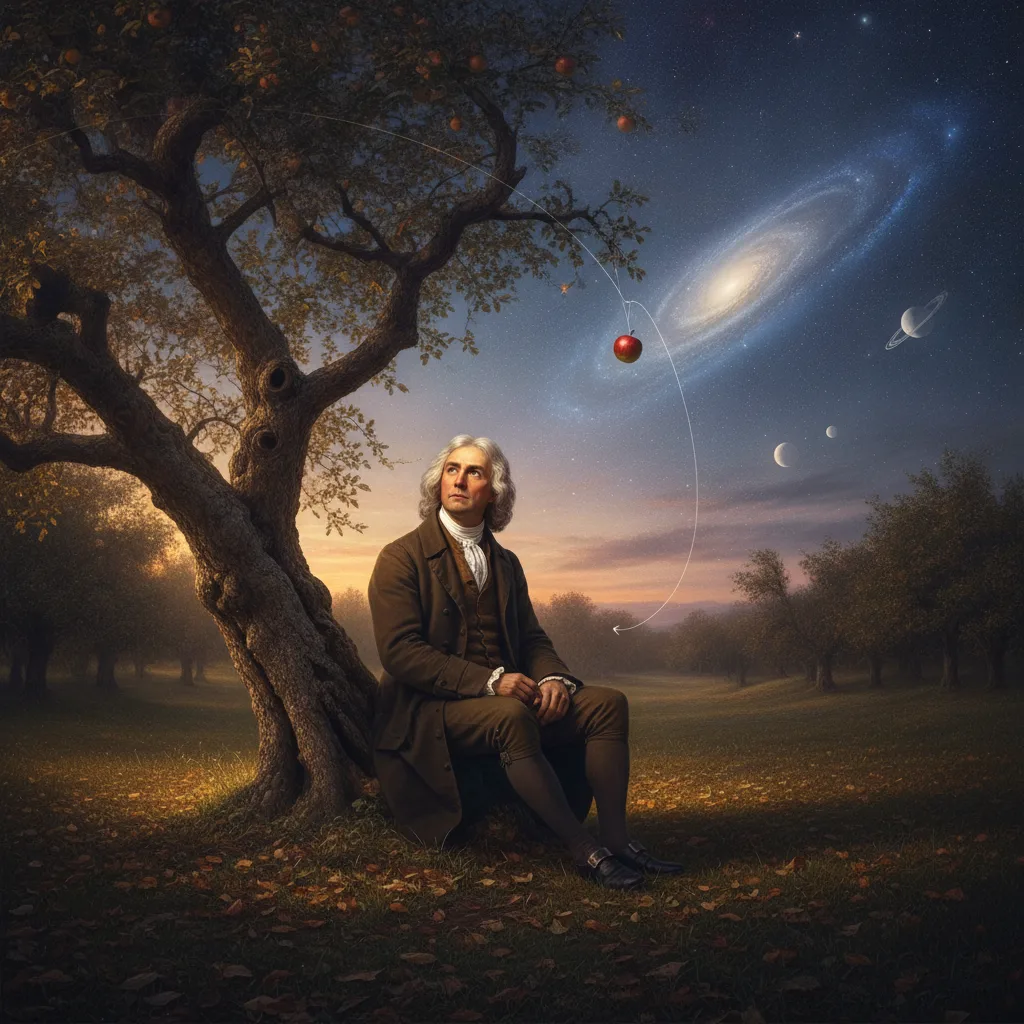
Isaac Newton published Philosophiæ Naturalis Principia Mathematica in 1687. This book introduced universal gravitation. It changed how we understood the cosmos forever. Most people picture gravity as just an apple falling. They see a simple, downward tug.
But this popular image, while basic, misses the point. Gravity isn’t just a local pull. It acts across vast cosmic distances. It shapes entire galaxies. It moves celestial bodies with astonishing complexity.
Gravity’s basic rules
Newton’s law says every particle in the universe attracts every other particle. The force is proportional to their masses. It gets weaker with distance, specifically by the square of the distance between them. This math first explained how things move on Earth and in space.
Planets don’t just circle the sun
Lots of us think planets just orbit the Sun because of a constant gravitational pull. This simple idea suggests a kind of invisible tether. It keeps objects circling in neat, predictable paths. This captures a basic truth about how orbits work.
But this explanation isn’t complete. Johannes Kepler, decades before Newton, showed that planetary orbits are ellipses, not perfect circles. His three laws, published between 1609 and 1619, detailed how planets moved. Newton’s universal gravitation then explained the why. It showed that an inverse-square law of attraction naturally creates elliptical paths.
Planetary orbits aren’t perfectly stable ellipses either. Other planets pull on them with subtle gravitational tugs. These perturbations cause measurable shifts. For example, Jupiter’s huge mass greatly influences its neighbors’ orbits. Pierre-Simon Laplace, an 18th-century astronomer, developed perturbation theory. He explained these gravitational nudges. He showed the solar system’s stability depends on these interactions.
Even Newton’s theory wasn’t quite right for some celestial events. Mercury’s orbit, for instance, has a small, odd shift in its perihelion. This means the point closest to the Sun moves more than Newton’s gravity predicted. Albert Einstein’s 1915 theory of General Relativity explained it precisely. He showed gravity is spacetime itself bending, not just a force.
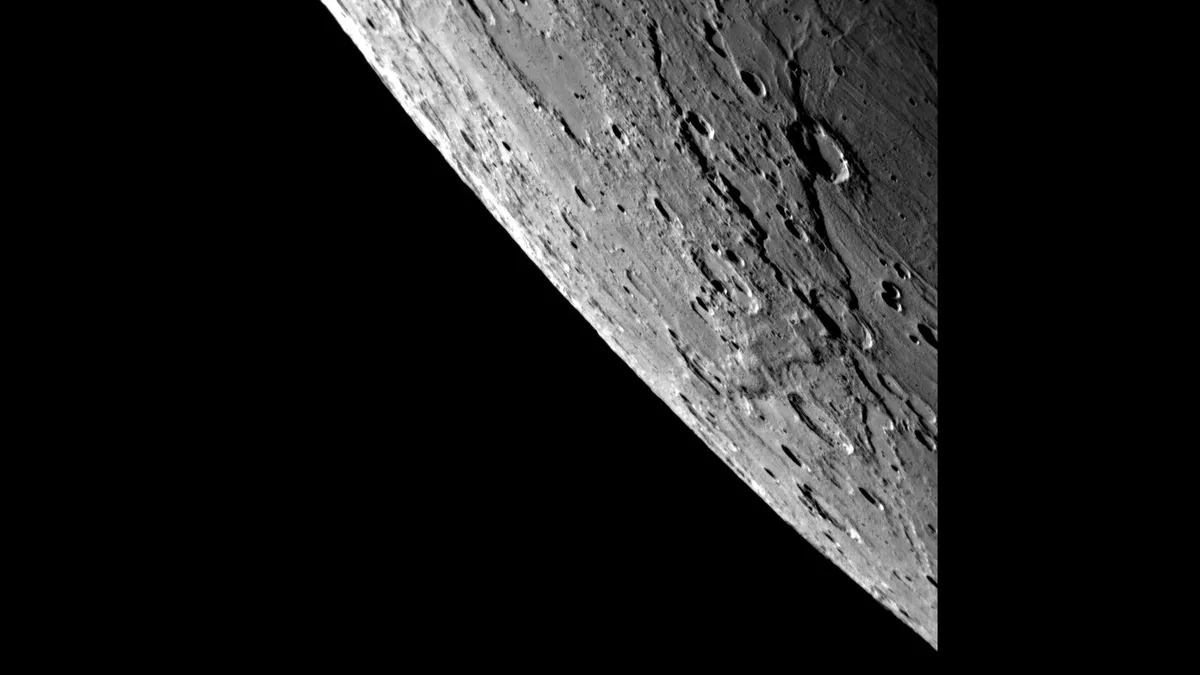
The planet Mercury, the innermost planet in our solar system, famously exhibits a small, odd shift in its perihelion. This orbital anomaly, which Newton's law of gravitation couldn't fully explain, was precisely accounted for by Albert Einstein's 1915 theory of General Relativity, showcasing gravity's true complexity. (Source: space.com)
Tides are more than just the moon pulling
Most people think the Moon’s gravity just pulls ocean water up. They imagine it simply drawing water upwards. This common idea is right about the Moon’s main role. It’s a key part of how tides work.
But the process is much more complex than a simple upward pull. Tides happen mostly because of differential gravity. The Moon’s gravity isn’t uniform across Earth’s diameter. It pulls harder on the side closest to it. This creates a water bulge. It also pulls Earth itself away from the water on the far side, creating a second bulge. This differential force explains why most places have two high tides and two low tides daily.
The Sun also plays a big, secondary role. Its gravity combines with the Moon’s. When the Sun, Moon, and Earth line up (during new and full moons), their gravity reinforces. This creates very high spring tides. When they’re at right angles (during quarter moons), their forces partly cancel. This results in weaker neap tides, as NOAA documents. Sir George Darwin, a late 19th-century geophysicist, studied tidal friction. He showed it slows Earth’s rotation and pushes the Moon farther away.
Tidal forces don’t just affect oceans. They also change the shape of the solid Earth. These “solid Earth tides” make the planet’s surface rise and fall by several centimeters daily. Gravimeters precisely measure these subtle changes. These measurements show gravity’s widespread effect on Earth’s entire structure.
How gravity builds stars and galaxies
Most people think gravity just pulls together gas and dust. This forms stars and galaxies. This idea gets gravity’s main job right: it’s an attractive force. It’s totally needed to form cosmic structures.
But it’s not a simple, even collapse. The early universe was very smooth. Slight density fluctuations were key. Without these tiny overdensities, regions wouldn’t have enough gravity. They couldn’t fight the universe’s expansion, which works against collapse. Cosmologist James Peebles, a 2019 Nobel laureate, developed this idea of cosmic structure formation. His work shows how important these initial conditions were.

Spring tides are a powerful demonstration of gravity, occurring when the Sun, Moon, and Earth align, combining their gravitational pull to create exceptionally high and low tides that dramatically alter coastal landscapes. (Source: sailingissues.com)
Gravity from visible matter alone also isn’t enough to explain how galaxies form and stay together. We see that galaxies spin too fast. Their outer stars should fly off into space. This problem led to the idea of dark matter. This invisible substance provides extra gravitational support. Vera Rubin and Kent Ford’s work in the 1970s, studying galaxy rotation, gave strong evidence for dark matter.
Individual stars also have a complex birth. A molecular cloud must overcome internal gas pressure and magnetic fields. It needs to be cold and dense enough to collapse under its own gravity. This condition is called the Jeans instability threshold. Sir James Jeans developed this idea in the early 20th century. This threshold shows not just any gas clump becomes a star. Specific physical conditions must be met.
Gravity’s biggest mysteries
Newton described gravity, and Einstein reinterpreted it. It’s still a key part of modern physics. It explains everything from falling objects to spacetime warping around black holes. It’s a powerful tool.
But gravity’s picture isn’t complete. For instance, gravity alone can’t explain the universe’s accelerating expansion. Observations of distant supernovae by teams led by Saul Perlmutter, Brian Schmidt, and Adam Riess (Nobel laureates in 2011) confirmed this. It suggests dark energy, a mystery force, pushes the universe apart. This is a big hole in our current understanding of gravity.
We’re still trying to link gravity with quantum mechanics. General Relativity describes gravity on large scales. Quantum mechanics governs the subatomic world. Unifying these two fields of physics is one of science’s hardest unsolved problems. It suggests there’s still more to learn about gravity.
What’s next for gravity?
In 2015, the Laser Interferometer Gravitational-Wave Observatory (LIGO) made a huge discovery. It observed gravitational waves for the first time. This confirmed a big prediction of Einstein’s General Relativity. It also opened a new window into the universe. Now we can “hear” cosmic events, not just “see” them.
The Laser Interferometer Space Antenna (LISA) is a future space mission. It will detect lower-frequency gravitational waves. These waves come from supermassive black hole mergers and the very early universe. Such future observatories will continue this work, giving us new insights into cosmic evolution.
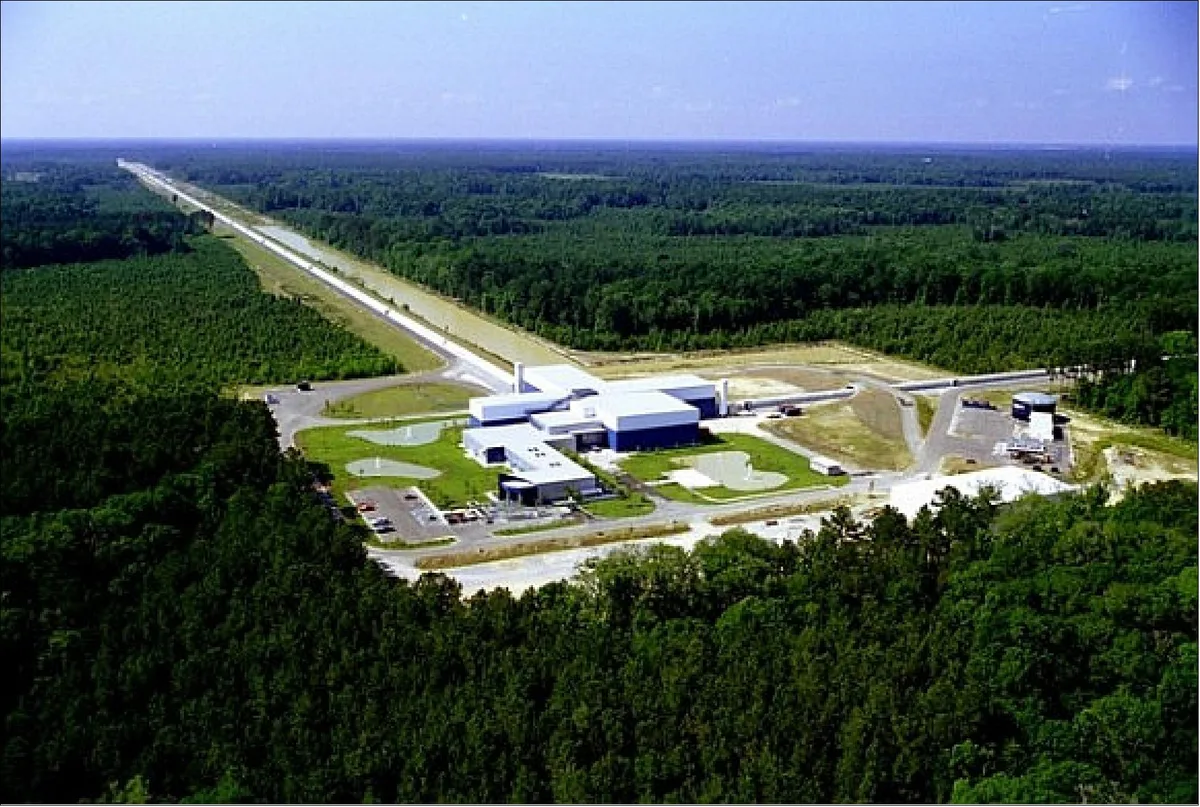
The Laser Interferometer Gravitational-Wave Observatory (LIGO) made history in 2015 by directly detecting gravitational waves for the first time, confirming a major prediction of Einstein's General Relativity. Its massive, L-shaped interferometers, each arm several kilometers long, are designed to measure incredibly tiny distortions in spacetime caused by cosmic events. (Source: eoportal.org)
Our understanding of gravity continually advances. New data from experiments and observatories improve our theories. The universe still holds many gravitational surprises.
FAQ
- What is the law of universal gravitation? Isaac Newton’s law says every particle attracts every other particle. This force is proportional to their masses and gets weaker with the square of the distance between them. It’s always a pull.
- How does gravity explain planetary orbits? Gravity gives the centripetal force that pulls planets toward the Sun, stopping them from flying off. This inward pull, plus the planet’s forward motion, creates a stable elliptical orbit.
- Why are there two high tides a day? Tides come from the Moon’s different gravitational pull across Earth. The Moon pulls harder on the near side, making a water bulge. It also pulls Earth away from the far side’s water, making another bulge there.
- What role does dark matter play in cosmic structure formation? Dark matter provides the extra gravitational support needed to pull gas and dust into stars and galaxies. Without its invisible gravity, visible matter alone wouldn’t have enough mass to form the large structures we see.
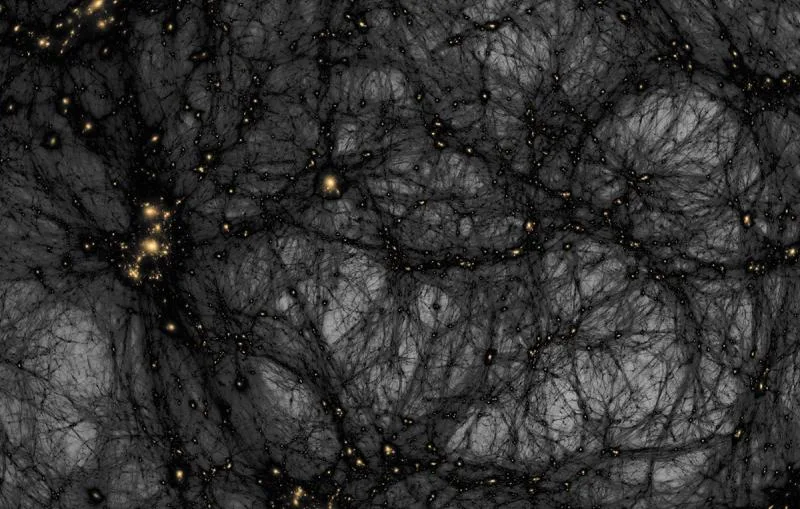
Though invisible, dark matter's gravitational pull is crucial for the formation of large-scale cosmic structures like galaxies and galaxy clusters, providing the scaffolding for visible matter to coalesce across the universe. (Source: science.nasa.gov)
You might also like:
👉 Unexplained Mysteries of Science: Cosmos, Quantum & Beyond