
MIT, Intel: The Quiet Progress Beyond Material Hype
Material science isn't just 'wonder material' headlines. Learn how MIT, Stanford, Intel, and BASF researchers quietly engineer substances with better properties.
Beyond the Hype: Material Science’s Quiet Progress
Forget the “wonder material” headlines. They paint a misleading picture of material science. This field, a mix of physics, chemistry, and engineering, studies matter. It looks at how matter is made and what it does. Researchers at places like MIT, Stanford, Intel, and BASF constantly search for new materials. They want to engineer substances with better properties for specific uses. But the popular idea of sudden, dramatic discoveries misses most of the real story.
The mainstream often celebrates material science for constant “breakthroughs.” You’ll hear talk of miracle substances ready to solve energy crises or change electronics. Real progress happens, but it’s often more complex and slower than headlines suggest. Many hyped discoveries face big problems. These issues delay or stop widespread adoption. To understand material science, we must look past initial lab success. We need to see the long, tough road to commercialization.
The popular narrative vs. hard reality
In 2004, Andre Geim and Konstantin Novoselov at the University of Manchester isolated graphene. This excited the world. Graphene is a two-dimensional material, just one atom thick. It showed great strength, electrical conductivity, and thermal properties. Many believed it would quickly change everything from electronics to aerospace. The initial hype promised fast, widespread use for this “wonder material.”
Graphene’s unique properties are real. Yet, nearly two decades later, its widespread commercial use has been slow. Dr. James Tour, a leading chemist at Rice University, often points out a huge challenge. It’s hard to produce large, defect-free graphene cheaply. Niche uses exist, like conductive inks or specialized sensors. Still, graphene hasn’t replaced silicon chips or traditional battery parts in most markets. Its journey from lab to market shows how far discovery is from practical use.
Perovskite solar cells are another celebrated material class. They emerged in 2009. Since then, these materials have rapidly gained efficiency. Researchers like Professor Henry Snaith at Oxford University pushed lab efficiencies past 25%. This rivals conventional silicon cells. Such quick progress often leads to predictions of a coming solar energy revolution.

Graphene, a revolutionary material just one atom thick, was isolated in 2004 by Andre Geim and Konstantin Novoselov. Its unique hexagonal lattice structure gives it exceptional strength, electrical conductivity, and thermal properties, making it a subject of intense research for diverse applications. (AI-generated illustration)
But perovskites struggle with stability in real-world conditions. Heat, moisture, and UV light degrade their performance over time. This differs from durable silicon panels. Many perovskite formulas also contain lead, which creates a big environmental and regulatory problem for mass production. Groups like the University of Toledo are developing lead-free options. However, these often have lower efficiencies. The promise remains, but the path to widespread use isn’t clear. It needs more than just high lab efficiency.
The unsung heroes: process and precision
We often focus on new materials. This overlooks equally important advances in manufacturing processes or material testing. These changes might not create a new “wonder substance.” But they fundamentally change how we use existing ones. Their impact is often quicker and broader, though less exciting. These are material science’s unsung heroes.
Additive manufacturing, or 3D printing, is one such advance. It’s not a new material. It’s a new way to build objects layer by layer. In 2016, GE Aviation started 3D printing fuel nozzles for its LEAP jet engines. This cut the part count from 20 to one. It also reduced weight by 25%. Teams at GE Additive developed the specific metal powders and printing steps.
This manufacturing change shows process matters more than just finding new materials. It allowed for complex shapes. These were impossible with old casting or machining methods. The result is a lighter, stronger, and more efficient engine part. This isn’t about inventing a new metal. It’s about getting amazing performance from existing alloys through better fabrication.
High-entropy alloys (HEAs) represent another important development. Professor Jien-Wei Yeh of National Tsing Hua University first popularized them in the early 2000s. Regular alloys usually have one or two main elements with small amounts of others. HEAs, though, mix five or more elements in nearly equal amounts. This unusual approach creates materials with incredible properties.
HEAs show great strength, ductility, and corrosion resistance. This is especially true at extreme temperatures. For example, some HEAs keep their strength at temperatures where normal superalloys would fail. This isn’t a new element discovery. It’s a new way of thinking about metals. Their use in demanding aerospace, nuclear, and defense applications changes how we design metallic materials. This comes from understanding how existing elements combine.

A 3D printed fuel nozzle for a GE LEAP jet engine, a marvel of additive manufacturing. This single, complex part replaced 20 components and reduced weight by 25%, showcasing how process innovation can revolutionize engineering. (Source: 3dprintingindustry.com)
Cryo-electron microscopy (cryo-EM) has also changed our ability to see materials at the atomic scale. Jacques Dubochet, Joachim Frank, and Richard Henderson won the Nobel Prize in Chemistry in 2017 for this. Cryo-EM lets scientists see biological molecules and material structures with amazing detail. This isn’t a material. It’s a tool.
This precise viewing ability helps scientists design and engineer materials accurately. For instance, understanding a catalyst’s atomic arrangement or a polymer chain allows for specific changes. These changes improve performance. It gives the necessary feedback needed for repeated material design. This drives progress in fields from drug delivery to advanced polymers. Such testing tools have an indirect impact. We often overlook it, but it’s very important.
Beyond the lab: overcoming commercialization gaps
The trip from a lab “breakthrough” to a widely used product is full of problems. Exciting lab results often grab headlines. They make it seem like a product is almost ready for market. However, scaling up production, managing costs, handling regulations, and building the necessary infrastructure takes years. It can even take decades. These are the hurdles we often ignore.
Consider solid-state batteries. People often call them the next generation for electric vehicles (EVs). They promise higher energy density, faster charging, and better safety than current lithium-ion batteries. Companies like QuantumScape, with Volkswagen’s support, have shown promising prototypes. These advances make people hopeful for a quick EV revolution.
But mass producing solid-state batteries faces huge engineering problems. Making solid electrolytes at scale is hard. Ensuring stable connections between layers is another challenge. Achieving the same cost as lithium-ion batteries remains a big obstacle. Dr. Arumugam Manthiram from the University of Texas at Austin stresses the need for strong, high-performance solid electrolytes. He also wants better electrode-electrolyte connections. Toyota, a leading developer, aims for a prototype EV with solid-state batteries by 2027-2028. This shows how long it takes for commercial readiness.
Self-healing materials also show this gap between lab and market. Researchers at the University of Illinois Urbana-Champaign, led by Professor Nancy Sottos, developed polymers. These can fix microcracks on their own. This idea, where materials mend themselves, is very appealing. It could make products last longer, from coatings to infrastructure. Early demonstrations looked good.

Self-healing polymers, like those developed at the University of Illinois Urbana-Champaign, can autonomously repair microcracks, promising to extend the lifespan of products from coatings to critical infrastructure. (Source: asme.org)
These materials work well in controlled lab settings. But putting them into large, real-world products is complex. Their healing often works for only a few cycles. Also, they usually fix only small cracks. A cost-benefit analysis for using them widely in big structures, such as bridges or aircraft wings, often doesn’t favor them. Traditional inspection and repair methods are often better. Practical use struggles to match the initial scientific promise. This highlights the difficulty of moving lab success to industrial scale.
The true trajectory: evolution, not revolution
Material science shows a truth different from the popular narrative of sudden, huge discoveries. Real breakthroughs often come not in a flash, but through steady, careful work. This field grows mainly through small steps, careful engineering, and a better understanding of existing materials. It’s an evolutionary journey, not a series of isolated revolutions.
Real scientific progress in material science is clear. Researchers keep pushing what’s possible. They design lighter alloys for aerospace. They make more efficient catalysts for chemical reactions. But lasting impact comes from solving practical problems. These include scalability, cost-effectiveness, and real-world durability. The carbon fiber reinforced polymers used in aircraft like the Boeing 787 show this. These weren’t “discovered.” They developed over decades.
Companies like Toray Industries spent decades perfecting high-strength, lightweight carbon fibers and resins. This meant careful research into fiber chemistry, weaving, and curing methods. It needed big investments in manufacturing infrastructure. It also required strict testing under extreme conditions. Modern aviation widely uses these composites. This is an evolutionary breakthrough. It’s a result of sustained engineering work, not a single eureka moment.
The future of material science isn’t about finding one “super material.” It’s more about combining knowledge from different fields. It involves advanced computer modeling, AI-driven design, and sophisticated manufacturing. These tools help scientists predict material properties. They improve existing designs and quickly prototype new combinations. The biggest successes will likely come from understanding and controlling matter at smaller and smaller scales. We won’t just wait for the next “wonder substance” headline.

The Boeing 787 Dreamliner is a testament to evolutionary material science, with its primary structure composed of 50% carbon fiber reinforced polymers by weight. This extensive use of advanced composites, perfected over decades, enables its lightweight design and superior fuel efficiency. (Source: boltflight.com)
FAQ
Q: What exactly is material science? A: Material science is a field that mixes different sciences. It studies material properties and how we use them. It involves understanding how a material’s atomic and molecular structure connects to its larger properties, like strength or conductivity. The goal is to design and find new materials with specific traits.
Q: Why don’t all lab breakthroughs become commercial products? A: Lab breakthroughs often work under ideal, small-scale conditions. Scaling up production is very hard and expensive. It needs new manufacturing processes. Problems like cost, long-term stability in real-world settings, regulatory hurdles, and market demand often stop widespread commercial use.
Q: What areas of material science show the most practical promise right now? A: Areas like advanced manufacturing, for example, precise 3D printing of complex parts, show significant practical gains. High-entropy alloys for extreme environments and sophisticated composite materials also offer practical promise. Improvements in energy storage materials are also critical, though they face big scaling challenges.
Q: Is graphene still relevant, given its slow commercialization? A: Absolutely. While it’s not a universal replacement for existing tech, graphene is very useful for specific niche applications. Its unique properties are valuable in sensors, flexible electronics, and as an additive to improve other materials. Research continues to find its specific uses.
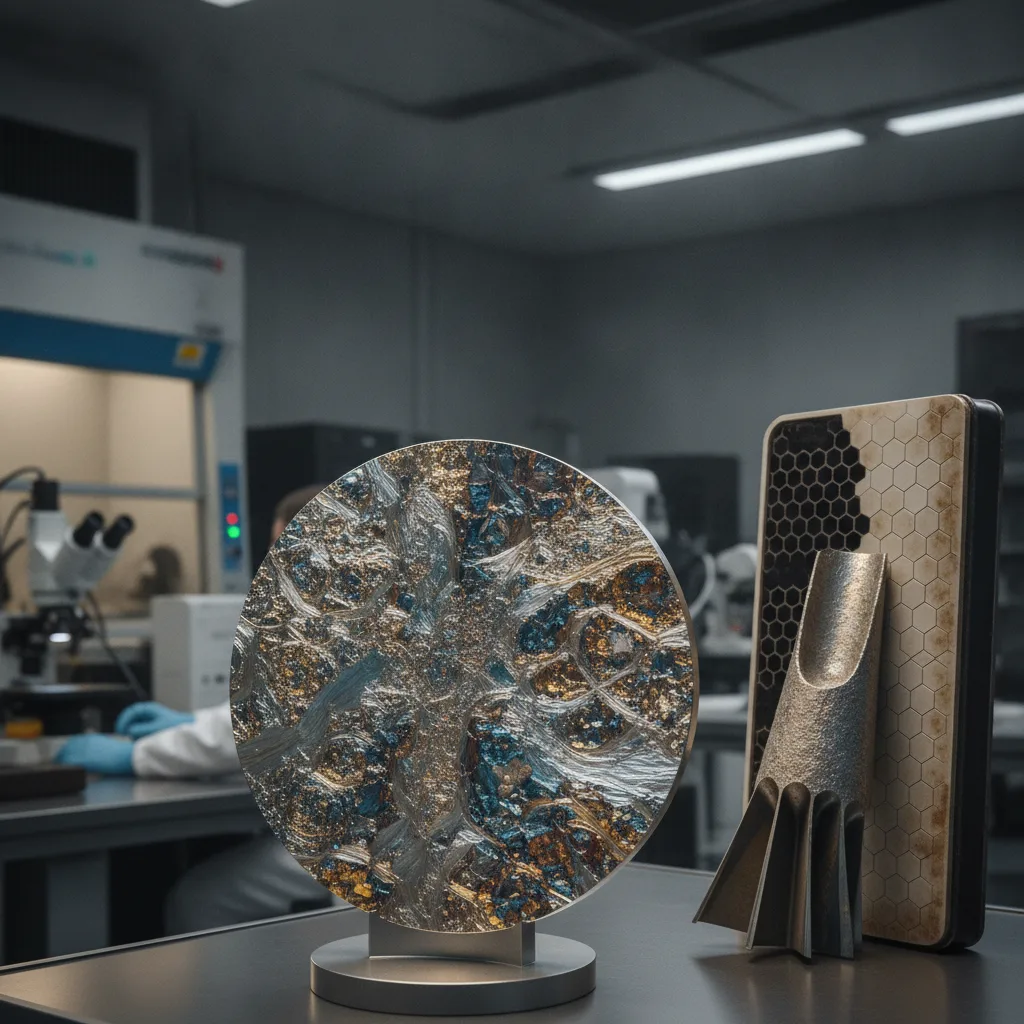
High-entropy alloys (HEAs) are a novel class of materials composed of multiple principal elements, offering exceptional properties like high strength, hardness, and corrosion resistance, particularly at extreme temperatures. They are being explored for critical applications in aerospace engines and nuclear reactors due to their superior performance in harsh environments. (AI-generated illustration)
You might also like:
👉 UC Berkeley’s 2023 Metamaterial: Sound Vanishes
👉 Unexplained Mysteries of Science: Cosmos, Quantum & Beyond