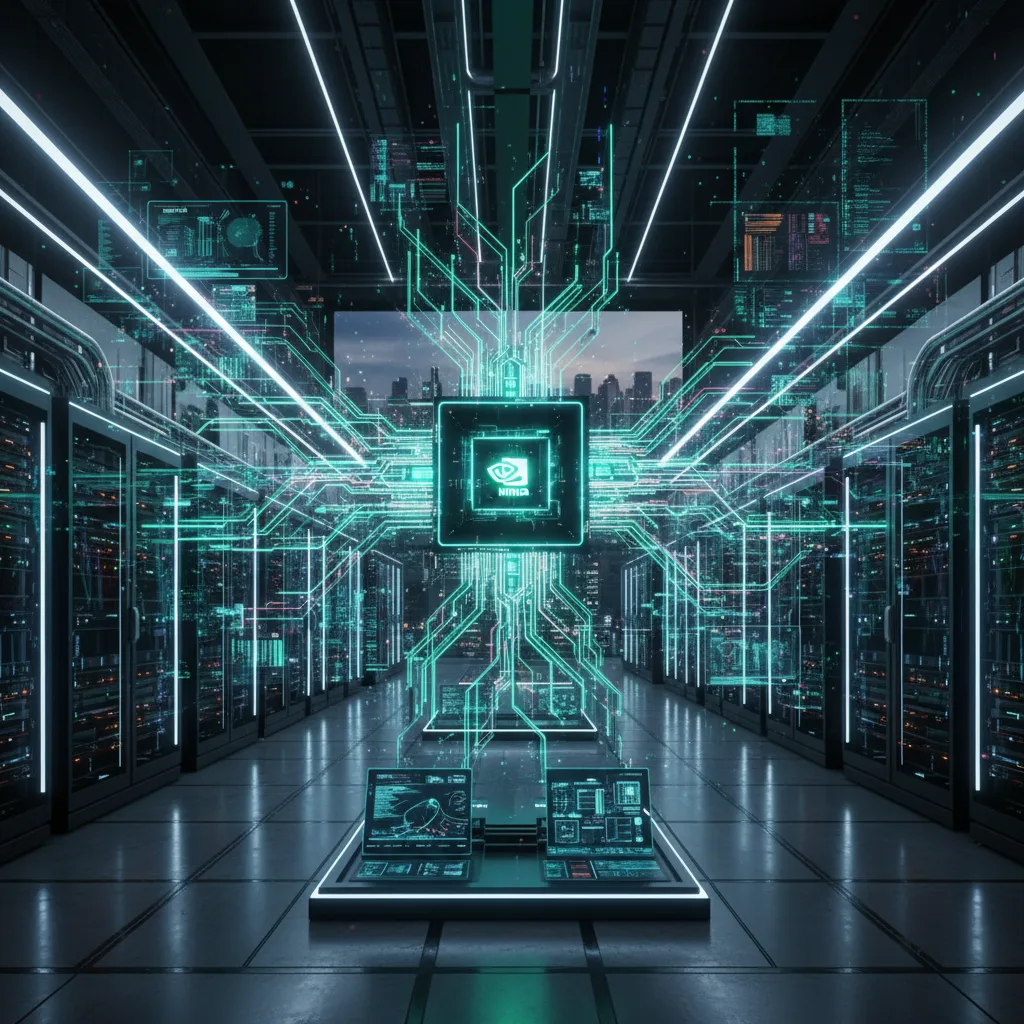
NVIDIA GTC: Powering AI, Parallel Computing & Future Innovation
Explore NVIDIA GTC, the pivotal event driving the revolution from sequential to parallel computing. Discover how GPUs are solving the world's most complex problems and shaping the future of AI and technology.
NVIDIA GTC: Where the Future Gets Its Brains (and a Seriously Good Tan)
Imagine for a moment trying to paint the Mona Lisa by meticulously placing individual atoms. Sounds absurd, right? Yet, for decades, that’s essentially how computers tackled some of the world’s most complex problems: one tiny, sequential step at a time, like a brilliant but solitary accountant poring over a ledger. Then came a revolutionary shift. Someone realized that if you had an army of enthusiastic, if slightly less brilliant, artists, each tasked with painting just one tiny pixel, you could create a masterpiece in a fraction of the time. This, in a nutshell, is the philosophical leap that birthed the modern GPU and, by extension, the gravitational pull of NVIDIA GTC.
NVIDIA GTC isn’t just another tech conference with stale coffee and PowerPoint karaoke. It’s the annual intellectual supernova where NVIDIA, the company that taught computers how to see, think, and even dream, unveils its latest visions for the future. It’s where the world gathers to witness the bleeding edge of AI, advanced graphics, and accelerated computing. From simulating climate change to designing next-generation drugs, the announcements and breakthroughs shared at GTC don’t just shape the tech industry; they reshape our very understanding of what’s possible. It’s less a trade show and more a pilgrimage for anyone serious about unlocking the next frontier of human ingenuity.
1. GTC: Not Your Grandpa’s Tech Conference
Rewind to 2009. The first GTC, then called the GPU Technology Conference, was held in San Jose, California. It drew about 1,500 attendees – mostly hardcore developers and researchers obsessed with the arcane art of parallel computing. It was a niche event, a gathering of the faithful who believed that Graphics Processing Units (GPUs) had a destiny far beyond rendering polygons for video games. Fast forward to today: GTC has exploded into a global phenomenon, often attracting hundreds of thousands of virtual attendees from every corner of the planet, from seasoned industry titans to curious students. It’s the difference between a garage band playing to a handful of friends and headlining a stadium tour – only the stadium is now the entire internet.
This wasn’t just organic growth; it was a deliberate evolution driven by the sheer, undeniable power of the GPU. What started as a focused technical conference on CUDA (NVIDIA’s parallel computing platform) and general-purpose GPU computing has transformed into the premier event for all things AI and accelerated computing. It’s where NVIDIA’s CEO, Jensen Huang, delivers his often-prophetic keynotes, outlining multi-year roadmaps that frequently become industry standards. The sessions cover everything from quantum computing simulations to the ethical implications of AI, from robotics to the metaverse.
Here’s the thing nobody tells you: GTC isn’t just for engineers with Ph.D.s in computational physics (though they are certainly well-represented). It’s a crystal ball for anyone trying to understand where AI, data science, and indeed, the entire digital economy are headed. The conversations, the research papers presented, and the tools unveiled at GTC aren’t just theoretical; they are the foundational blocks upon which the next generation of technological innovation will be built. It’s a vibrant, sometimes overwhelming, testament to how quickly our world is being re-engineered by computational might.
2. The GPU Revolution: Why NVIDIA GTC Matters So Much
To understand the magnetic pull of NVIDIA GTC, you first have to grasp the quiet revolution of the GPU itself. Think of it this way: if a Central Processing Unit (CPU) is a brilliant, meticulous librarian, capable of finding any book with precision and care, a GPU is an entire army of librarians. Each GPU librarian might not be as individually brilliant as the CPU, but there are thousands of them, and they can all search for different books simultaneously. When you need to find all the books on, say, astrophysics, the army wins, hands down.
Initially designed to render millions of pixels for realistic computer graphics, GPUs are masters of parallel processing – performing many calculations simultaneously. This inherent architecture, it turns out, is perfectly suited for a vast array of computational problems far beyond gaming. In 2006, NVIDIA launched CUDA, its proprietary software platform that allowed developers to program GPUs for general-purpose computing. This was the true game-changer. Suddenly, those armies of digital librarians could be repurposed for scientific simulations, financial modeling, and, most importantly, artificial intelligence.
The AI tsunami that swept the world in the 2010s rode directly on the back of the GPU. Training deep neural networks, which involve billions of calculations to adjust parameters, is an inherently parallel problem. GPUs, with their thousands of cores, proved to be orders of magnitude faster than CPUs for this task. Landmark achievements like AlexNet in 2012, which significantly advanced image recognition, were powered by NVIDIA GPUs. Since then, from natural language processing models like GPT-3 to advanced robotics, the GPU has become the indispensable workhorse of modern AI. Here’s the thing nobody tells you: the real magic of GPUs isn’t just raw speed; it’s their ability to break down enormous, seemingly intractable problems into tiny, manageable pieces and solve them all at once. It’s like having a million tiny brains working on different parts of a complex puzzle simultaneously, dramatically accelerating discovery and innovation across every scientific and industrial domain imaginable.
3. Jensen Huang’s Keynote: The Oracle of Accelerated Computing at NVIDIA GTC
If Steve Jobs had his “one more thing,” then NVIDIA’s CEO, Jensen Huang, has his “future of everything.” His opening keynote at NVIDIA GTC isn’t just a presentation; it’s an event. Donning his signature leather jacket, Huang commands the stage, whether physical or virtual, with a captivating blend of technical depth, visionary foresight, and an infectious enthusiasm for the future. He’s not just a CEO announcing products; he’s an architect outlining a multi-year blueprint for the entire field of accelerated computing and AI.
These keynotes are where the biggest news drops: new GPU architectures, like the groundbreaking Hopper in 2022 or the even more powerful Blackwell platform in 2024, are unveiled. These aren’t just faster chips; they are fundamental shifts in how computing power is delivered and utilized, often introducing entirely new paradigms like Transformer Engines for AI acceleration. But it’s not just hardware. Huang also introduces new software platforms (like NVIDIA Omniverse for building and operating metaverse applications, or NVIDIA Clara for healthcare), new initiatives (like Earth-2 for climate modeling), and strategic partnerships that redefine industry landscapes.
His themes consistently revolve around the idea of “AI factories” – data centers designed not just to process information, but to generate intelligence. He champions the concept of digital twins, where virtual replicas of everything from cities to factories to biological systems can be simulated with incredible fidelity. Here’s the thing nobody tells you: Huang’s keynotes aren’t just product showcases; they are manifestos that often predict and shape industry trends years before they become mainstream. He connects seemingly disparate technologies – from physics simulation to generative AI, from robotics to quantum computing – into a cohesive, often breathtaking, vision of a future where intelligence is infused into every aspect of our lives. His ability to articulate this complex tapestry makes GTC a must-watch event for anyone trying to decipher the trajectory of technological progress.
4. From Pixels to Cures: The Real-World Impact of GTC Innovations
The innovations showcased at NVIDIA GTC are far from theoretical musings; they are the engines driving tangible, often life-changing, progress across a dizzying array of industries. Imagine a single spark igniting a wildfire, but this wildfire brings positive, transformative change. That’s the practical impact of GTC announcements.
In healthcare, NVIDIA’s platforms are accelerating drug discovery at an unprecedented pace. The NVIDIA BioNeMo framework, for instance, uses generative AI to design new proteins and molecules, drastically cutting down the time and cost associated with traditional research. AI-powered medical imaging is enabling earlier and more accurate diagnoses, while personalized medicine leverages vast datasets to tailor treatments to individual patients. Think of AI assisting radiologists at GE Healthcare or helping researchers at AstraZeneca find novel therapies.
For climate science, the stakes couldn’t be higher. NVIDIA’s Earth-2 digital twin initiative aims to create a high-resolution, interactive simulation of the entire planet, allowing scientists to predict climate change scenarios and model extreme weather events with greater accuracy than ever before. This isn’t just about understanding; it’s about developing strategies for mitigation and adaptation. In autonomous vehicles, the NVIDIA DRIVE platform provides the computational horsepower for self-driving cars, from sensor processing to path planning. Simulation environments like DRIVE Sim allow millions of miles to be driven virtually, safely training AI models before they ever hit the road.
Beyond these, industries like manufacturing and architecture are being revolutionized by NVIDIA Omniverse. Companies like BMW are using Omniverse to create digital twin factories, optimizing production lines and designing new products in a virtual space before committing to physical builds. This not only saves immense resources but also allows for unprecedented levels of collaboration and iteration. Here’s the thing nobody tells you: these aren’t just incremental improvements. GTC breakthroughs often represent order-of-magnitude leaps in what’s computationally possible, fundamentally changing research methodologies and product development cycles across the globe. They are the bedrock for solving some of humanity’s grandest challenges.
5. The GTC Ecosystem: Building the Future, Together
NVIDIA GTC is far more than a corporate showcase; it’s a bustling city where every building, every street, every person contributes to a shared future. It’s a vibrant, global ecosystem of innovation, bringing together a diverse community of developers, researchers, startups, industry giants, and academics. This collaborative spirit is what truly amplifies the impact of NVIDIA’s technology.
The conference agenda is dense with technical sessions, workshops, and research presentations, offering deep dives into everything from optimizing AI models to building complex metaverse environments. It’s a place where cutting-edge research papers are unveiled, and best practices are shared, fostering an environment of continuous learning and collective advancement. NVIDIA actively supports this community through programs like Inception, which nurtures promising startups leveraging NVIDIA technology, providing them with resources, expertise, and visibility.
Crucially, GTC highlights the intricate web of partnerships that define the accelerated computing landscape. Collaborations with major cloud providers like AWS, Microsoft Azure, and Google Cloud Platform ensure that NVIDIA’s powerful hardware and software are accessible to a global audience. Partnerships with universities drive fundamental research, while alliances with software vendors integrate NVIDIA’s platforms into a myriad of applications. Here’s the thing nobody tells you: the real power of GTC isn’t just the announcements; it’s the networking. It’s where the informal conversations happen that spark the next big idea, where researchers find collaborators for groundbreaking projects, and startups find their first big break, forging the human connections essential for future breakthroughs.
Frequently Asked Questions
Q: What does GTC stand for? A: GTC originally stood for GPU Technology Conference, reflecting its early focus on Graphics Processing Units and their application in general-purpose computing. While the name remains, its scope has expanded significantly to encompass all aspects of AI and accelerated computing.
Q: Is GTC only for developers and engineers? A: While GTC offers deeply technical sessions for developers and researchers, it also features keynotes and sessions relevant to business leaders, policymakers, students, and anyone interested in the future of AI, high-performance computing, and related technologies. It’s designed to appeal to a broad audience.
Q: How often is GTC held? A: GTC is typically held annually. For several years, it has been primarily a virtual event, making it accessible to a global audience, though smaller in-person components or regional events may also occur.
Q: What’s the difference between GTC and other major tech conferences? A: GTC distinguishes itself by its singular, deep focus on accelerated computing, AI, and NVIDIA’s ecosystem. While other conferences might cover a broader range of consumer tech or enterprise IT, GTC delves into the foundational technologies and research driving the most demanding computational workloads, from scientific discovery to industrial digital twins. It’s less about gadgets and more about the fundamental computational infrastructure of the future.
From its humble beginnings as a niche gathering for GPU enthusiasts, NVIDIA GTC has blossomed into a global bellwether for AI and accelerated computing. It’s a testament to the transformative power of parallel processing and the relentless pursuit of computational excellence. GTC is more than just a conference; it’s a locus of innovation, a grand stage where the human intellect, powered by NVIDIA’s groundbreaking technology, dares to dream bigger, solve harder problems, and build a future that was once relegated to the realm of science fiction. It’s where the future gets its brains, its blueprint, and the collective energy to turn audacious visions into tangible realities.
You might also like:
👉 AI Tsunami: Charting Artificial Intelligence’s Future for Humanity
👉 Quantum AI’s Impact on Future Work & Investment Strategy
👉 The Quantum Leap: Unpacking Quantum Computing’s Impact on Cybersecurity