
Space Sickness: Yuri Gagarin's 108-Minute Warning from 1961
Yuri Gagarin's 108-minute Vostok 1 mission in 1961 revealed the harsh reality of space sickness, a critical challenge for human space travel.
Human health beyond Earth: The unseen frontier
Yuri Gagarin shot into space on April 12, 1961. He became the first human to orbit Earth. His Vostok 1 mission lasted just 108 minutes, but it changed everything.
Gagarin returned a hero, yet his brief journey held a secret: space sickness. Nausea and disorientation hit him hard. This discomfort was a stark warning. Space, with its alien lack of gravity, would greatly affect our bodies. Earth’s constant pull shaped human evolution. Now, that was gone.
Early space travel focused on basic survival. Engineers built rockets. Doctors knew little about long-term risks. They understood acute problems like g-forces and re-entry. But the effects of prolonged weightlessness? That was a mystery. NASA and Roscosmos began collecting data. This was important for future, longer missions.
Early flights: The first challenges
Gagarin’s flight proved we could survive space. It also opened a new medical chapter. Though he reported feeling well, he later admitted motion sickness.
Cosmonaut Gherman Titov followed in August 1961. He spent over 25 hours in space. Titov suffered severe space sickness, vomiting and feeling dizzy. Doctors were puzzled by these early symptoms.
America’s Project Mercury astronauts also struggled. Alan Shepard, the first American in space, flew a suborbital mission in May 1961. He endured high g-forces. John Glenn, the first American to orbit in February 1962, reported disorientation.
These short missions showed the human body adapted quickly. Fluids shifted towards the head. Astronauts often had puffy faces and thin legs. This temporary change came from the lack of gravity.
As missions grew longer, new concerns appeared. Physicians saw cardiovascular changes. The heart worked less without gravity’s constant pull. This raised questions about muscle and bone health. Each flight gave us more data. It hinted at deeper problems for future explorers.
Longer missions: Problems emerge
In 1971, the Soviet Union launched Salyut 1, the world’s first space station. Three cosmonauts spent 23 days aboard. They returned to Earth in poor physical shape. Tragically, a depressurization during re-entry killed them. Still, their medical data from orbit was very valuable.
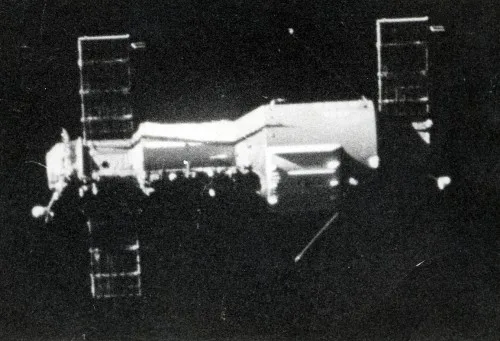
Salyut 1, the world's first space station, launched in 1971. Its crew spent 23 days in orbit, providing invaluable medical data that highlighted the emerging health challenges of longer space missions before their tragic return. (Source: americaspace.com)
America’s Skylab missions began in 1973. Astronauts lived in orbit for up to 84 days. This was a big jump in duration. Doctors carefully watched the crews. They found serious health impacts.
Astronauts like Pete Conrad and Alan Bean on Skylab 2 reported significant bone loss. Dr. Arnauld Nicogossian, a key NASA medical officer, documented this. Bone density dropped by 1-2% per month. This rate far exceeded osteoporosis on Earth. It especially hit weight-bearing bones such as the hips and spine.
Muscle atrophy also became clear. Without gravity, muscles wasted away. The heart, a muscle, also weakened. These issues could severely impair astronauts back on Earth. They might struggle to stand or walk.
Radiation exposure became another serious worry. Earth’s atmosphere and magnetic field protect us. In space, astronauts face cosmic rays and solar flares. These can damage DNA and raise cancer risk. We still don’t know the full long-term effects. These discoveries made longer missions seem far more dangerous.
The ISS: Living in space, fighting back
On November 2, 2000, the first permanent crew arrived at the International Space Station (ISS). The ISS became a unique orbiting lab. It allowed continuous research on how humans adapt to space. Astronauts now live there for months, sometimes over a year.
Scott Kelly spent 340 days on the ISS in 2015-2016. His “Twin Study” with brother Mark gave us new insights. NASA researchers saw changes in Scott’s gene expression and gut microbiome. They also noted alterations in his eye structure. His immune system showed some stress.
To fight bone loss, astronauts exercise rigorously. They use treadmills and resistance machines. Dr. Virginia Wotring researches muscle protein synthesis in space. Her work helps improve exercise routines. These measures greatly reduce bone and muscle atrophy.
Vision issues, called Spaceflight Associated Neuro-ocular Syndrome (SANS), are common. Fluid shifts swell the optic nerve. This can flatten the back of the eyeball. Some astronauts experience permanent vision changes. Dr. Kathleen McMonigal at NASA studies SANS. She works to understand it and find solutions.
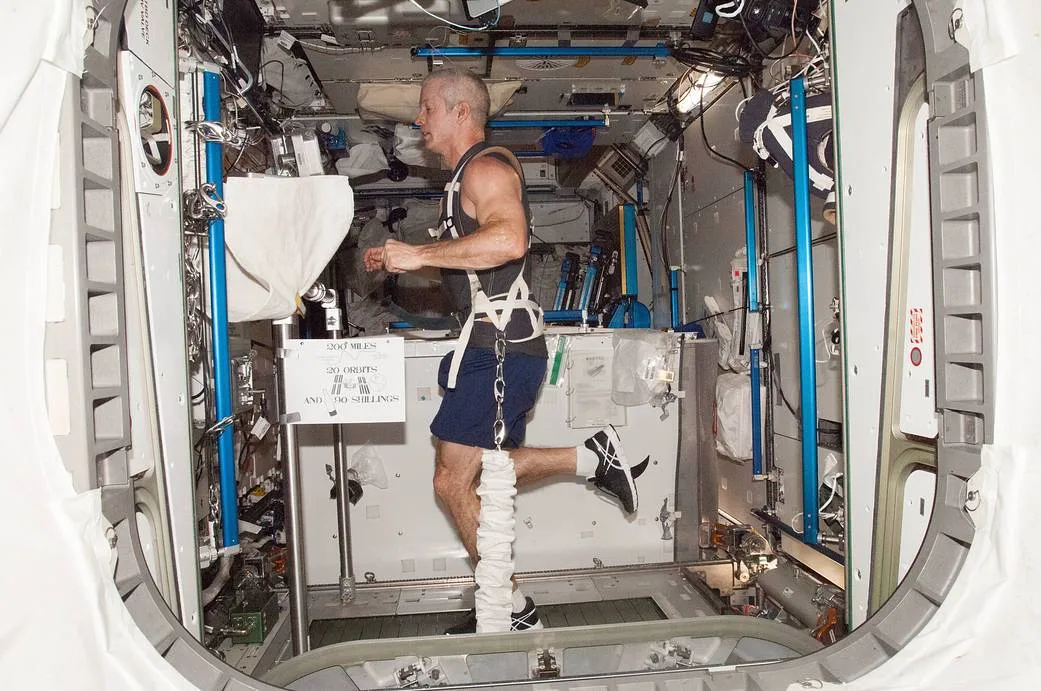
Astronauts on the International Space Station (ISS) spend hours each day exercising on specialized equipment, such as treadmills and resistance machines, to combat severe bone loss and muscle atrophy. Research by scientists like Dr. Virginia Wotring helps refine these routines, which are crucial for maintaining astronaut health in microgravity. (Source: nasa.gov)
Cardiovascular deconditioning remains a challenge. The heart works less in microgravity. It pumps less blood. This can lead to fainting spells when astronauts return to Earth. Exercise helps maintain heart health.
Radiation exposure is a constant threat. Galactic Cosmic Rays (GCRs) and Solar Particle Events (SPEs) damage DNA. Dr. Francis Cucinotta studies radiation risks at NASA. Shielding on the ISS helps, but it is not complete. Although radiation risks are manageable in Earth orbit, they grow much worse further out.
Psychological stress also affects crews. Confinement, isolation, and constant risk take a toll. Dr. Nick Kanas studies behavioral health in space. Crew cohesion and support systems are important. The ISS has helped develop strategies for these issues.
Mars: The ultimate health test
NASA plans crewed missions to Mars by the 2030s. These missions bring much greater health challenges. A journey to Mars could last 6-9 months each way. Astronauts would spend 18 months on the Martian surface. That means a total mission time of about 2.5 to 3 years.
The distance from Earth intensifies radiation exposure. Beyond Earth’s protective magnetic field, astronauts face higher doses. Dr. Cucinotta emphasizes: radiation shielding is a major hurdle. Longer exposure increases cancer risk and potential neurological damage. This is a major barrier to deep-space travel.
Psychological factors will also be more extreme. Crews will experience extreme isolation. They can’t return to Earth quickly. Communication delays will be significant. Autonomous medical care becomes absolutely essential. No immediate help will come from mission control.
Research continues into advanced countermeasures. Scientists are exploring artificial gravity concepts. Centrifuges could spin a spacecraft or habitat. This would create simulated gravity. It could help prevent bone and muscle loss.
Genetic research offers another path. Scientists are trying to identify individuals. These people might be more resilient to space stressors. This could inform crew selection. Understanding individual responses is essential.
Solving these complex health puzzles is most important. It will decide humanity’s ability to explore beyond low Earth orbit. The health of our astronauts is the real frontier. Their well-being holds the future of reaching Mars and stars beyond. Without solutions, those dreams remain just that: dreams.
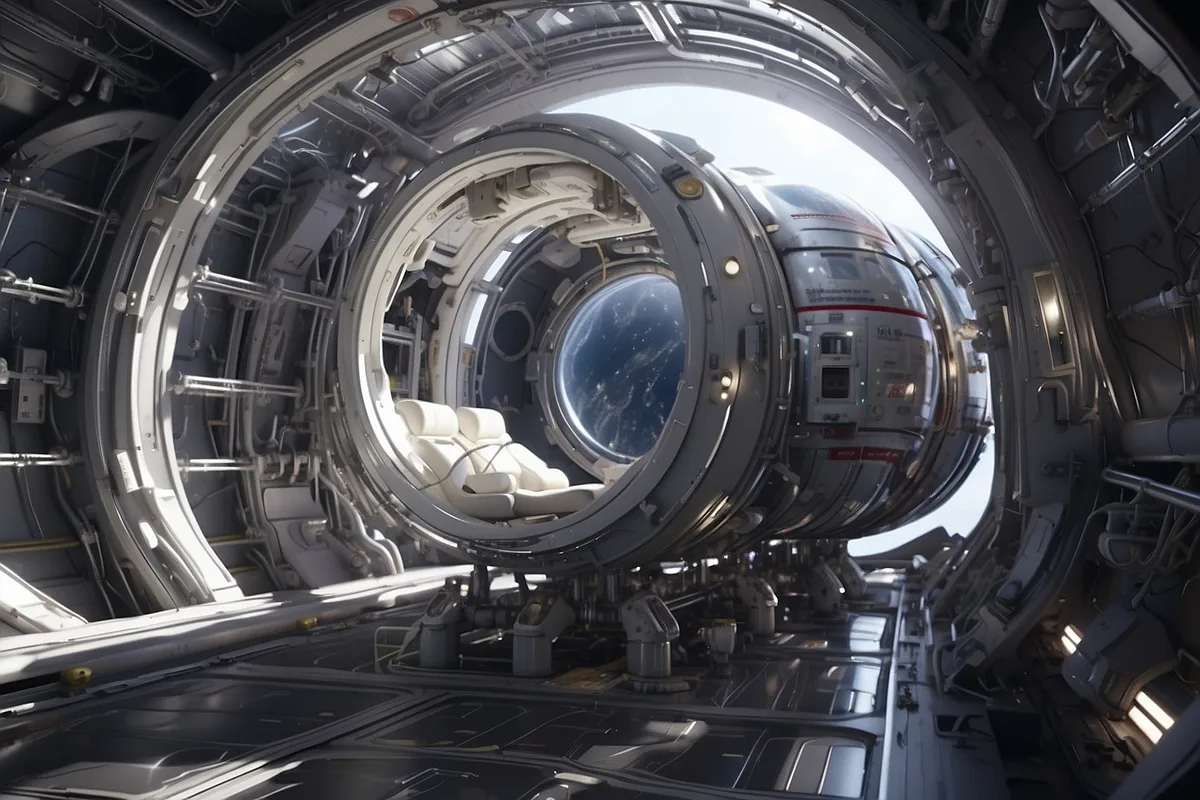
To combat the severe health issues of long-duration space travel, scientists are exploring artificial gravity concepts, such as centrifuges that spin a spacecraft or habitat. This simulated gravity could prevent bone and muscle loss, crucial for missions to Mars and beyond. (Source: spacevoyageventures.com)
FAQ
What is space adaptation syndrome? It’s motion sickness experienced in space. Astronauts feel nausea, dizziness, and disorientation. It typically resolves within a few days as the body adjusts to microgravity.
How does space travel affect bones? Without gravity, bones lose density. This happens at a rate of 1-2% per month. Weight-bearing bones like the spine and hips are most affected.
What is the biggest health risk on a Mars mission? Radiation exposure is the primary concern. Long durations outside Earth’s magnetic field lead to high doses. This increases risks of cancer and other severe health problems.
Can astronauts recover fully after spaceflight? Most astronauts recover significantly. Bone and muscle mass can return. Vision changes and some other effects can persist. The long-term impacts of deep-space radiation are still being studied.

Astronauts wear personal radiation dosimeters to continuously monitor their exposure to cosmic and solar radiation, a primary health concern for long-duration space missions, especially beyond Earth's protective magnetic field. (Source: airandspace.si.edu)
You might also like:
👉 Why 1960s Rocket Tech Won’t Get Us to Mars Fast Enough