Nuremberg 1561: What Caused the Sky's Fiery Battle?
On April 14, 1561, Nuremberg residents witnessed a terrifying aerial battle with blood-red spheres. Discover the explanation behind this 4 AM event.
When the Sky Fought: Nuremberg’s 1561 Mystery
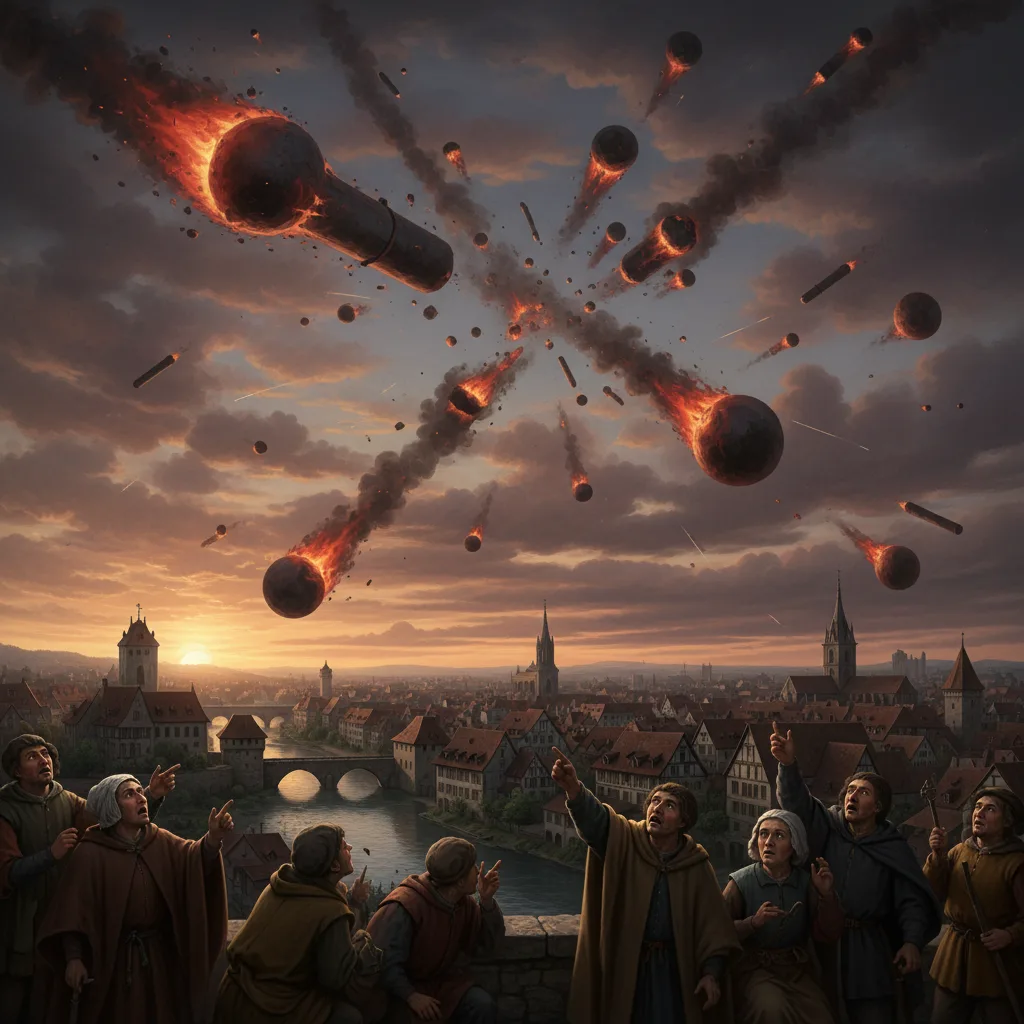
On April 14, 1561, the sky above Nuremberg, Germany, appeared to be on fire. Residents witnessed a terrifying aerial battle. Countless objects created a dramatic show. This event sparked widespread fear and was quickly documented as a divine omen.
The show began at dawn, around 4 AM. Blood-red, black, and blue-black spheres appeared. Cylinders, crosses, and other objects moved across the sky. These shapes seemed to fight above the city.
Nuremberg was a free imperial city within the Holy Roman Empire. It was a major hub for commerce and culture. The city had embraced the Protestant Reformation, a time of intense religious and social chaos.
Hans Glaser, a local printer, printed a broadsheet about the event. These broadsheets acted as early newspapers, spreading news and ideas. Glaser’s account is the main record of the 1561 phenomenon.
April 14, 1561: the sky on fire
The sky over Nuremberg filled with moving objects. Glaser’s broadsheet described “cylinders, spheres, and crosses” in great numbers. Many objects were “blood-red.” Others were “dark, bluish, and black.” They moved erratically, then came together.
Witnesses reported the objects “fought one another.” This aerial combat lasted about an hour. A large, black, spear-shaped object appeared. It reportedly fell to Earth outside the city gates.
Smoke and fire followed this dark object’s fall. Glaser’s woodcut clearly shows these events. It displays the various shapes, a large cross, and a spear-like object falling. The woodcut also shows people watching the show below.
The event happened in the morning, just after sunrise. This timing is important for understanding the modern explanation. The sun’s low angle is vital for certain atmospheric optics. The specific date was April 14, 1561.
Nuremberg in 1561: a city’s fear
Nuremberg in 1561 was a busy, independent city-state. It was a center for arts, crafts, and printing. The city’s freedom often led to tricky political situations in Europe.
The 16th century was a time of deep religious faith and fear. People often saw unusual sky events as omens from God. These signs could foretell war, plague, or divine judgment. This idea was widespread across Europe.
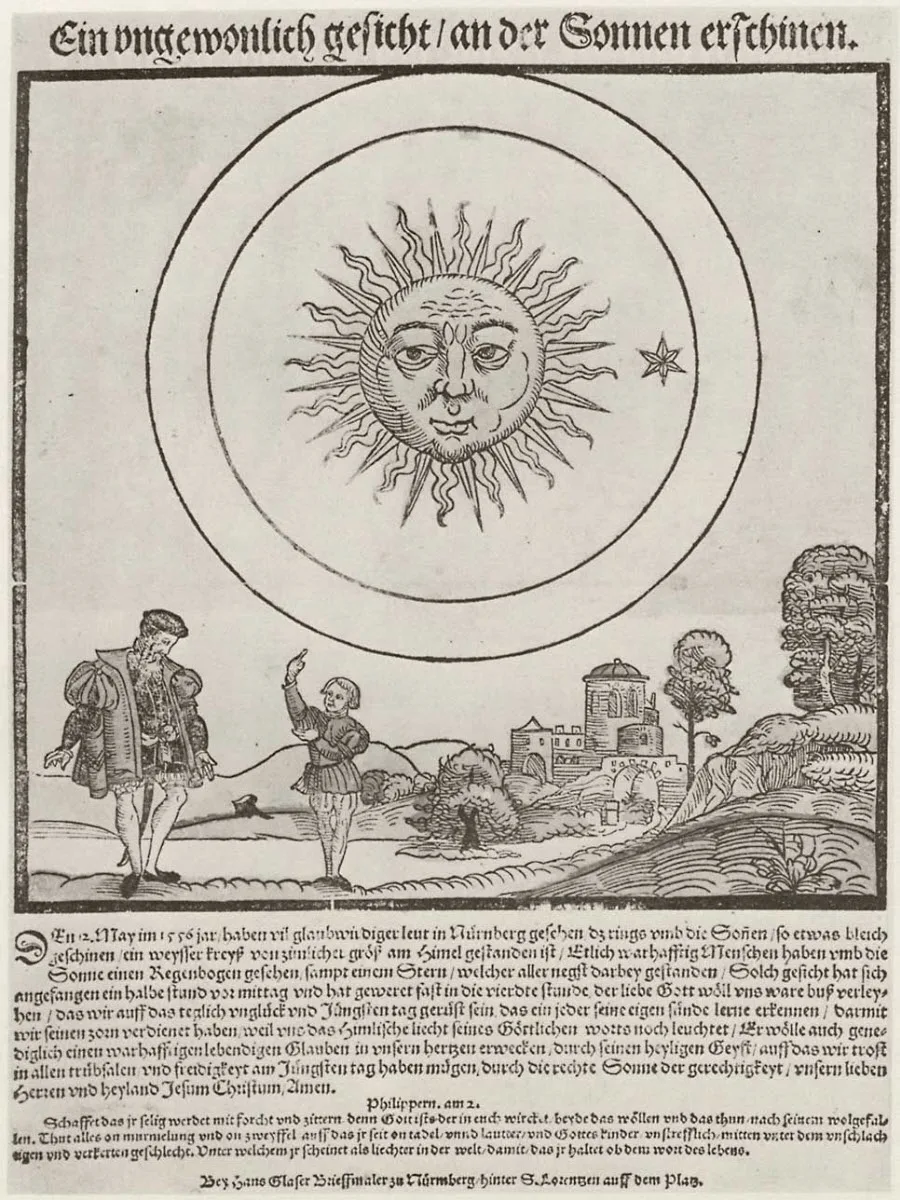
This famous woodcut by Hans Glaser, printed in 1561, is the primary visual record of the mysterious celestial phenomenon over Nuremberg. It depicts the 'aerial battle' of spheres, cylinders, and crosses, with a spear-like object falling to Earth, as terrified residents watch below. (Source: amusingplanet.com)
The Protestant Reformation had rooted itself in Nuremberg. Religious tensions ran high throughout the Holy Roman Empire. People often viewed natural disasters and strange sights through a religious lens. They meant warnings or prophecies.
Dr. Richard Stothers, a physicist at the NASA Goddard Institute for Space Studies, studied old sky events. He notes that pre-scientific societies often blamed supernatural forces for unexplainable happenings. This cultural context shaped Nuremberg’s interpretation.
The main record: Hans Glaser’s broadsheet
Hans Glaser’s broadsheet, titled “Phenomenon over Nuremberg, 1561,” is the main source. He printed it shortly after the event. The broadsheet includes a detailed woodcut image. It also has text with it.
The text describes many round objects. Some were blood-red, some black, some lead-colored. It mentions “two large tubes” that released “three large, blood-red, round objects.” The objects “fought violently with each other.”
Glaser’s broadsheet clearly called the phenomenon a “terrible spectacle.” He saw it as a “divine sign.” He warned readers to “take it to heart” and repent their sins. This reflects the common religious view of the time.
Explaining the Mystery: modern science explains
Modern scientists mostly blame the 1561 Nuremberg phenomenon on atmospheric optical effects. These happen when sunlight interacts with ice crystals in the air. They can create complex, seemingly impossible displays.
Parhelia, also known as “sun dogs,” are common examples. These bright spots appear on either side of the sun. Sunlight refracting through hexagonal ice crystals forms them. They can often look like multiple suns.
Sun pillars are another similar sight. They are vertical shafts of light above or below the sun. Sunlight reflecting off flat, plate-like ice crystals forms them. These pillars can look like towering columns or spears.
Circumhorizontal arcs and halo displays can also create complex patterns. These shows involve various rings and arcs of light. They appear when sunlight hits ice crystals at specific angles. The effects can be highly colorful.
Dr. Stothers suggested the described “battle” could be these optical phenomena moving. As atmospheric conditions change, these “mock suns” and pillars shift. They can seem to move and interact. The “spear-like object” falling might have been a sun pillar fading or appearing to descend.
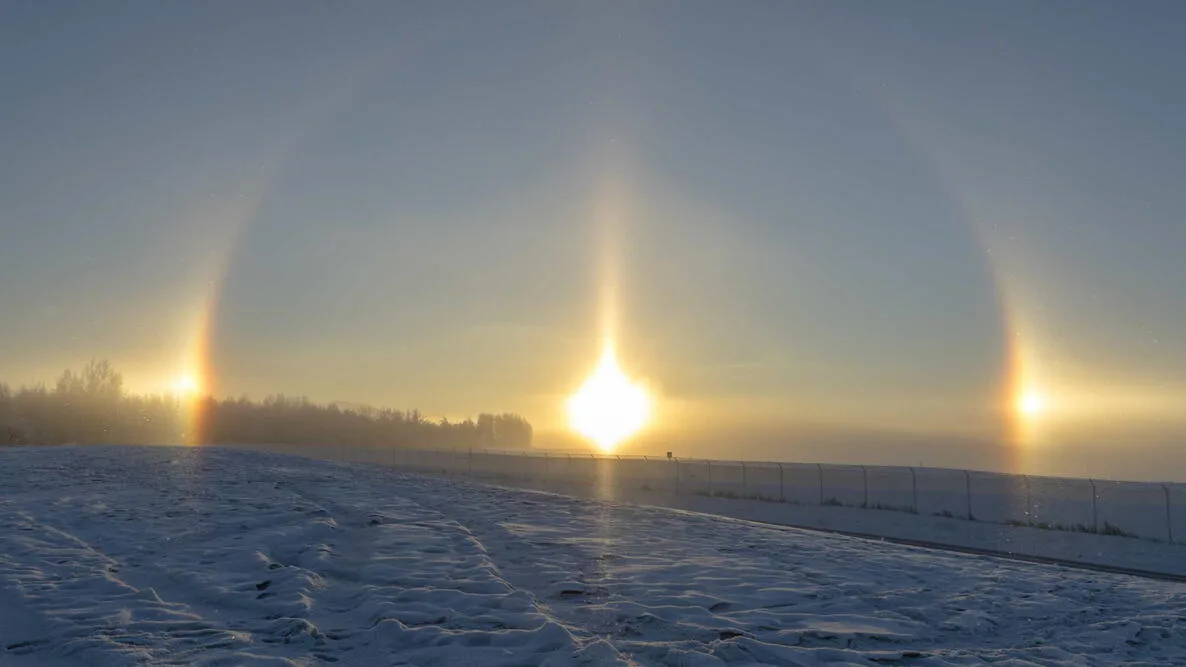
Parhelia, commonly known as sun dogs, are bright spots of light that appear on either side of the sun, often resembling multiple suns. These striking atmospheric optical effects, caused by sunlight refracting through ice crystals, are a leading scientific explanation for the 'many round objects' described in the 1561 Nuremberg phenomenon. (Source: almanac.com)
The “cylinders” could be tangent arcs or other halo formations. The “spheres” might be bright parhelia or other ice-crystal reflections. The variable colors (red, black, blue) also match atmospheric optics. Atmospheric scattering can make the sun and related sights appear redder at sunrise. A darkening sky or clouds could create the “black” descriptions.
Echoes in history: similar accounts and lasting impact
The Nuremberg event is not the only one in history. People have recorded similar sky sightings across centuries. A similar event happened in Basel, Switzerland, in 1566. This phenomenon also involved “large black spheres” and “fighting” in the sky.
Samuel Coccius, a student, recorded the Basel event. His account also included a woodcut. These old records show a pattern of explaining strange sky events. People blamed them on omens or supernatural forces.
Scientific understanding slowly took over these ideas. The study of atmospheric optics grew over centuries. Scientists like René Descartes and Christiaan Huygens began to explain halo phenomena. Their work laid the foundation for modern explanations.
The 1561 Nuremberg event still fascinates us. It shows our human need to find meaning in the unknown. It also shows how limited science once led to wild interpretations. It’s a stark reminder that even the most terrifying visions can have a simple, earthly explanation.
Frequently asked questions
What happened in Nuremberg in 1561? On April 14, 1561, Nuremberg residents saw many objects in the sky. These included spheres, cylinders, and crosses, some appearing blood-red. They seemed to “fight,” and a black, spear-like object reportedly fell to Earth.
Was it a UFO? No, modern science says it was an atmospheric optical display. These include sun dogs, sun pillars, and other halo effects. Sunlight interacting with ice crystals creates these complex visual illusions.
Who recorded the event? Hans Glaser, a local printer, created the main record. His broadsheet included a woodcut and text. It described the event and saw it as a divine omen or warning.
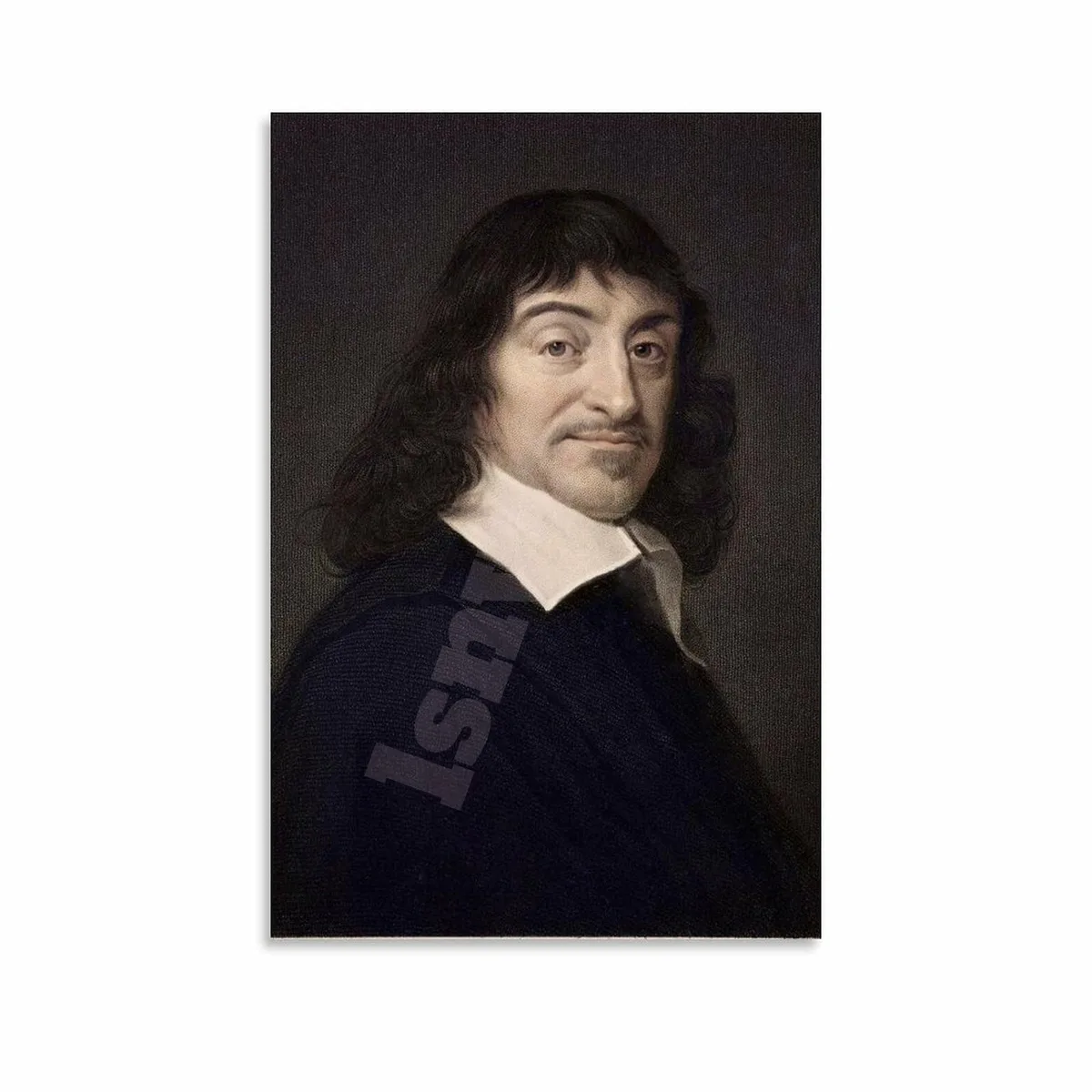
René Descartes, the renowned philosopher and mathematician, was also a pioneer in atmospheric optics, providing early scientific explanations for phenomena like halos and rainbows, which helped demystify celestial events such as the 1561 Nuremberg sighting. (Source: amazon.com)
Why do people still discuss it today? The 1561 Nuremberg phenomenon is still discussed because of its dramatic story. It shows how pre-scientific societies explained strange events. It also shows the power of atmospheric optics to create amazing shows.
You might also like:
👉 Tucker Carlson on Aliens: UFOs, UAP & Media Discourse
👉 Unexplained Mysteries of Science: Cosmos, Quantum & Beyond