Rethinking Bento XVI & Habermas: Bridging Faith, Reason, and Society
Explore the unseen intellectual bridge between Pope Benedict XVI and Jürgen Habermas. This article challenges their perceived divide, examining shared ground on reason and the public sphere.
Rethinking the Rift: The Unseen Bridge Between Bento XVI and Habermas
The intellectual landscape of the early 21st century often painted a stark picture: on one side, Joseph Ratzinger, later Pope Benedict XVI, the staunch defender of Catholic tradition and universal reason; on the other, Jürgen Habermas, the towering figure of critical theory, championing communicative rationality and the secular public sphere. Conventional wisdom decreed them intellectual antipodes, their respective worldviews irreconcilable, their dialogue a mere polite formality masking fundamental disagreement. This narrative, however, is not just simplistic; it fundamentally misrepresents one of the most intellectually fertile and unexpectedly convergent exchanges of our time. To merely see a clash is to miss the profound, often challenging, agreement that emerged from their engagement, an agreement that forces us to re-evaluate the very foundations of modern public discourse.
The Conventional Narrative: Faith vs. Enlightenment Reason
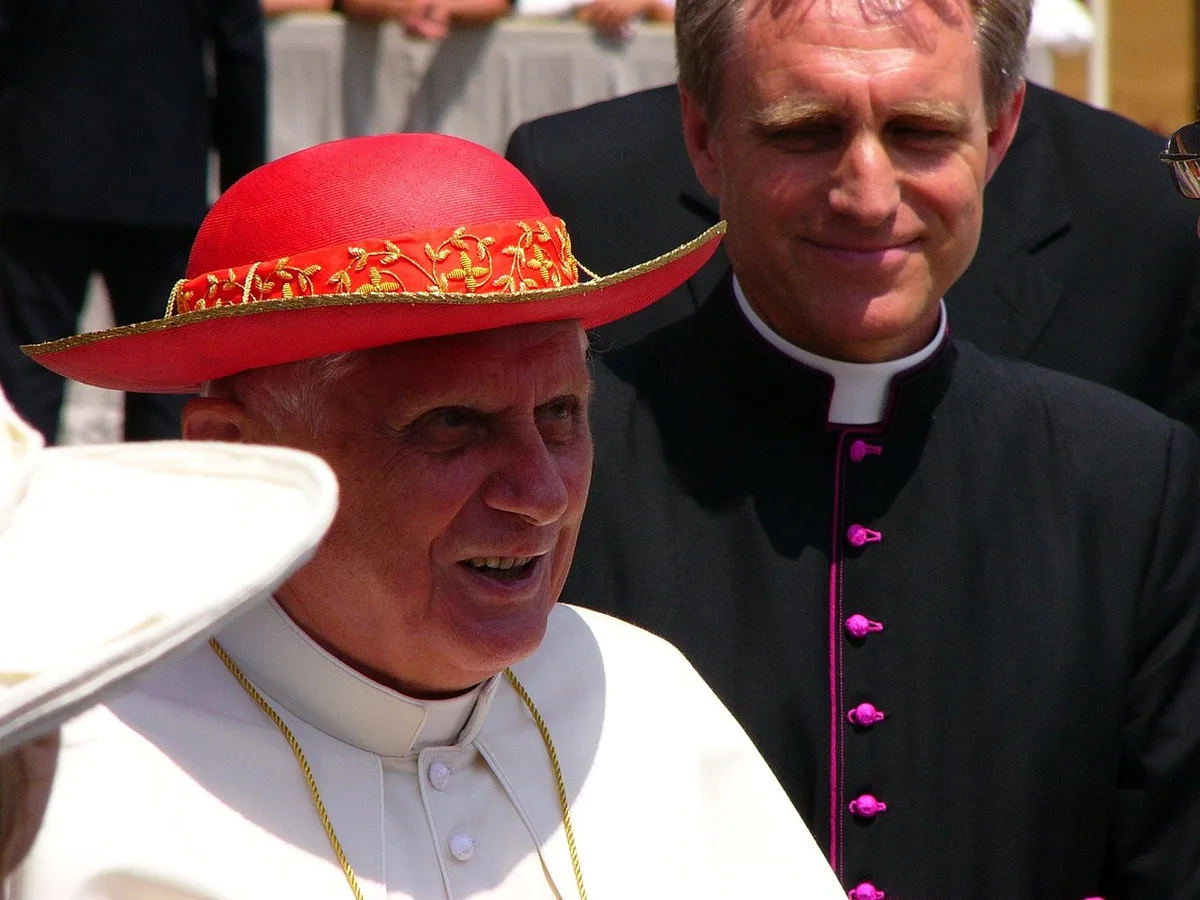 For decades, the academic establishment neatly categorized Ratzinger and Habermas into opposing camps. **Ratzinger**, a brilliant theologian and philosopher, was widely perceived as the intellectual heir to Augustine and Aquinas, deeply rooted in a Thomistic understanding of reason as inherently open to ultimate truth, divinely illuminated. His critique of modernity often focused on what he termed the **"dictatorship of relativism"**, a system where reason, severed from its spiritual and metaphysical roots, degenerates into mere instrumental calculation, leading to moral decay and societal fragmentation. His intellectual project, epitomized by his 2006 Regensburg Address, was seen as a call to reclaim a broader, more robust concept of reason, one that could embrace faith without surrendering intellectual rigor.
Habermas, in contrast, stood as the quintessential Enlightenment philosopher. His monumental work on communicative action and discourse ethics posited a public sphere where rational consensus could be achieved through uncoerced dialogue, free from dogmatic assertions or hierarchical authority. For him, the secularization of the public sphere was a hard-won achievement, safeguarding individual autonomy and democratic legitimacy. While acknowledging the “unavoidable loss” that secularization entailed for some, his primary concern was to articulate a form of reason that could operate independently of religious presuppositions, yet still provide universalizable norms for a pluralistic society. The chasm seemed unbridgeable: one arguing for a reason purified by faith, the other for a faith constrained by secular reason.
The Munich Dialogue of 2004: A Cracking Facade
 The first significant crack in this conventional facade appeared on January 19, 2004, at the Catholic Academy of Bavaria in Munich. Cardinal Ratzinger and Jürgen Habermas, two intellectual titans, met not for a confrontational debate, but for a moderated discussion on a topic of profound societal relevance: **"The Pre-Political Foundations of the Democratic State."** The very premise of the dialogue was revolutionary. Rather than engaging in a theological-philosophical duel, they converged on a shared anxiety: the perceived fragility of Western liberal democracies, specifically their capacity to sustain the ethical values necessary for their own survival without appealing to sources beyond purely procedural or instrumental reason.
The event, which would later be published as “The Dialectics of Secularization: On Reason and Religion” (2005), revealed a surprising degree of common ground. Both thinkers, albeit from vastly different starting points, expressed deep concern over the erosion of shared moral norms and the potential for a purely positivist legal framework to become an empty shell, incapable of inspiring civic virtue or safeguarding human dignity. This wasn’t a superficial agreement; it was a profound recognition that modern states, for all their secular aspirations, might be cutting off the very branch they sit on by systematically marginalizing the moral insights traditionally provided by religious traditions. The intellectual world, accustomed to seeing them as antagonists, was forced to take notice of their unexpected alignment on a crucial societal diagnosis.
Shared Concerns: The Crisis of Modernity and Moral Vacuum
Despite their divergent epistemological paths, both Ratzinger and Habermas independently arrived at a strikingly similar diagnosis of modernity’s ailments. Ratzinger, through his theological lens, repeatedly warned against the perils of a “self-limiting reason” that confines itself to the empirically verifiable, thereby excluding questions of ultimate meaning, purpose, and moral truth. He saw this as leading to a “moral vacuum” that could be filled by arbitrary power or fleeting desires, ultimately undermining human flourishing and societal cohesion. For him, the crisis was one of truth, where relativism threatened to dissolve any objective basis for ethics or justice.
Habermas, from his critical theory perspective, articulated a similar concern about the “colonization of the lifeworld” by instrumental reason. He argued that the logic of the market and bureaucratic administration, while efficient in their domains, were increasingly encroaching upon areas of human life – family, community, ethics – traditionally governed by communicative rationality and shared values. This instrumentalization, he feared, led to alienation, a loss of solidarity, and the erosion of the very communicative structures necessary for a vibrant democracy. Though one spoke of God and the other of discourse, both were grappling with the existential threat posed by a form of reason that had become detached from its ethical moorings, leaving society vulnerable to nihilism or authoritarianism.
The “Pre-Political Foundations”: A Surprising Consensus on Bento XVI and Habermas
The heart of their convergence lay in their shared conviction that the democratic state, while necessarily secular in its operation, depends on “pre-political foundations”—ethical and moral resources—that it cannot generate solely from within its own legal or political procedures. Habermas, famously, conceded that “the liberal state lives on presuppositions that it cannot itself guarantee.” He argued that secular reason, in its quest for universal validity, should not simply dismiss religious traditions but must engage in a “learning process” with them. Religious communities, he suggested, possess a unique capacity to articulate moral intuitions and solidaristic insights that might have been lost or become inarticulate within purely secular discourse. He termed this necessary openness to religious contributions as “post-secular reason.”
Ratzinger, for his part, while emphasizing the inherent rationality of faith, equally stressed that faith must always be open to the purifying critique of reason. He cautioned against religious fundamentalism or irrationalism, insisting that faith, to be truly human and universal, must align with a “broad reason” that is not afraid to ask ultimate questions and engage with the world rationally. This mutual call for “self-limitation” was extraordinary: Habermas urging secular reason to learn from religion, and Ratzinger insisting that faith must submit to rational scrutiny. Their agreement was not on what constitutes these pre-political foundations, but on the crucial necessity of such foundations and the potential for both secular and religious traditions to contribute to their articulation.
Beyond Munich: Expanding the Dialogue’s Resonance
 The Munich dialogue was not an isolated incident; it catalyzed a broader intellectual shift. The publication of their exchange in **"The Dialectics of Secularization"** became a touchstone for subsequent discussions on the role of religion in the public sphere. Scholars like **Marcello Pera**, a secular Italian philosopher and politician, further engaged with Ratzinger's arguments, finding resonance with his concerns about Western cultural decline. The dialogue also influenced figures like **Rowan Williams**, the former Archbishop of Canterbury, who frequently referenced the Ratzinger-Habermas exchange as a model for constructive engagement between faith and reason.
This ongoing resonance demonstrated that their exchange transcended a mere academic curiosity. It provided a concrete framework for understanding how seemingly opposing worldviews could find common ground on pressing societal issues. It challenged the prevailing assumption that secularization necessarily entailed the complete privatization of religion, suggesting instead a more complex “post-secular condition” where religious voices, when translated into universalizable language, could legitimately contribute to public deliberation. Their intellectual encounter became a case study in how deeply held convictions, rather than leading to an impasse, could, under the right conditions, foster a richer, more nuanced understanding of shared human challenges.
The Limits and Criticisms: Where the Divergence Persists
While their convergence on the diagnosis of modernity’s crisis and the need for pre-political foundations was striking, it would be naive to suggest a complete philosophical merger. Significant epistemological divergences remain, and critics rightly point out the limits of their agreement. Habermas, despite his openness to religious “learning processes,” ultimately insists on the “translation proviso”: religious contributions to public discourse must be rendered into a universally accessible, secular language to be legitimate. The public sphere, for him, remains fundamentally secular, and religious reasons, qua religious, cannot form the basis of law or policy. His commitment to a procedurally generated consensus, independent of any substantive metaphysical claims, remains steadfast.
Ratzinger (Benedict XVI), conversely, while embracing the purification of faith by reason, ultimately grounds universal reason in a divinely ordered cosmos, a concept Habermas cannot accept within his strictly immanent framework. For Ratzinger, the truth of faith is not merely a moral resource but an objective reality, and reason, when fully actualized, points towards it. The fundamental difference between a reason that seeks to uncover a pre-existing truth and a reason that seeks to construct consensus through discourse remains. Acknowledging this complexity is crucial: their dialogue was not about converting each other, nor was it about dissolving the differences between theology and critical theory. It was about identifying a shared concern and exploring the potential for mutual enrichment despite—and perhaps because of—their profound intellectual distinctions.
Reassessing the Intellectual Landscape: Bento XVI, Habermas, and the Post-Secular Turn
The dialogue between Bento XVI and Habermas represents more than just a footnote in intellectual history; it signifies a pivotal moment in the re-evaluation of the secular-religious divide. Their exchange profoundly challenged the entrenched assumption that religion is a relic of the past, destined to fade from public relevance, or an irrational force antithetical to modern reason. Instead, they demonstrated that sophisticated religious thought and critical secular philosophy could engage in a productive, mutually critical, and ultimately enriching dialogue about the very survival and moral fabric of democratic societies.
This convergence, driven by a shared anxiety about the ethical vacuum in Western modernity, helped usher in what many scholars now refer to as the “post-secular turn.” It’s a recognition that simply privatizing religion or dismissing its claims is insufficient for understanding or addressing complex societal challenges. Their work compels us to move beyond simplistic binaries and appreciate the intricate ways in which faith and reason, far from being perpetually at war, can act as crucial, albeit distinct, resources for cultivating justice, solidarity, and meaning in a fragmented world. Their dialogue forces us to ask: if these two intellectual giants, from such seemingly opposing worldviews, could find common ground on the most fundamental questions of societal health, what does this truly mean for our contemporary polarized discourses?

FAQ Section
Q1: What was the core topic of the famous dialogue between Ratzinger (Benedict XVI) and Habermas? A1: The core topic was “The Pre-Political Foundations of the Democratic State.” Both thinkers explored the ethical and moral underpinnings necessary for a liberal democracy to thrive, foundations which they argued the state itself cannot generate solely through legal or political procedures.
Q2: Did Habermas convert to Catholicism, or did Ratzinger abandon theology as a result of their exchange? A2: No to both. Their dialogue was an intellectual exchange, not a conversion experience. Habermas remained a secular philosopher, and Ratzinger remained a Catholic theologian. The significance of their encounter lies in their surprising convergence on shared societal concerns and their mutual call for “learning processes” between faith and reason, not in a change of fundamental worldview.
Q3: Why is their dialogue considered significant by scholars? A3: It’s significant because it challenged the prevailing narrative of an inevitable conflict between religion and secular reason. It demonstrated that even from deeply divergent epistemological starting points, intellectual leaders could find common ground on critical issues facing modern societies, paving the way for more nuanced discussions about the role of religion in the public sphere, often referred to as the “post-secular turn.”
Q4: What is “post-secular reason” in this context? A4: “Post-secular reason,” as articulated by Habermas in the wake of this dialogue, refers to the idea that secular reason, while maintaining its autonomy, must remain open to “learning processes” from religious traditions regarding moral insights, particularly concerning human dignity and solidarity. It acknowledges that religious communities can contribute valuable ethical perspectives to public discourse, provided these contributions can be translated into universally accessible, secular language.
Key Takeaways: The enduring legacy of the Ratzinger-Habermas dialogue is its profound redefinition of the relationship between faith and reason in public life. It wasn’t a clash of titans, but a sophisticated, mutually enriching engagement that underscored their shared anxiety about modernity’s moral vacuum. Their unexpected consensus on the “pre-political foundations” of the democratic state challenged the simplistic secularization thesis, demonstrating that productive dialogue between seemingly irreconcilable worldviews is not only possible but essential for navigating the complexities of the 21st century. It forces us to reconsider the untapped potential of religious and secular thought to collaboratively address our most pressing societal challenges.
You might also like:
👉 The Black Stone of Mecca: History, Legends & Spiritual Significance
👉 Quantum Brain: Does Human Consciousness Operate at a Quantum Level?
👉 Minimalism and the Death of Detail: Navigating Simplicity’s Edge