Quantum Computers: Still 5 Years Away? The Truth Behind the Hype
The quantum computer promise of 'five years away' has persisted. Discover what quantum science is *actually* achieving with superposition today.
Beyond the Quantum Hype: What I Found
Quantum computers. Headlines scream about world-changing “quantum leaps.” But where are they? I kept hearing the same promise: “five years away.” This disconnect bothered me. I wanted to know what quantum science was actually doing, beyond the hype.
Quantum science looks at the universe’s smallest parts: atoms and subatomic particles. Here, classical physics rules don’t apply. Particles can exist in multiple states at once, a concept called superposition. They can also link up, sharing states instantly across vast distances. This is entanglement. These two ideas build all quantum tech. The US, China, and the European Union lead this research. Google AI Quantum, IBM Quantum, and several universities lead this work. These include Delft University of Technology and the California Institute of Technology. I first thought quantum computing was the only focus. I was wrong.
For decades, these quantum ideas were just theoretical. Richard Feynman, in a 1981 speech, first suggested using quantum mechanics to build stronger computers. This sparked huge interest. Before recent breakthroughs, we had a rich theory but few practical examples. Researchers saw huge potential. But they couldn’t reliably control quantum effects. The engineering wasn’t precise enough. This started to change dramatically around 2000.
Quantum computing’s difficult path
In 2019, Google’s Sycamore processor made news. Researchers claimed its 53-qubit machine did a calculation in 200 seconds. The fastest supercomputer would need 10,000 years for the same task. This event, published in Nature, was called “quantum supremacy.” It showed a quantum computer could beat a classical one on one specific, specialized task. This wasn’t a universal computer, though. It couldn’t run your spreadsheet faster.
Looking at the numbers, I saw a key difference. Google’s achievement showed a specific computational edge, not a general one. IBM, a big name in quantum computing, quickly pushed back. They said a classical supercomputer could solve the problem in 2.5 days with more memory, not 10,000 years. This fight showed the fierce competition and how tricky it is to define “quantum supremacy.” It also made clear the vast difference between theoretical potential and practical use.
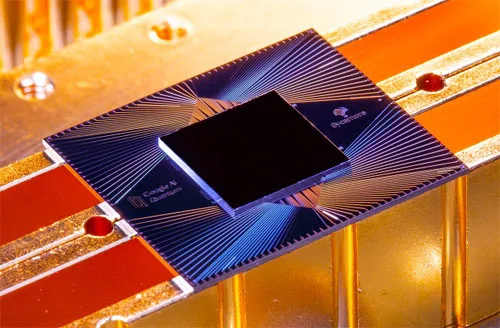
In 2019, Google's Sycamore processor, a 53-qubit machine, made headlines for its claim of 'quantum supremacy,' performing a calculation in 200 seconds that would take a classical supercomputer millennia. This event, though debated, marked a significant milestone in demonstrating a quantum computer's specific computational edge. (Source: photonics.com)
Today’s quantum computers, called Noisy Intermediate-Scale Quantum (NISQ) devices, face huge challenges. Qubits, the quantum bits that hold information, are very fragile. They lose their quantum state—decoherence—almost instantly. Dr. John Preskill of Caltech named this NISQ era in 2018. These machines can’t run complex programs without big errors. Fixing these errors is a massive problem. It takes many physical qubits to make just one stable, logical qubit. For instance, some say thousands of physical qubits might be needed for one error-corrected logical qubit.
Still, progress is clear. IBM announced its “Osprey” processor in November 2022, with 433 superconducting qubits. In 2023, they showed “Condor,” having 1,121 qubits. These numbers mark big engineering wins. But a high qubit count doesn’t directly mean more power for real-world uses. Researchers also look at other qubit types. IonQ, for example, uses trapped ions. These offer high fidelity but fewer qubits. Topological qubits, studied by Microsoft, are another promising path. They aim for built-in error resistance but are mostly experimental.
Quantum sensors and communication: the quiet victories
This is where my thinking changed. Quantum computing gets the headlines, but quantum sensing and communication quietly deliver real results. I was surprised to see practical uses already happening in these less-known areas. These technologies use quantum properties for extreme precision or unhackable security. They don’t calculate faster; they see the world differently.
Quantum sensors are already making a difference. They use superposition and entanglement to find tiny changes in magnetic fields, gravity, or time. For example, they can greatly improve magnetoencephalography (MEG) devices for brain imaging. In 2020, University of Sussex researchers showed a new quantum sensor. It could measure brain activity with incredible detail. These sensors might help diagnose neurological disorders like epilepsy and dementia earlier. Their extreme sensitivity cuts down on measurement noise.
Quantum gravimeters are another area. These devices use superposed atoms to find tiny gravity changes. Cold atom interferometers, for instance, measure gravitational fields with amazing accuracy. This matters for underground mapping, finding resources, and even navigation. A 2023 report from the UK’s National Quantum Technologies Programme highlighted successful field trials. These trials used quantum gravimeters for civil engineering. They can find hidden tunnels or voids more precisely than old methods.
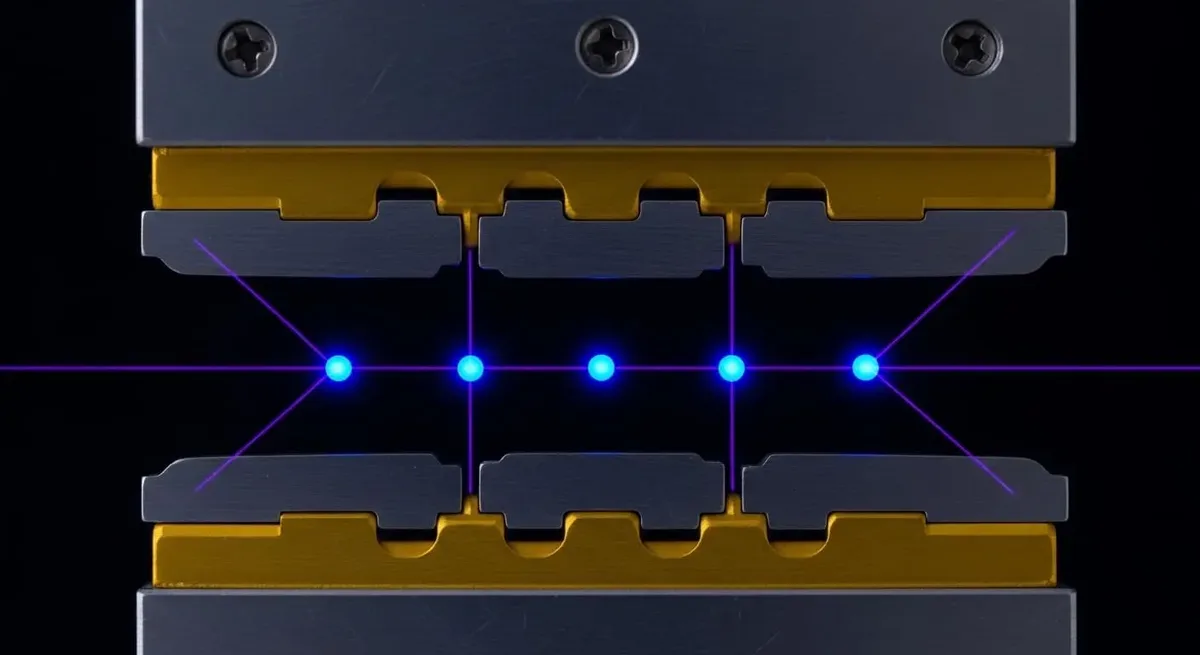
IonQ and other researchers use trapped ions as a promising alternative to superconducting qubits. These individual atoms are suspended in a vacuum by electromagnetic fields and manipulated with lasers, offering high fidelity for quantum information processing. (Source: quantumzeitgeist.com)
Quantum communication focuses on Quantum Key Distribution (QKD). This tech uses entangled photons to make encryption keys. If someone tries to listen in, the quantum state instantly collapses, alerting the users. This makes the communication theoretically unhackable. China leads here. Their Micius satellite, launched in 2016, showed intercontinental QKD working over thousands of kilometers. This is a big step toward a secure quantum internet.
Commercial solutions are also appearing. Swiss company ID Quantique has sold QKD systems for years. They give secure communication links to governments and banks. In 2021, the company said its QKD systems were joining secure networks across Europe. These systems guard data from future decryption by quantum computers. This immediate, practical security comes straight from quantum mechanics.
The road ahead: from lab to reality
When I started this research, I wanted a clear timeline for universal quantum computers. Instead, I found a far more complex and spread-out effort. Quantum science’s future isn’t one “killer app.” It’s a range of game-changing technologies. Total global investment in quantum tech should hit over $40 billion by 2027. That’s according to a 2022 Boston Consulting Group report. This big funding shows confidence in many applications.
One promising near-term use is in materials science and drug discovery. Quantum computers, even noisy ones, could simulate molecular interactions far more accurately than classical computers. This could speed up new catalysts, superconductors, and medicines. For instance, drug companies like Roche already partner with quantum computing firms. They explore new drug candidates. They use quantum simulations to understand protein folding and molecular dynamics. This is a key step in drug development.
Many challenges remain. Superconducting qubits need extreme cooling, often near absolute zero. This makes big deployments hard and costly. Error rates are still too high for most useful algorithms. The “quantum winter” debate—a possible drop in investment if progress slows—still hangs over us. Dr. Charles Marcus, a leader in topological quantum computing, often warns against overhyping current capabilities. He points out the long road ahead for fault-tolerant quantum computers.
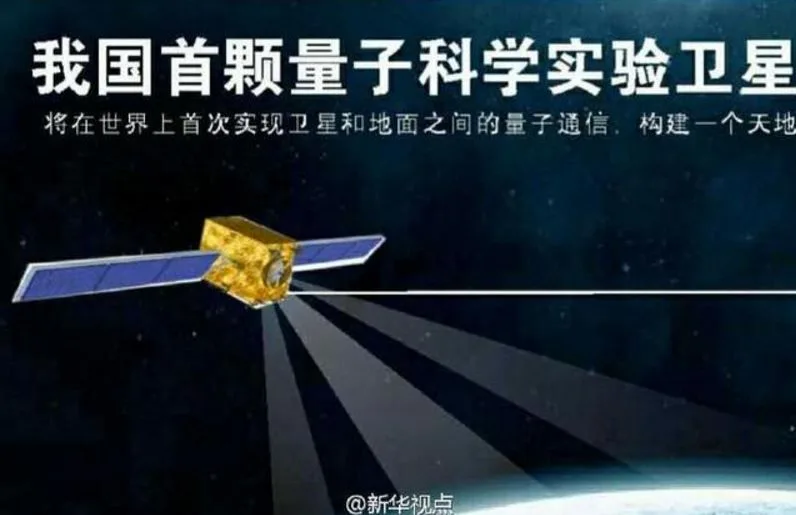
Launched by China in 2016, the Micius (or Mozi) satellite achieved the first intercontinental quantum key distribution. It successfully transmitted entangled photons over thousands of kilometers, demonstrating a crucial step towards a secure quantum internet. (Source: lifeboat.com)
Despite these problems, the drive is clear. The US National Quantum Initiative Act, signed in 2018, put $1.2 billion into quantum research. This money supports many projects. China’s national quantum plan also includes huge investment. These efforts aren’t just about bigger machines. They’re about building the basic science and engineering for a real quantum revolution. We’re shifting from showing what’s possible to building practical, if specialized, tools.
FAQ
Q: What’s the difference between classical and quantum computers? A: Classical computers use bits, which are either 0 or 1. Quantum computers use qubits, which can be 0, 1, or both simultaneously through superposition. This allows for vastly more complex calculations.
Q: Are quantum computers going to replace my laptop? A: Not anytime soon. Quantum computers excel at very specific, complex problems like molecular simulation. They won’t replace your laptop for tasks like browsing the web or word processing.
Q: What is “quantum supremacy”? A: Quantum supremacy means a quantum computer has performed a specific computational task faster than any classical supercomputer. It’s a benchmark of capability, not a sign of general utility.
Q: How does quantum communication work? A: Quantum communication uses entangled particles to create unhackable encryption keys. Any attempt to intercept the key instantly changes the particles’ quantum state, revealing the eavesdropper.
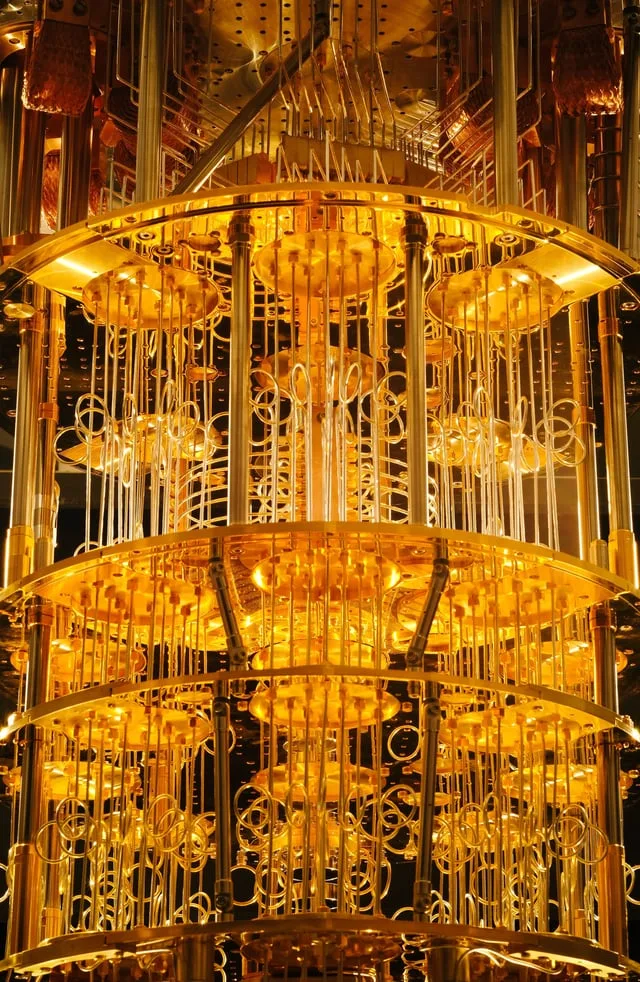
A dilution refrigerator is a critical piece of engineering in many quantum computing labs, providing the ultra-cold temperatures (often colder than outer space) necessary for quantum bits (qubits) to maintain their fragile quantum states. Its intricate, multi-layered design is essential for isolating qubits from thermal noise, representing the 'basic science and engineering' mentioned in the passage. (Source: reddit.com)
You might also like:
👉 Unexplained Mysteries of Science: Cosmos, Quantum & Beyond
👉 Space Colonization: The Grand Illusion & Earth’s Real Solutions
👉 Significant Medical Breakthroughs: A Journey Through Medicine History