
60621: How a Chicago Zip Code Decides Your Health
In Chicago's 60621, Maria Rodriguez had no health insurance in 2008. Your zip code predicts life expectancy more accurately than your genes.
Your zip code shouldn’t decide your health
In the U.S., millions of people find their health determined by their address. Maria Rodriguez knew this reality on a cold Tuesday morning in January 2008. She lived in Chicago’s Englewood neighborhood, zip code 60621. Maria worked two jobs and had no health insurance. A doctor felt out of reach. Her address was a barrier to care.
Her experience reflects a wider problem. Your zip code often predicts your life expectancy more accurately than your genetic code. We call this the zip code lottery. It dictates access to fresh food, safe housing, good education, and reliable transportation. These factors are essential for health. They’re known as social determinants of health.
This issue appears nationwide. It shows up in urban, suburban, and rural areas alike. Take Baltimore, for example. Residents in Baltimore’s largely Black 21217 zip code live 20 years less. This contrasts with those in the predominantly white 21210 zip code. These areas are only five miles apart. Johns Hopkins University researchers reported this disparity in 2015. Similar gaps appear in almost every major U.S. city. These differences show deep systemic unfairness.
Such health gaps have clear roots. They grew from decades of discriminatory housing policies and economic neglect. Redlining, for instance, historically denied services and loans to minority neighborhoods. This left communities without vital health infrastructure. It created a healthcare system that served some well, and left others behind entirely.
Early warnings and big policy changes
In 1998, then-Surgeon General Dr. David Satcher called eliminating health disparities a national priority. He pointed out huge differences in health outcomes. These often depended on race, ethnicity, and socioeconomic status. His warning showed a growing realization. The traditional medical model, which focused on individual treatment, wasn’t solving these bigger systemic issues.
A major policy change arrived with the Affordable Care Act (ACA) in 2010. This law expanded health insurance coverage. It aimed to cut the number of uninsured Americans. The ACA also put money into community health centers. These centers brought care to underserved areas. It was a huge step toward wider access.

President Barack Obama signs the Affordable Care Act (ACA) into law on March 23, 2010, at the White House, marking a monumental step toward expanding health insurance coverage and addressing systemic barriers to care in the United States. The law aimed to reduce the number of uninsured Americans and invest in community health centers. (Source: obama.org)
The ACA showed clear benefits. By 2016, the uninsured rate hit a record low of 8.6%, reports the Kaiser Family Foundation. Millions gained coverage, yet deep-seated problems persisted. Many low-income people still faced high deductibles and copayments. Geography kept blocking access to care. While the law helped, it could not undo decades of economic and social neglect.
During this time, research continued to highlight the issue. The Robert Wood Johnson Foundation (RWJF) started programs like “County Health Rankings & Roadmaps.” This project revealed how non-medical factors shaped health. It mapped health outcomes and social determinants county by county. This data proved a doctor’s visit alone wouldn’t fix community health challenges. So, the focus changed. We started looking at preventing illness and tackling root causes, not just treating sickness.
Technology: promises and reality
By the mid-2010s, new technologies began to offer solutions. Telehealth, once a rare service, began catching on. It linked patients in remote areas with specialists. Rural hospitals could consult city experts by video. This cut down travel for many. It offered help where doctors were few.
However, early telehealth faced challenges. Broadband internet access was spotty. Many patients didn’t have the right devices or digital skills. Despite these issues, its potential was clear. The American Telemedicine Association (ATA) reported steady growth. More providers began using virtual visit platforms. This changed how some people got routine care.
Then the COVID-19 pandemic hit in 2020. It forced a quick, massive telehealth expansion. Doctor’s offices closed. Patients needed safe care at home. Rules for telehealth relaxed fast. Paying for virtual visits became normal. This sped up a shift that might have taken ten years.
The pandemic harshly revealed existing inequalities. Communities with bad internet struggled with telehealth. Many essential workers, often from lower-income zip codes, couldn’t work from home. They faced higher infection risks. However, for others, telehealth greatly improved access. It linked them to mental health services and chronic disease management. Technology offered hope, yet it also worsened the digital divide.
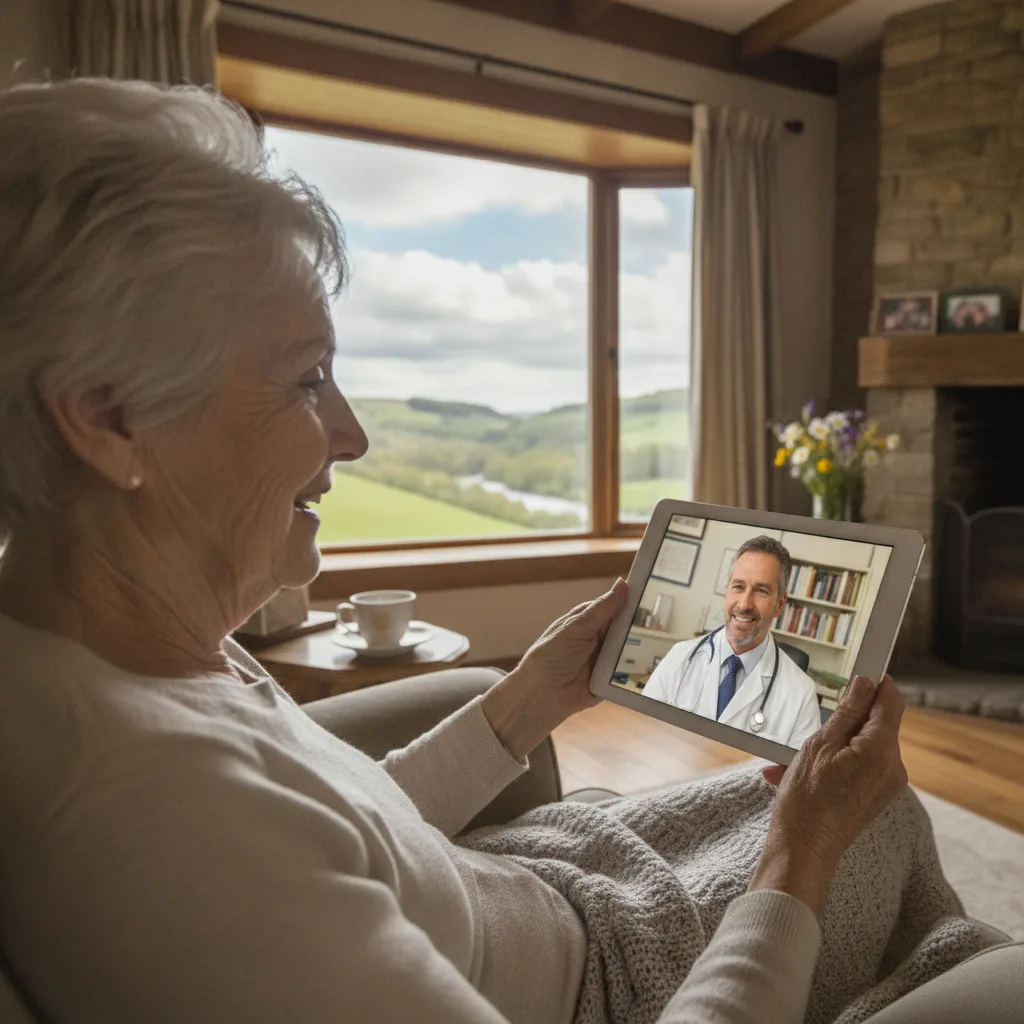
Telehealth, once a niche service, experienced a massive, rapid expansion during the COVID-19 pandemic, accelerating a shift that might have taken a decade. It became a crucial tool for connecting patients in remote areas with specialists and providing safe care from home, despite early challenges with broadband access. (AI-generated illustration)
Data, AI, and custom care
Health data exploded in the late 2010s. Electronic health records became standard. Wearable devices tracked activity and vital signs. This created huge amounts of information. Researchers and healthcare systems started using this data. They used it to understand community health patterns.
Artificial intelligence (AI) quickly became a powerful tool. AI algorithms could analyze complicated datasets. They found people at high risk for certain conditions. For example, AI might flag patients likely to miss appointments. It could predict who might get diabetes based on lifestyle and biometric data. This pushed medicine towards a more proactive approach. It helped find needs before they turned into crises.
One key use involves genomic medicine. DNA sequencing advances allow for custom treatment plans. Doctors can adjust medications based on a patient’s genetic profile. This promises more effective, safer therapies. Dr. Eric Topol, a top cardiologist and geneticist, often champions this future. He sees “precision medicine” becoming standard. This means treatments made just for you.
However, AI and genomics do not benefit everyone equally. Advanced genetic testing is still expensive. Data privacy also raises big worries. Plus, AI models are only as good as the data they learn from. If data from underserved communities is missing, the AI might not help those groups accurately. This could worsen existing health disparities. Advanced medicine could either close or widen the health equity gap. The choices made now are crucial.
Community solutions and coordinated care
Solving the zip code challenge requires more than just medical care. It needs community involvement. Since the early 2000s, many communities started their own solutions. These programs tackle the social determinants of health. They know health begins where people live, learn, work, and play.
Take the Camden Coalition of Healthcare Providers in Camden, New Jersey. Dr. Jeffrey Brenner founded this group. It finds “super-utilizers” of emergency rooms. These patients have complex medical and social needs. The Coalition links them with social workers, housing help, and steady primary care. This coordinated approach cuts hospital visits. It also makes patients healthier.

The Camden Coalition of Healthcare Providers, founded by Dr. Jeffrey Brenner, pioneered the 'hotspotting' model in Camden, New Jersey, identifying 'super-utilizers' of emergency rooms and connecting them with comprehensive social and medical support to improve health outcomes and reduce hospital visits. (Source: camdenhealth.org)
Community Health Workers (CHWs) offer another model. These trusted people often come from the communities they serve. They help residents find their way through the healthcare system. CHWs connect people to social services, like food banks or legal aid. They teach health in a way that respects local culture. Programs using CHWs have shown good results in improving health. The Centers for Disease Control and Prevention (CDC) backs these programs. They are essential for reaching vulnerable people.
Local food efforts also matter. Farmers’ markets in food deserts and community gardens offer fresh produce. These efforts fight diet-related diseases. They make communities healthier overall. These programs show that real health reform goes beyond clinic walls. We now see that health equity needs collaboration across sectors and local power.
A healthier future, no matter your address
Healthcare is changing. Its future promises to break free from geographic limits. Imagine a system where your zip code no longer decides your health. This future blends technology, data, and local solutions. It focuses on proactive, preventative, and custom care for everyone.
Personal health will be a constant journey, not just occasional doctor visits. Wearable sensors will always watch vital signs. AI will crunch this data. It will warn people and their care teams about problems early. This means help arrives before conditions get worse. Care will be more responsive and personalized.
Mobile clinics and telehealth hubs will grow. They will bring specialized care straight to neighborhoods. These hubs will offer diagnostics, shots, and consultations. They will link virtually to advanced medical centers. This puts high-quality care closer to home for underserved communities. It skips traditional infrastructure hurdles.
Policy will change too. Governments and healthcare systems will invest more in social determinants of health. This includes money for affordable housing, safe places, and good food programs. Health will be seen as a shared responsibility, not just a personal burden. This integrated approach aims to build healthier communities from the ground up.

Community Health Workers (CHWs) are trusted members of their communities who help residents navigate the healthcare system, connect to social services, and promote health education. The Centers for Disease Control and Prevention (CDC) backs these programs, recognizing their vital role in reaching vulnerable populations and improving health outcomes. (Source: magnific.com)
The ultimate goal is health equity. Everyone, no matter their address, should have the chance to be as healthy as possible. This takes ongoing effort and new ideas. It demands a fundamental change in how we think about and deliver healthcare. The future of medicine means erasing the invisible lines that divide us. It means building a system where wellness is a universal right, not a geographic perk.
Frequently asked questions
Q: What are social determinants of health? A: These are non-medical factors that affect your health. They include economic stability, education, housing, access to healthy food, and neighborhood safety. They show why your environment impacts your health as much as medical care.
Q: How does telehealth help with care access? A: Telehealth uses technology to provide healthcare remotely. It removes geographic barriers, especially for rural residents or those without transport. It also offers more flexible scheduling, making care easier to fit into busy lives.
Q: Can AI really cut health disparities? A: AI can find at-risk groups and customize interventions. But its success relies on fair data and ethical design. If not done carefully, AI might accidentally worsen existing inequalities.
Q: What do community health workers do? A: Community Health Workers are frontline public health staff. They bridge communities and healthcare services. They offer education, support, and guidance, helping people get the resources they need for better health.

Artificial Intelligence (AI) holds promise for the future of medicine by identifying at-risk groups and customizing interventions to reduce health disparities. However, its ethical design and reliance on fair data are crucial to prevent it from inadvertently worsening existing inequalities. (Photo: Pavel Danilyuk, Pexels)
You might also like:
👉 1 Billion Urban Poor: How Cities Fight Climate Shocks
👉 Why 1/3 of Food Waste Won’t Feed 735 Million Hungry People