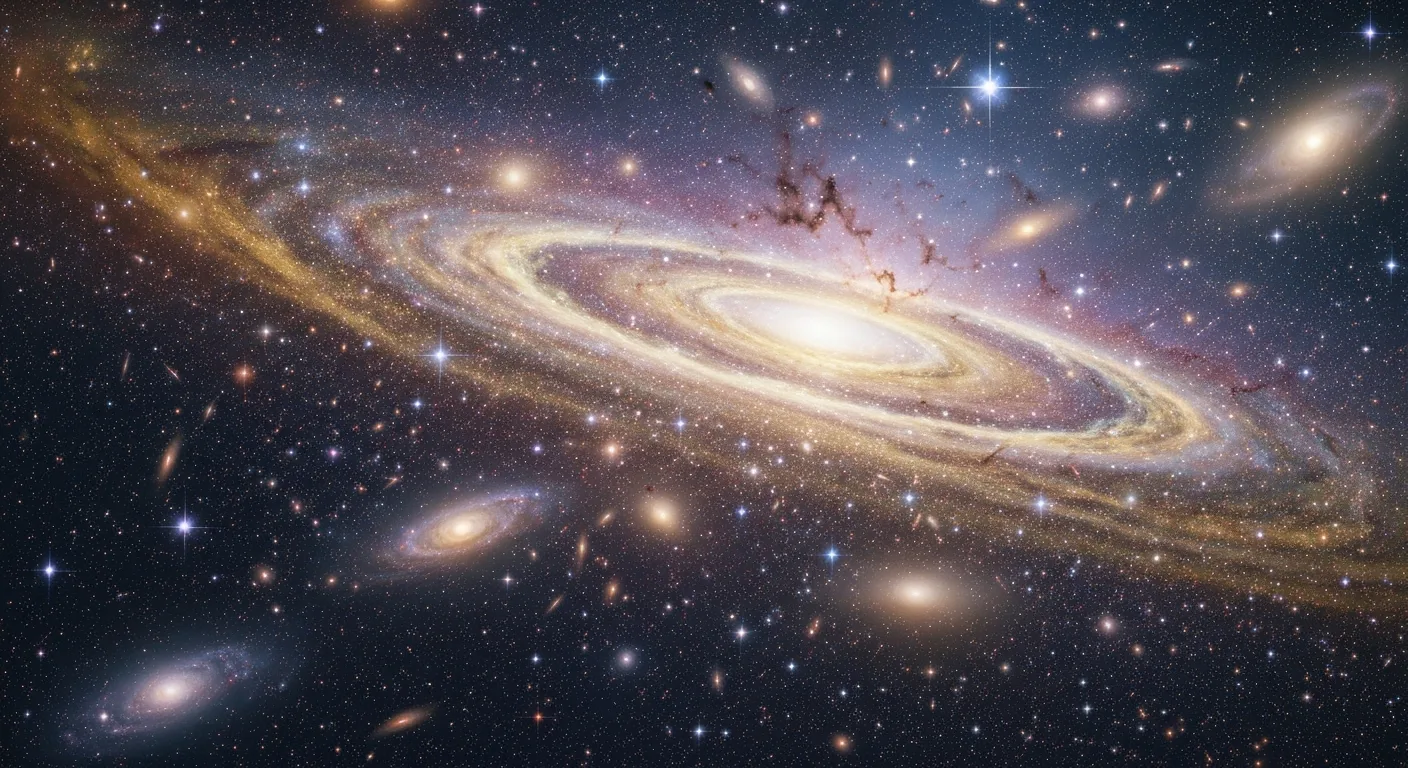
Big Bang Wrong? The Universe's Endless Cosmic Bounce Cycle
Forget the Big Bang! This theory suggests our universe is just one phase in an endless cycle of expansion and contraction.
Beyond the bang: The cosmic bounce theory
Everyone pictures the universe bursting into existence from nothing. We call it the Big Bang. But this common story might be wrong. The standard Big Bang model leaves huge questions unanswered, making physicists look for other ideas.
What if the universe never started? What if it’s been here forever, always recycling itself? That’s the core idea of the cosmic bounce theory. It says our universe is just one phase. It’s an endless cycle of expanding and shrinking, not a one-off event.
1. The universe had a beginning, right? Maybe not.
The main cosmology model, Lambda-CDM, says our universe began about 13.8 billion years ago. This model shows an incredibly hot, dense state that quickly expanded. We call this rapid expansion the Big Bang. It explains things we see, like the expanding universe and the cosmic microwave background radiation.
But the Big Bang model includes a singularity. This is a point of infinite density and temperature. Here, the laws of physics just stop working. It’s like asking what happened before time started. The Big Bang doesn’t fully answer that.
The cosmic bounce theory gives us a different idea. It says the universe never hits a singularity. Instead, it collapses almost completely, then “bounces” back into a new expansion. Imagine a ball hitting a super springy floor. It drops, hits, and instantly springs up again. It never rests at zero height.
2. The Big Bang: A brief (and problematic) origin story
In 1927, Belgian priest and physicist Georges Lemaître first suggested an expanding universe from a “primeval atom.” Later observations strongly backed his theory. In 1929, American astronomer Edwin Hubble saw distant galaxies moving away from us. He noticed that the farther a galaxy is, the faster it goes. This proved cosmic expansion.
The Big Bang model explains this expansion well. It shows a universe that started incredibly hot and dense. Then it cooled and expanded for billions of years. This led to stars, galaxies, and eventually, us. Arno Penzias and Robert Wilson discovered the Cosmic Microwave Background (CMB) in 1964. It is a faint echo of that early hot phase. This radiation comes from when the universe was only about 380,000 years old.
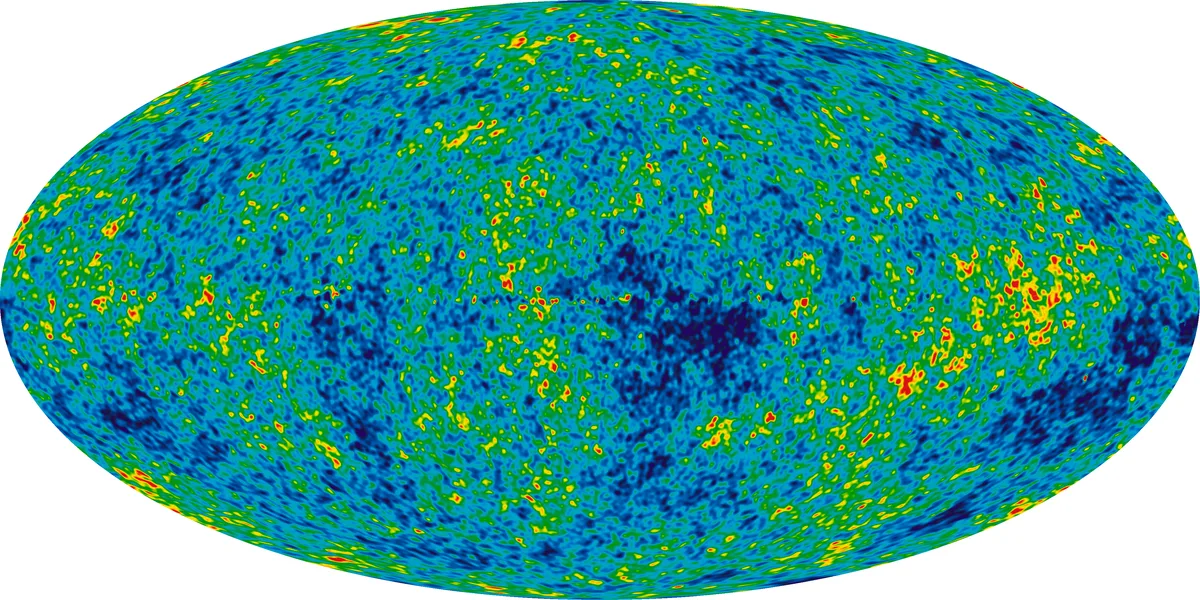
The Cosmic Microwave Background (CMB) is the oldest light in the universe, a faint echo from when the cosmos was only about 380,000 years old. Its discovery in 1964 provided strong evidence for the Big Bang theory, showing the universe's early hot, dense state. (Source: science.nasa.gov)
Even with its wins, the Big Bang model has big theoretical problems. One is the singularity problem we just mentioned. Another is the flatness problem: why is the universe’s shape so incredibly flat? A third is the horizon problem: why is the CMB so even across areas that should never have touched? The standard Big Bang model needs another idea, cosmic inflation, to fix these. Inflation suggests an extremely fast, exponential expansion happened a fraction of a second after the Big Bang.
3. Enter the bounce: An endless cosmic cycle
A universe without a beginning or end isn’t a new idea. Philosophers have discussed cyclic models for thousands of years. But modern scientific bounce theories offer real physical ways this could happen. They say that instead of collapsing into a singularity, some basic physics steps in. This makes the universe rebound.
Many bounce theories focus on avoiding the singularity. The Big Bang’s singularity is a math problem; it means our equations break. Bounce theories often use quantum gravity ideas to stop this. Quantum gravity theories try to combine general relativity (gravity) with quantum mechanics (the physics of tiny things).
Take the ekpyrotic universe model. Paul Steinhardt of Princeton and Neil Turok of the Perimeter Institute developed it in the early 2000s. This model says our universe came from two higher-dimensional “branes” colliding. Imagine two huge, flat sheets of paper in a higher dimension. They drift gently towards each other. When they hit, the impact’s energy creates our Big Bang-like expansion.
Loop Quantum Cosmology (LQC) offers another way. This theory applies Loop Quantum Gravity’s rules to the whole universe. LQC suggests spacetime isn’t a smooth fabric. Instead, it’s discrete, like tiny loops. This “quantization” of spacetime stops a singularity naturally. The universe doesn’t collapse to infinite density. It hits a maximum density, then quantum effects make it repel itself and bounce. Martin Bojowald, a researcher in LQC at Penn State, has shown how this bounce could happen.

Paul Steinhardt, a theoretical physicist at Princeton University, co-developed the ekpyrotic universe model, a leading "bounce theory" that proposes our universe arose from the collision of higher-dimensional "branes" rather than a Big Bang singularity. He is also known for his early work on cosmic inflation. (Source: thecrimson.com)
4. How would a bounce even work? The mechanisms
In 2001, Paul Steinhardt and Neil Turok published their “ekpyrotic universe” model in Physical Review D. This model gives a detailed way a cosmic bounce could happen. It uses string theory, which says fundamental particles are tiny vibrating strings. String theory also allows for extra spatial dimensions. In the ekpyrotic model, our visible universe lives on a three-dimensional “brane.” This is a membrane-like object. It exists inside a higher-dimensional space.
The ekpyrotic bounce doesn’t start with a hot, dense singularity. Instead, two parallel branes slowly move toward each other. As they get close, they create a gravitational pull. When they finally hit, that immense energy makes the matter, radiation, and space we see as our expanding universe. The collision itself is the “bounce.” After, the branes separate, cool, and then slowly start to approach again. This makes an endless cycle.
Loop Quantum Cosmology (LQC) shows a different scenario. It says gravity pushes back at super high densities. When the universe shrinks to the Planck scale — the smallest length where quantum gravity matters — spacetime itself stiffens. This stiffness stops further collapse. The universe doesn’t hit infinite density. It reaches a maximum, finite density, then rebounds. This is a “Big Bounce” without needing extra dimensions or branes.
Martin Bojowald and others have shown LQC fixes the Big Bang singularity. It swaps it for a smooth shift from contracting to expanding. This means a “previous universe” shrank to extreme density. Then it bounced and expanded into our current one.
5. Hunting for echoes: Observational evidence and challenges
Telling the difference between an inflationary universe and one that bounced is hard for cosmologists. Both theories want to explain the universe’s observed traits. Both also need to explain the uniformity and flatness we see. Their predictions for certain subtle cosmic features can differ, though.
One big difference is gravitational waves. Cosmic inflation expects a specific pattern of primordial gravitational waves. These are ripples in spacetime made in the very early universe. Bounce theories, depending on the model, might predict a different signal. They could even predict fewer primordial gravitational waves. Finding and describing these waves, perhaps with future observatories like LISA, would offer important clues.
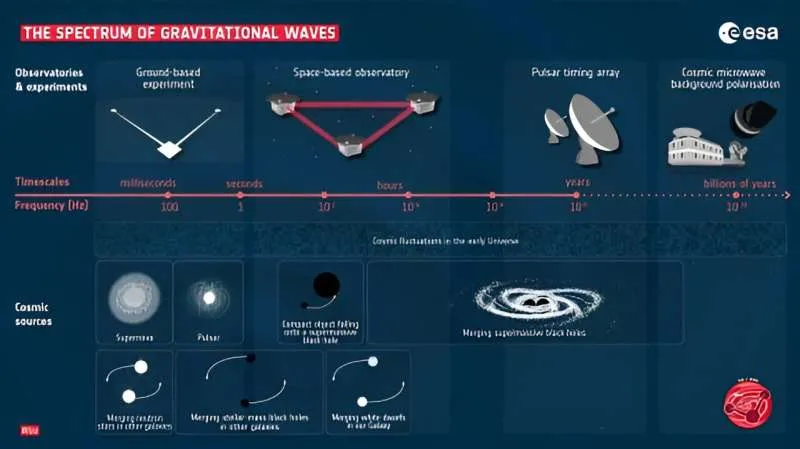
The Laser Interferometer Space Antenna (LISA) is a planned space mission designed to detect gravitational waves by precisely measuring the distance between three spacecraft orbiting the Sun. This ambitious observatory aims to open a new window into the universe, potentially revealing primordial gravitational waves that could distinguish between cosmic inflation and bounce theories. (Source: phys.org)
Another clue is the non-Gaussianity of the Cosmic Microwave Background (CMB). The standard inflation model predicts a very specific, almost Gaussian spread of temperature changes in the CMB. But some bounce models predict noticeable shifts from this Gaussianity. Researchers like Anna Ijjas at Princeton and Paul Steinhardt are studying these subtle differences in their models.
Explaining the universe’s current accelerated expansion is a tough problem for bounce theories. Dark energy drives this acceleration. If the universe is meant to contract for a bounce, dark energy must somehow weaken or reverse its effects. Recent work by Steinhardt and Ijjas looks at how a cyclic universe could still work with dark energy. Maybe dark energy decays over cosmic time. How exactly the expansion reverses is still being studied.
6. The universe’s next act: An evolving cosmic story
Physicists keep building and improving models of the early universe. The cosmic bounce theory shows how much we still want to understand where our universe came from and where it’s going. It solves some of the Big Bang model’s toughest problems, especially the singularity.
If proven right, the cosmic bounce would completely change how we see existence. Our universe wouldn’t be a unique, lonely event. It would be part of an endless cosmic dance. This idea points to an infinite past and future. Universes would constantly be born, change, and then rebirth themselves. This takes cosmology far beyond a simple start.
Looking for primordial gravitational waves and getting more exact CMB non-Gaussianity data will be important in the next decades. These observations could finally give us the clear answers. They might tell us if we had an inflationary start or a cosmic bounce. The universe’s next move — more expansion or a big squeeze leading to a new cycle — stays a thrilling mystery.
FAQs
Q: What’s the main difference between the Big Bang and Cosmic Bounce theories? A: The Big Bang theory says the universe started from a singularity about 13.8 billion years ago. Cosmic bounce theory suggests our universe is one phase in an endless cycle of expanding and shrinking, avoiding a singular beginning.

Anna Ijjas, a theoretical physicist at Princeton University, is a leading researcher in cosmic bounce theory, exploring how the universe could undergo endless cycles of expansion and contraction. Her work with Paul Steinhardt investigates how dark energy and non-Gaussianity in the Cosmic Microwave Background fit into these cyclic models, challenging the traditional Big Bang singularity. (Source: worldsciencefestival.com)
Q: Does dark energy prevent a cosmic bounce? A: Dark energy’s accelerating expansion is a problem for simple bounce models. But some newer bounce theories, like those from Paul Steinhardt and Anna Ijjas, suggest it could decay or reverse. This would allow for a future contraction and bounce.
Q: How could scientists find evidence for a cosmic bounce? A: Scientists look for specific signs in the Cosmic Microwave Background radiation, like different levels of non-Gaussianity. They also search for primordial gravitational waves, which might have different patterns than inflation predicts.
Q: What problems does the cosmic bounce theory try to solve? A: The theory wants to fix problems like the Big Bang’s initial singularity, where physics breaks down. It also offers other explanations for the universe’s observed flatness and uniformity, problems cosmic inflation usually addresses.
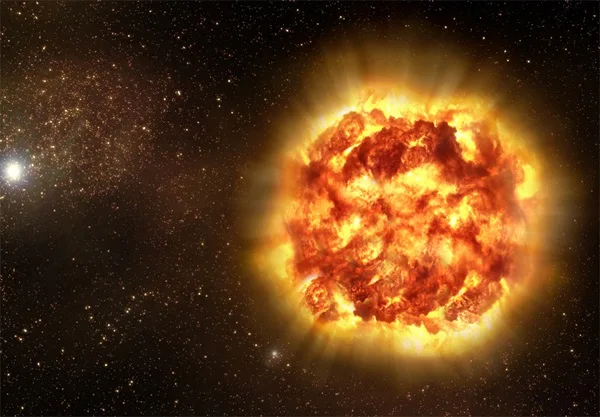
Type Ia supernovae are crucial 'standard candles' in cosmology, used to measure vast cosmic distances and the universe's expansion rate. Their consistent peak luminosity provided the pivotal evidence for the accelerating expansion of the universe, attributed to dark energy. (Source: astronomy.com)
You might also like:
👉 Unexplained Mysteries of Science: Cosmos, Quantum & Beyond