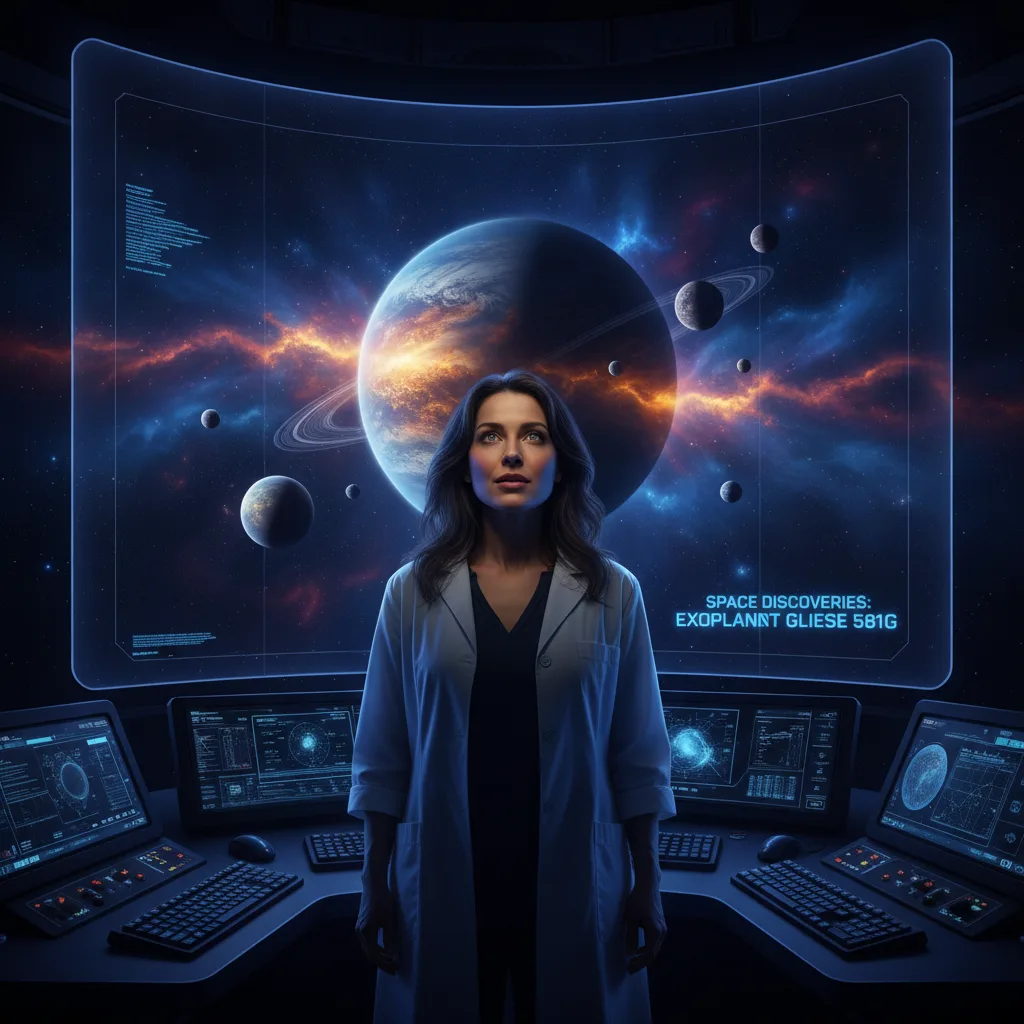
Before Rockets: The Centuries-Old Space Discoveries That Rewrote Reality
Explore how the most significant space discoveries, made centuries before anyone left Earth, profoundly altered our perception of reality.
Beyond the firmament: how space rewrote our reality
We often think of space exploration as a modern pursuit, picturing rockets and astronauts. Yet, the most significant discoveries about space happened long before anyone left Earth. These were not about traveling to space, but about seeing it differently.
I expected to write about the Space Race or the Hubble Telescope. What truly surprised me was how observations from centuries ago changed everything. These early glimpses deeply changed what we understood about existence. They didn’t just add facts; they changed where humanity stood in the universe.
The Universe Before Major Discoveries
For thousands of years, people saw the universe consistently. Earth, our home, was the undisputed center. Claudius Ptolemy formalized this geocentric model in the 2nd century AD. It dominated thought for over 1,400 years. Scholars like Aristotle had set up the philosophy for this view.
This wasn’t just a scientific model; it was a universe with a clear pecking order. The heavens were perfect, unchanging spheres, ruled by divine will. Earth, flawed and changing, sat at the heart of everything. This idea shaped religion, philosophy, and even daily life. It gave people a comforting, ordered universe where humanity had a unique, central spot.
Our tools for seeing were basic: the naked eye, careful charts, and geometry. We watched planets wander across the sky, stars stuck in their patterns. To explain these movements, people often used complex epicycles. This complex system, while mathematically impressive then, eventually broke under the weight of more and more observations.
The Earth Moves: Copernicus and Galileo
Nicolaus Copernicus, a Polish astronomer, published his groundbreaking work De revolutionibus orbium coelestium in 1543. His idea was simple yet shocking: the Sun, not Earth, was the center of the solar system. Earth, he argued, was just another planet, circling the Sun. This heliocentric model first met resistance. It challenged Ptolemaic astronomy and deeply held religious and philosophical doctrines.
Copernicus’s idea wouldn’t show its full power for decades. In 1610, Italian astronomer Galileo Galilei turned his improved telescope to the night sky. What he saw showed key observational evidence for heliocentrism. He observed Venus’s phases, which mirrored the Moon’s. This only made sense if Venus orbited the Sun. He also found four moons circling Jupiter.
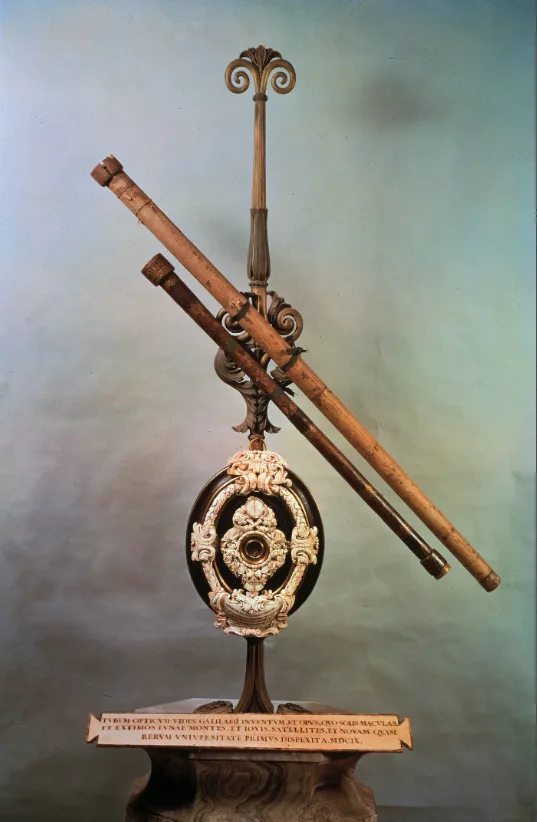
Galileo Galilei's improved telescope, though simple by modern standards, allowed him to make groundbreaking observations like the phases of Venus and Jupiter's moons. These findings provided crucial observational evidence for the heliocentric model, fundamentally changing humanity's understanding of its place in the universe. (Source: historyofinformation.com)
These Jovian moons, named the Medicean stars by Galileo, proved not everything orbited Earth. This directly disproved the geocentric model. Galileo’s findings, detailed in his Sidereus Nuncius, shocked the intellectual world. The Church famously condemned his views, placing him under house arrest for his last years. Still, a new way to understand the universe had begun. It showed that actual observation, not dogma, could reveal the universe’s true nature.
Unifying the universe: Newton’s universal law
The shift from Earth-centered to Sun-centered was only the start. The next big change came with Isaac Newton, an English physicist and mathematician. In 1687, he published his Philosophiæ Naturalis Principia Mathematica. This massive work laid out the laws of motion and universal gravitation.
Newton’s theory said the same force that made an apple fall to Earth also kept the Moon in orbit. This was a major break. It showed that sky mechanics and Earth physics weren’t separate. A single, universal law governed them. Suddenly, the heavens weren’t a place of divine perfection. They followed the same predictable, mathematical rules as everything on Earth.
This discovery made the universe less mysterious. It let scientists predict planetary movements with amazing accuracy. It also gave the math needed for future space travel. As Professor Richard Feynman often noted, Newton’s work brought our understanding of the universe together. It moved us from a universe of separate realms to one single, understandable system.
An Expanding Universe: Hubble’s Distant Galaxies
Centuries passed, and our understanding of the universe grew. But a basic question remained: how big was it? Many astronomers, including Albert Einstein for a time, thought the universe was static. Our Milky Way galaxy was believed to hold all of creation. This view was challenged strongly in the early 20th century.
In 1929, American astronomer Edwin Hubble showed observations from Mount Wilson Observatory. He used the newly built 100-inch Hooker telescope. Hubble studied “nebulae,” then thought to be gas clouds inside our own galaxy. He found these nebulae were actually distant galaxies, far past the Milky Way.
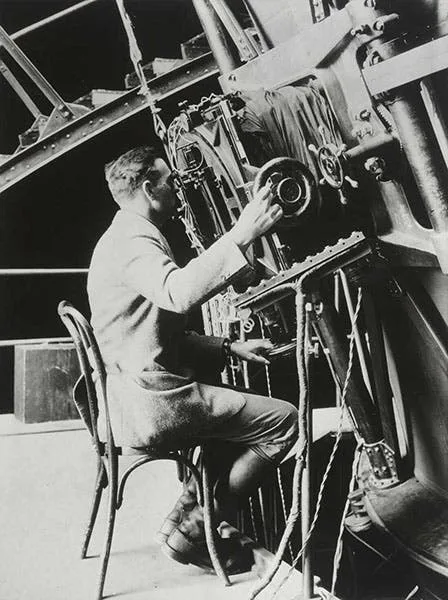
The monumental 100-inch Hooker Telescope at Mount Wilson Observatory was the world's largest operational telescope for over 30 years. It was famously used by Edwin Hubble in 1929 to prove that 'nebulae' were actually distant galaxies, fundamentally expanding our understanding of the universe's scale. (Source: lindahall.org)
Hubble also saw that these galaxies moved away from us. The farther a galaxy was, the faster it moved. This phenomenon, called Hubble’s Law, first showed evidence of an expanding universe. It suggested a beginning, a moment when everything was much closer. This discovery shattered the static universe model. It grew our universe from one galaxy to billions. It truly changed how big we thought existence was.
The echo of creation: cosmic microwave background
Hubble’s expanding universe strongly suggested a hot, dense beginning. This was the core idea of what became known as the Big Bang theory. Theoretical physics still needed proof, though. That proof came almost by accident in 1964.
Arno Penzias and Robert Wilson were engineers at Bell Labs in New Jersey. They worked with a new horn antenna for satellite communication. They kept hearing a strange, unexplained “hiss” or “noise” in their receiver. This noise came from every direction in the sky. They tried everything to stop it, even cleaning pigeon droppings from the antenna.
The noise wouldn’t go away. They eventually heard about theoretical work by Robert Dicke and his team at Princeton. Dicke had predicted a faint afterglow from the Big Bang. This afterglow would spread evenly across the universe. Penzias and Wilson had stumbled upon the Cosmic Microwave Background (CMB) radiation. Its temperature, measured at about 2.7 Kelvin, precisely matched predictions. This accidental discovery gave direct, strong evidence for the Big Bang. It gave us a “baby picture” of the universe, confirming its explosive birth.
Worlds beyond our sun: the rise of exoplanets
For centuries, planets orbiting other stars were just a guess. Science fiction writers imagined countless alien worlds. Actual scientific evidence stayed elusive, though. This changed quickly in the 1990s.
In 1992, astronomers Aleksander Wolszczan and Dale Frail announced they found planets orbiting a pulsar. PSR B1257+12, a rapidly spinning neutron star, had at least two planets. This was the first solid proof of exoplanets. It showed that planet formation wasn’t unique to our solar system.
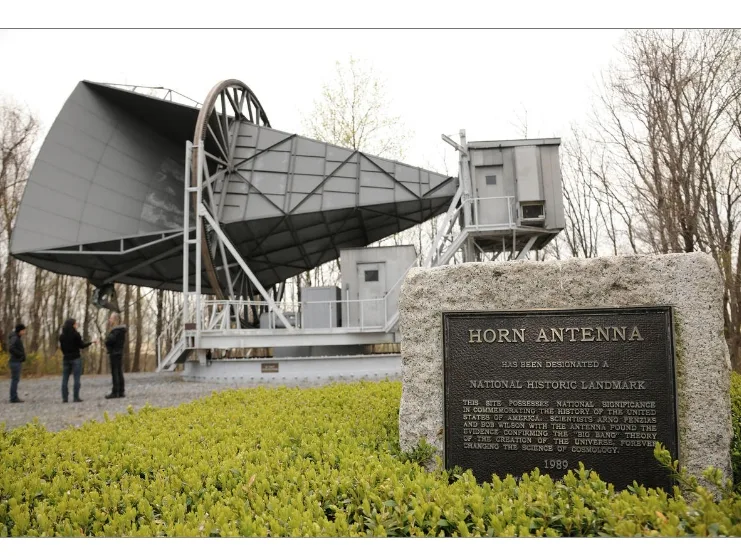
The iconic Bell Labs horn antenna in Holmdel, New Jersey, where Arno Penzias and Robert Wilson accidentally discovered the Cosmic Microwave Background radiation in 1964, providing strong evidence for the Big Bang theory. They famously tried cleaning pigeon droppings from it, thinking it was the source of the unexplained 'hiss'. (Source: patch.com)
Then, in 1995, Michel Mayor and Didier Queloz confirmed the first exoplanet around a sun-like star. This planet, 51 Pegasi b, was a “hot Jupiter.” It circled its star in just four days. This discovery, made using the radial velocity method, led to many more. As of 2023, over 5,500 exoplanets have been confirmed. Missions like the Kepler Space Telescope show that planets are common. Most stars likely have at least one planet. This changed the main question from “Are there other planets?” to “How many are habitable?” The huge scale of potential life-bearing worlds is amazing.
The unending quest
These space discoveries are more than just scientific facts. They are big steps in understanding ourselves. They always change our place in the universe. We went from being the center of creation to a small planet orbiting one of billions of stars. Our perspective has completely changed.
The search continues. Telescopes like the James Webb Space Telescope are showing us the first galaxies. Scientists are hunting for signs of life on distant exoplanets. The mysteries of dark matter and dark energy still loom. Each new discovery will no doubt change our world again. It will expand what we know and who we are.
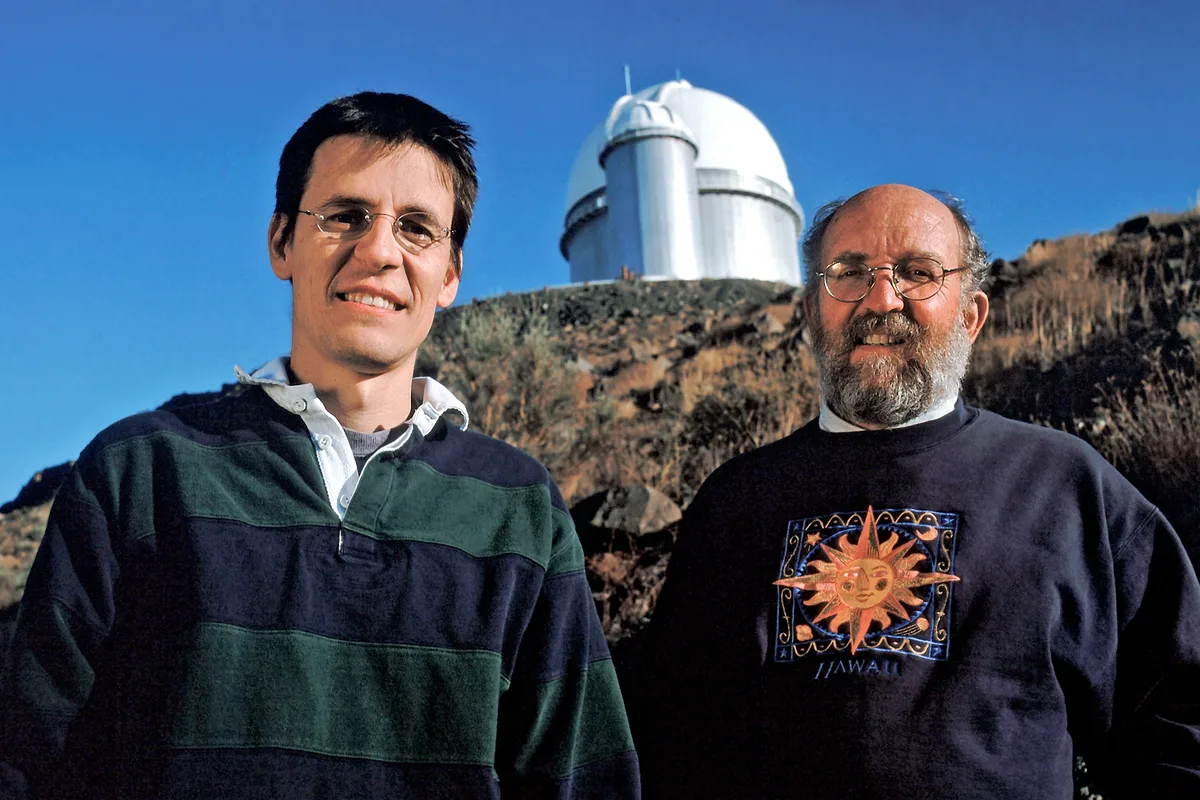
Swiss astronomers Michel Mayor and Didier Queloz confirmed the first exoplanet orbiting a sun-like star, 51 Pegasi b, in 1995. Their groundbreaking discovery, for which they later shared the Nobel Prize in Physics, revolutionized our understanding of planetary systems beyond our own. (Source: en.wikipedia.org)
You might also like:
👉 Unexplained Mysteries of Science: Cosmos, Quantum & Beyond