
Your Brain Can't Grasp Earth's 4.54 Billion Years
Earth is 4.54 billion years old, a span called Deep Time. Most of humanity's story fits into the last few words of its final chapter.
Earth’s Story: A Geological Timeline
Most people know Earth is old. They think millions of years. But it’s far, far older. Try 4.54 billion years. This immense span, called Deep Time, is almost impossible to truly grasp.
Imagine Earth’s history as a thick, unread novel. Each page represents millions of years. Most of humanity’s story fits into the last few words of the final chapter. Grasping this scale changes how we see everything. Geologists slice this timeline into major chunks. Eons span billions of years. Eras last hundreds of millions of years. Periods cover tens of millions of years. This helps us follow the planet’s history.
The Hadean Eon: Earth’s Fiery Start
Earth formed 4.54 billion years ago. That’s when the Hadean Eon began. Earth was a molten, hellish place back then. Asteroids and comets constantly slammed into it. Imagine a cosmic firing range, with the target still glowing hot.
The Moon also formed during this chaotic time. A Mars-sized protoplanet, named Theia, likely collided with early Earth. Debris from this crash formed our moon. Dr. Sarah Stewart of the University of California, Davis, theorized this. Earth’s surface was too hot for solid rock or liquid water. Any water present immediately vaporized.
As the planet slowly cooled, a thin crust began to form. Volcanic activity was intense and widespread. Gases spewed from inside, making Earth’s first atmosphere. This atmosphere was thick with water vapor, carbon dioxide, and nitrogen. Water eventually condensed. This created the first primitive oceans, a process backed by University of Hawaii research.
The Archean Eon: Life Begins
The Archean Eon began around 4 billion years ago. Earth had cooled significantly by this point. A solid crust became more widespread. Small, unstable landmasses rose from the global ocean. Think of them as proto-continents, constantly shifting and merging.
Life first appeared in the Archean. These were simple, single-celled organisms, known as prokaryotes. They were ancestors of modern bacteria and archaea. Evidence for this early life comes from stromatolites. These layered rock structures are fossilized microbial mats. Dr. Abigail Allwood, a geologist at NASA’s Jet Propulsion Laboratory, has studied some of the oldest known stromatolites.
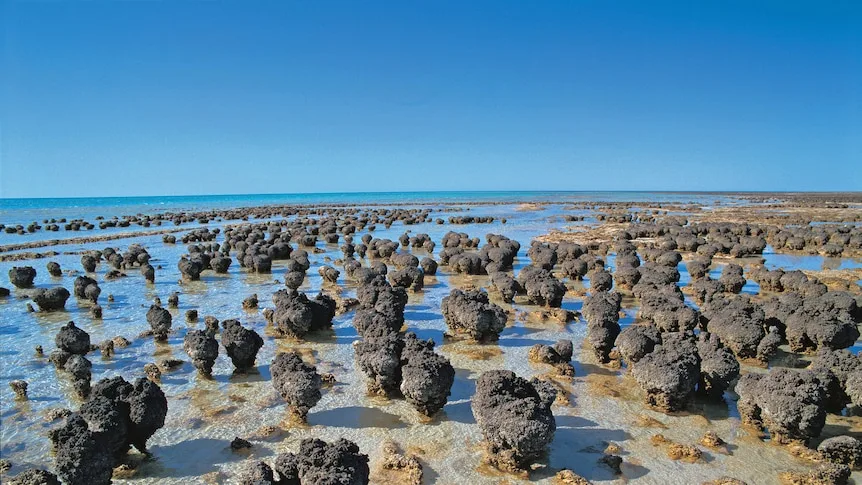
Stromatolites are layered rock structures built by ancient microbial mats, representing some of the earliest evidence of life on Earth. Living examples, like those found in Shark Bay, Australia, offer a rare glimpse into the planet's Archean Eon. (Source: abc.net.au)
The Archean atmosphere contained almost no free oxygen. It was a reducing environment. Early life forms used different chemical processes for energy. Photosynthesis eventually evolved in some microbes. This process released oxygen as a byproduct. This oxygen reacted with iron in the oceans. It formed banded iron formations.
The Proterozoic Eon: Oxygen Fills the Air
The Proterozoic Eon started 2.5 billion years ago. The planet’s surface and air changed dramatically. Continents grew larger and more stable. They began to assemble into early supercontinents. One example is Rodinia, which formed about 1.1 billion years ago. A supercontinent is a landmass comprising most or all of Earth’s continental crust.
Then came a huge shift. This was the Great Oxidation Event (GOE), around 2.4 billion years ago. Oxygen from photosynthetic microbes built up in the air. This changed the planet fundamentally. The sky turned blue. The oceans changed chemistry. Scientists like Dr. James Kasting from Penn State University have well-documented this event.
The rise of oxygen was a double-edged sword for early life. It was toxic to many anaerobic organisms. It also enabled the development of more complex life. Eukaryotic cells, with their internal structures and nuclei, evolved. These cells are the building blocks of all complex organisms. The late Proterozoic also saw extreme global glaciations. These are known as Snowball Earth events, as described by Dr. Paul Hoffman of Harvard University. The entire planet may have frozen over multiple times.
The Phanerozoic Eon: Life Explodes
The Phanerozoic Eon began 541 million years ago. This is the eon of abundant, visible life. It is the most recent and best-understood part of Earth’s history. This eon is divided into three Eras: the Paleozoic, Mesozoic, and Cenozoic. Each era highlights significant events in life and planetary change.
The Paleozoic Era (541 to 252 million years ago) started with the Cambrian Explosion. This was a rapid diversification of animal life. Most major animal phyla appeared in the fossil record during this relatively short period. The Smithsonian National Museum of Natural History calls it a key moment. Early fish evolved. Plants colonized land, followed by insects and amphibians. Reptiles also emerged. By the end, all major landmasses converged. They formed the supercontinent Pangaea. The era concluded with the Permian-Triassic Extinction event. This was the largest mass extinction in Earth’s history. It wiped out about 90% of marine species. Dr. Michael Benton of the University of Bristol has extensively researched this event.
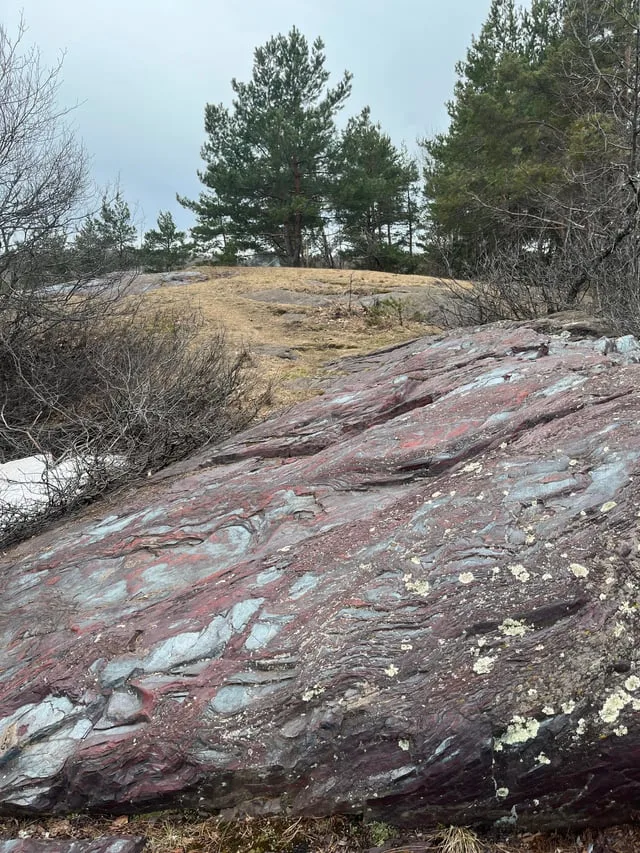
Banded Iron Formations are ancient sedimentary rocks with distinctive alternating layers of iron-rich minerals and chert. These geological wonders provide crucial evidence of Earth's early oxygenation, as oxygen released by photosynthetic microbes reacted with dissolved iron in the oceans billions of years ago. (Source: reddit.com)
The Mesozoic Era (252 to 66 million years ago) is famously known as the Age of Dinosaurs. It’s divided into the Triassic, Jurassic, and Cretaceous periods. Dinosaurs diversified and dominated terrestrial ecosystems. The first mammals and birds also appeared. Flowering plants evolved and spread. Pangaea began to break apart. This continental drift shaped the modern world. The Mesozoic ended abruptly. The Cretaceous-Paleogene Extinction event occurred 66 million years ago. A large asteroid impact caused widespread devastation. This event led to the extinction of most dinosaurs. Dr. Kirk Johnson, director of the Smithsonian National Museum of Natural History, has led research on the impact site.
The Cenozoic Era (66 million years ago to present) is the Age of Mammals. With the dinosaurs gone, mammals diversified rapidly. They filled ecological niches. Modern continents continued to drift towards their current positions. Mountain ranges like the Himalayas and the Alps formed from continental collisions. Earth’s climate swung wildly. This included a series of Ice Ages. Early hominids evolved in Africa. Eventually, Homo sapiens emerged and spread across the globe.
Why Deep Time Matters
Earth’s geological history holds crucial information for our present and future. Natural resources, for example, exist where they do because of past geology. Fossil fuels like coal and oil formed from ancient biomass under specific conditions. Volcanic activity or tectonic forces concentrated mineral deposits.
Earth’s climate history also informs our current problems. We see natural cycles of warming and cooling. However, current changes are occurring at a rapid and expansive rate. Geological records help us distinguish natural variations from human-caused impacts. This understanding is essential for predicting future climate scenarios. Dr. Katherine Hayhoe, a climate scientist, emphasizes the importance of historical data in climate modeling.
The timeline also shows life’s ability to recover and adapt. It shows how species adapt and evolve over vast periods. It also highlights the devastating impact of mass extinction events. Learning from these past events can guide conservation efforts. It helps us understand the interconnectedness of ecosystems. Our own existence is a tiny blip on this enormous timeline. Seeing this scale makes us appreciate our planet more.
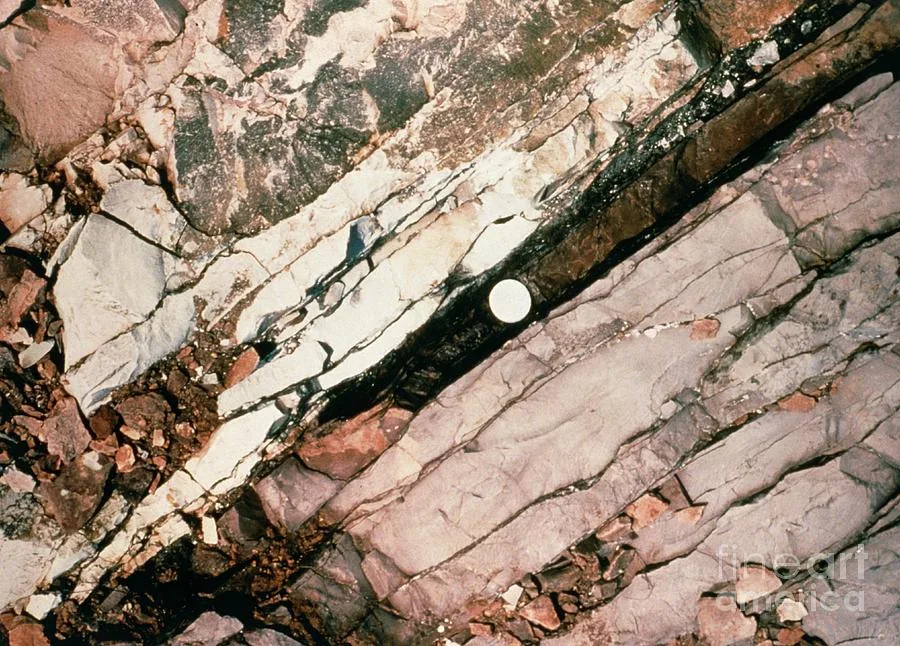
The thin, dark layer of iridium-rich clay known as the Cretaceous-Paleogene (K-Pg) boundary marks the geological moment 66 million years ago when a massive asteroid impact caused a global catastrophe. This distinct layer, found worldwide, provides crucial evidence for the event that led to the extinction of most dinosaurs and ushered in the Age of Mammals. (Source: sciencephotogallery.com)
Earth’s Future: Still Unfolding
Earth’s geological processes continue to shape the planet. Plate tectonics continue to reshape the continents. Scientists predict future supercontinents will form. Dr. Christopher Scotese’s Paleomap Project forecasts Pangaea Proxima forming in about 250 million years. Volcanoes erupt, earthquakes shake the ground. These are all ongoing reminders of a dynamic planet.
Climate will continue to fluctuate over geological timescales. Astronomical cycles influence long-term ice ages and warming periods. Humanity now plays a significant geological role. Our activities are impacting the planet at an accelerated rate. Some scientists propose we’ve entered a new geological epoch: the Anthropocene. This epoch recognizes humans as the dominant force shaping Earth’s geology and ecosystems.
Ultimately, the sun will determine Earth’s ultimate fate. In roughly 5 billion years, our star will expand into a red giant. It will likely engulf Earth. Until then, our planet continues its slow journey through time. We are temporary inhabitants, witnessing a tiny fraction of its long history.
FAQ
How do scientists piece together this timeline? Scientists use many methods. Radiometric dating measures radioactive decay in rocks to determine their absolute age. The fossil record provides evidence of ancient life and helps correlate rock layers. Analyzing rock layers themselves, called stratigraphy, reveals the sequence of geological events.
What was the shortest geological period? Geological periods vary greatly in length. The Holocene Epoch, which began about 11,700 years ago, is relatively short. Some geologists argue we have entered the even shorter, human-defined Anthropocene. Its start date is still debated.
Will Earth ever have another supercontinent? Yes, Earth’s tectonic plates are constantly moving. They will eventually converge again. Scientists predict that in hundreds of millions of years, the continents will merge into a new supercontinent. This process is part of the ongoing supercontinent cycle.
Is Earth’s core still hot? Absolutely. Earth’s core remains incredibly hot. Its heat comes from the residual energy of the planet’s formation. It also comes from the ongoing decay of radioactive elements within the Earth. This heat drives plate tectonics and generates Earth’s magnetic field.
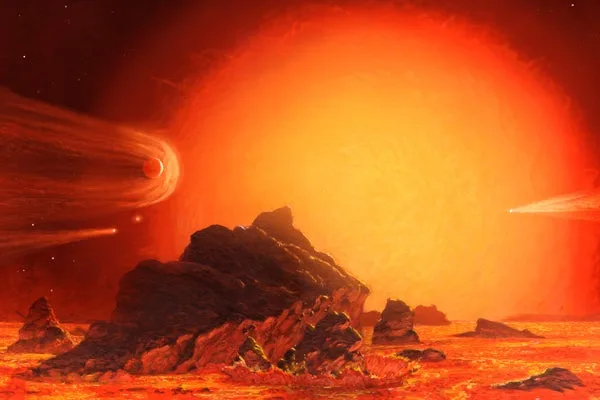
In approximately 5 billion years, our Sun will expand into a red giant star, growing so large that it is predicted to engulf Earth, marking the ultimate end of our planet's long geological journey. (Source: scientificamerican.com)
You might also like:
👉 The Human Brain: Unraveling Its Mysteries & How It Works
👉 Unexplained Mysteries of Science: Cosmos, Quantum & Beyond