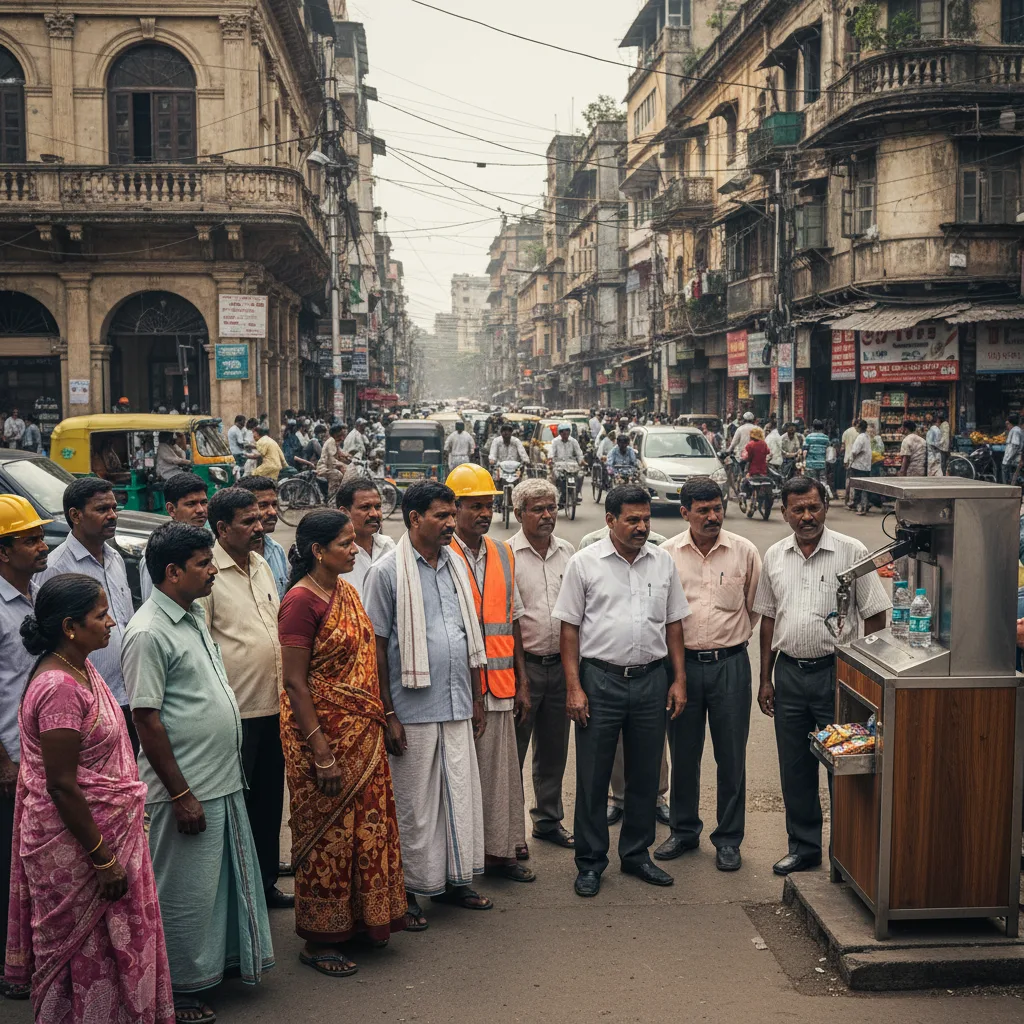
AI & Automation's Impact on India's Employment Landscape
Explore how AI and automation are rapidly transforming India's job market, displacing some roles while creating new opportunities and demanding future-ready skills. Understand the economic shift.
India’s AI Tsunami: Reshaping the Future of Work and the Nation’s Employment Landscape
Imagine waking up to find your job, a steady source of income for years, now being performed by a tireless algorithm or a gleaming robotic arm. For millions across India, this isn’t a dystopian fantasy; it’s a rapidly unfolding reality. But here’s the twist: for every job transformed or displaced, another is being born, demanding skills we could barely conceive a decade ago. We stand at the precipice of a monumental shift, where the impact of AI and automation on India’s employment landscape is not just a ripple, but a full-blown tsunami, promising both unprecedented opportunities and profound challenges.
Consider the journey of Rohan, a data entry operator in Bengaluru. For years, his meticulous work involved sifting through invoices and inputting figures. Today, sophisticated OCR (Optical Character Recognition) and AI-powered automation handle his former tasks with astounding speed and accuracy. Rohan, however, isn’t unemployed. He chose a different path: an intensive upskilling program in data analytics, learning to design the very algorithms that now process data, moving from manual drudgery to strategic insight. His story encapsulates the dynamic, often contradictory, forces at play. Is India ready for this transformation? The answer is complex, woven into the fabric of its massive workforce, its burgeoning tech sector, and its unique socio-economic realities.

The Double-Edged Sword: Displacement and the Dawn of New Roles
The narrative around AI often defaults to fear: job losses, mass unemployment, an army of robots replacing human hands. While it’s true that automation is inexorably changing traditional roles, particularly those that are repetitive, predictable, and rule-based, the picture is far more nuanced. Sectors like manufacturing, which once relied heavily on manual assembly lines, are seeing robots take over tasks like welding, painting, and precision assembly. Similarly, back-office operations, call centers, and even basic accounting functions are increasingly being handled by intelligent automation and chatbots, leading to a significant reduction in demand for entry-level human intervention.
However, this displacement is simultaneously creating an entirely new ecosystem of jobs. Who designs, maintains, and trains these AI systems? Who analyzes the vast datasets they generate? We’re witnessing the rise of roles like AI trainers, data scientists, prompt engineers, robotics maintenance technicians, and ethical AI specialists. NASSCOM, India’s premier IT industry body, estimates that by 2025, the AI sector alone could create over 2.3 million jobs in India, offsetting many of the jobs lost to automation. This isn’t just a reshuffling; it’s a fundamental redefinition of what “work” means, urging us to look beyond the immediate losses to the emerging horizons.
India’s Demographic Dividend Meets the Digital Push
India possesses a unique advantage: its immense youth population. With over 65% of its population under 35, the country has a demographic dividend that could either be a powerful engine for growth or a ticking time bomb if not adequately skilled for the future. The government’s ambitious “Digital India” initiative, launched in 2015, alongside “Skill India,” aims to bridge this gap, focusing on digital literacy, infrastructure, and vocational training. These programs are crucial in harnessing the potential of millions of young people who will enter the workforce in the coming decades.
The challenge, however, is immense. While urban centers like Bengaluru, Hyderabad, and Pune are vibrant tech hubs, a vast majority of India’s youth reside in rural areas with limited access to quality education and digital infrastructure. Bridging this urban-rural divide is paramount. Initiatives like BharatNet are working to connect over 250,000 gram panchayats (village councils) with broadband, laying the groundwork for digital access. However, ensuring that this access translates into tangible skills for the AI era requires a concerted effort from both public and private sectors to deliver relevant, future-proof education at scale.
The Gig Economy: A New Frontier for AI-Augmented Work
 The proliferation of AI and automation has been a significant catalyst for the burgeoning **gig economy** in India, fundamentally altering traditional employment structures. Platforms like Swiggy, Zomato, Ola, and Uber, powered by sophisticated AI algorithms, efficiently connect service providers with consumers, optimizing routes, predicting demand, and managing transactions. These platforms leverage AI to create flexible work opportunities for millions, from delivery riders to ride-share drivers, allowing them to earn incomes on their own terms, often supplementing other sources.
Beyond these well-known examples, the gig economy extends to online freelancing platforms like Upwork and Fiverr, where Indian professionals offer services ranging from content writing and graphic design to software development and data annotation. AI plays a crucial role here too, matching freelancers with suitable projects and streamlining payment processes. While the gig economy offers flexibility and a lower barrier to entry for many, it also presents challenges regarding worker benefits, job security, and fair compensation, issues that policymakers are increasingly grappling with as this sector continues its rapid expansion across India.

Reskilling and Upskilling: The Imperative for Survival and Growth
 In a landscape defined by rapid technological change, the ability to **reskill and upskill** is no longer an option but an absolute necessity for the Indian workforce. The shelf life of skills is shrinking, meaning continuous learning is paramount. Companies are increasingly investing in internal training programs to future-proof their employees. For instance, major IT service providers like TCS, Infosys, and Wipro have launched massive internal upskilling initiatives, training hundreds of thousands of employees in AI, machine learning, cloud computing, and cybersecurity. These programs are not just about technical skills; they also focus on critical thinking, problem-solving, and adaptability – uniquely human traits that AI struggles to replicate.
Beyond corporate initiatives, a wave of ed-tech platforms and government-backed programs are democratizing access to future skills. Coursera, Udemy, and edX offer online courses, often in partnership with leading global universities. In India, platforms like NPTEL (National Programme on Technology Enhanced Learning) provide free online courses from IITs and IISc, while initiatives like the FutureSkills Prime program, a collaboration between NASSCOM and the Ministry of Electronics and Information Technology, aim to make India a global hub for digital talent. The challenge remains in reaching the vast informal sector and those in traditional industries, ensuring they are not left behind in this relentless march towards an AI-driven future.
Beyond the Metros: AI’s Reach into Rural and Informal India
While much of the discussion around AI’s impact focuses on the organized sector and urban tech hubs, its tendrils are quietly reaching into India’s vast rural and informal economies, often in surprising ways. In agriculture, AI-powered solutions are helping farmers optimize crop yields through predictive analytics, monitor soil health, and even detect crop diseases early. Startups like Fasal and CropIn provide data-driven insights to farmers, potentially improving livelihoods and food security across the nation. This technology, accessed via affordable smartphones, is transforming centuries-old practices.
Furthermore, the informal sector, which employs the majority of India’s workforce, is also seeing subtle shifts. Digital payment platforms like UPI, powered by underlying AI algorithms for fraud detection and transaction processing, are enabling micro-enterprises and street vendors to participate in the formal economy, streamlining operations and expanding their customer base. AI-driven micro-lending platforms are providing access to credit for small businesses that were traditionally underserved by formal financial institutions. While these changes may not involve direct job displacement in the same way as a factory robot, they are undeniably altering business models, increasing efficiency, and demanding new forms of digital literacy even from the smallest entrepreneurs.

Navigating the Future: Policy, Ethics, and Inclusive Growth
As India hurtles into an AI-powered future, a proactive and comprehensive policy framework is essential to harness its benefits while mitigating its risks. The government has begun to articulate a vision for “AI for All,” focusing on inclusive growth, but specific policies are still evolving. Key areas of focus must include investing heavily in public education and vocational training, creating robust social safety nets for those displaced by automation, and fostering an environment for ethical AI development. This includes addressing concerns around data privacy, algorithmic bias, and accountability.
Public-private partnerships will be crucial. Collaboration between government, industry, academia, and civil society can accelerate research and development, develop relevant curricula, and ensure that AI technologies are deployed responsibly and equitably. India’s unique position, with its massive digital consumer base and a growing pool of tech talent, offers an unparalleled opportunity to become a global leader in ethical and inclusive AI. The journey ahead is complex, demanding continuous adaptation, strategic foresight, and a commitment to ensuring that the benefits of this technological revolution are shared by all, not just a select few.
Conclusion
The impact of AI and automation on India’s employment landscape is not a singular event but an ongoing, multifaceted transformation. It’s a story of both creative destruction and unprecedented creation, demanding a fundamental re-evaluation of education, skills, and societal support systems. From the gig worker coordinating deliveries via AI-powered apps to the farmer using machine learning to optimize his harvest, and the software engineer designing the next generation of intelligent systems, every facet of India’s workforce is being touched. The nation stands at a pivotal juncture, where strategic investment in human capital, coupled with forward-thinking policy, can unlock an era of unparalleled productivity and prosperity. The future of work in India isn’t just about adapting to AI; it’s about actively shaping it to build a more resilient, inclusive, and digitally empowered nation.
You might also like:
👉 AI & Automation’s Impact on Jobs: Navigating the Future of Work
👉 How AI and Automation are Reshaping the Future of Banking Jobs
👉 AI Tsunami: Charting Artificial Intelligence’s Future for Humanity