
Jensen Huang's 2007 CUDA Bet: How NVIDIA Built the AI Chip Market
The seemingly minor January 27, 2007, CUDA reveal by NVIDIA's CEO Jensen Huang secretly paved the way for the massive AI chip market.
On January 27, 2007, at the San Jose Convention Center, Jensen Huang, NVIDIA’s CEO, introduced CUDA. This new platform allowed developers to program NVIDIA’s Graphics Processing Units (GPUs) for more than just graphics. The public paid little attention to this technical reveal. However, it prepared the way for artificial intelligence.
Before CUDA, Central Processing Units (CPUs) dominated computing. CPUs are good at sequential tasks, processing instructions one by one. AI, especially neural networks, required a different approach. These algorithms needed to perform millions of simple calculations at the same time. GPUs, designed for complex 3D graphics, became highly effective here. They processed many pixels at once.
NVIDIA, founded in 1993, spent years perfecting parallel processing. Their GPUs became more sophisticated. CUDA made this processing capability available for general computing. Researchers could now use the GPU’s thousands of cores. This change was important for the complex math AI models needed.
The Unseen Architect: How AI Chips Started
In 2006, NVIDIA launched its G80 GPU architecture. This chip contained 681 million transistors. It offered parallel processing superior to traditional CPUs. Jensen Huang believed GPUs were not just for gaming. He thought they could speed up scientific discovery.
The CUDA framework launched with the G80. It provided programming tools to scientists and engineers. They could now write code that used the GPU’s significant parallel processing ability. Early users included researchers in seismic imaging and computational biology. They found notable speedups for their data-heavy problems. This early success showed the GPU could do more than its designers first thought.
Academic institutions, often on tight budgets, began experimenting. They found a single GPU could outperform CPU clusters for certain tasks. This cost-efficiency appealed to research labs. CUDA-enabled GPUs gradually made high-performance computing available to more people.
GPU use in science created a small group of users. These users explored the limits of GPUs. Their work unintentionally prepared the ground for the increase in AI development. NVIDIA’s commitment to CUDA built an expanding set of tools and experts.
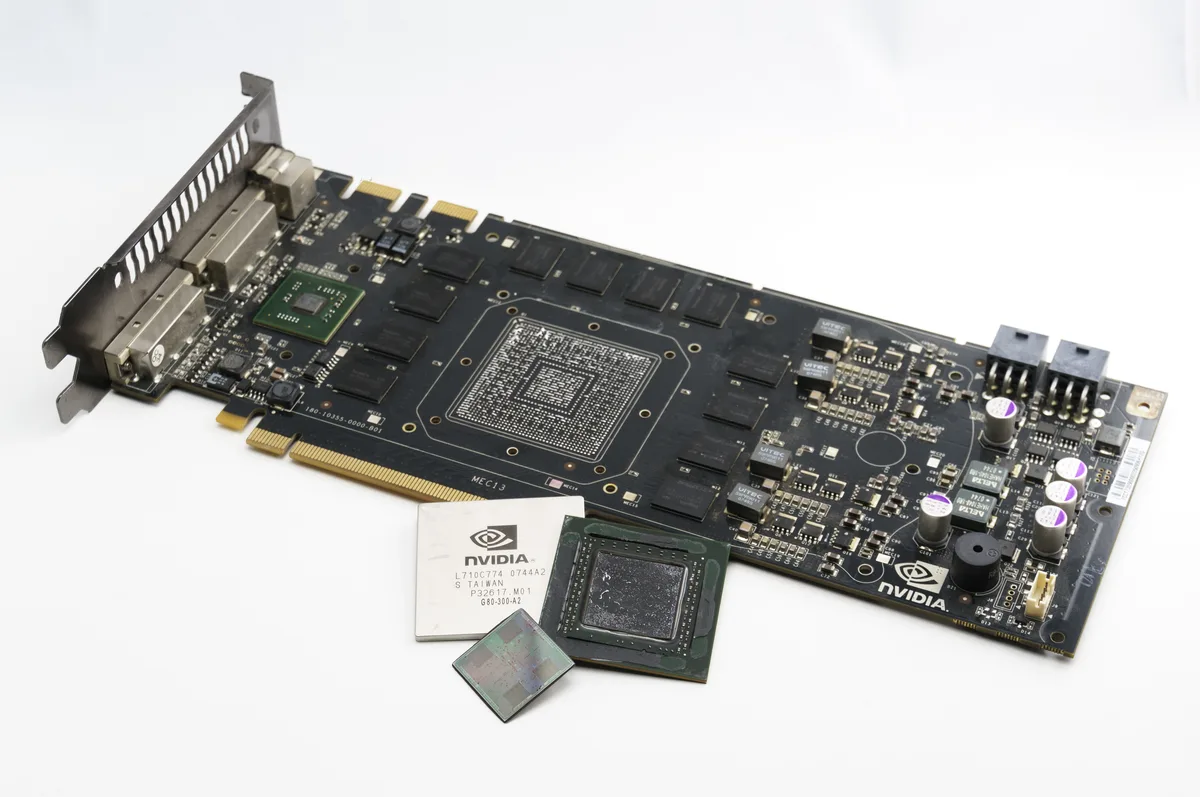
The NVIDIA G80 GPU, launched in 2006, was a pivotal chip containing 681 million transistors. Its advanced parallel processing capabilities, unlocked by the CUDA platform, laid the groundwork for modern artificial intelligence by enabling the complex calculations needed for neural networks. (Source: commons.wikimedia.org)
Deep Learning’s Spark: AI Chips Take Off
On September 30, 2012, a University of Toronto team gained attention. Researchers Alex Krizhevsky, Ilya Sutskever, and Geoffrey Hinton entered the ImageNet Large Scale Visual Recognition Challenge (ILSVRC). Their deep convolutional neural network, AlexNet, achieved a 15.3% error rate. This significantly surpassed the previous year’s winner, which scored 26.2%.
AlexNet trained on two NVIDIA GTX 580 GPUs. The researchers used these consumer-grade cards to process millions of images. This achievement demonstrated deep learning’s significant capability when paired with GPU acceleration. It was a key moment for AI. The research community immediately noticed.
Suddenly, deep learning, an AI subfield, gained widespread interest. Google, Facebook, and Microsoft started investing heavily. They built their own AI research divisions. They aimed to copy and improve AlexNet’s success. The demand for powerful GPUs rose sharply among these tech giants.
Jensen Huang described this shift at a 2014 university event. He stated that “the rise of deep learning started with GPUs.” NVIDIA quickly changed its strategy, focusing on the data center market. The company understood the significant effect of this new way of computing. Deep neural network performance now depended on specialized chips.
ChatGPT: Demand Explodes
On November 30, 2022, OpenAI launched ChatGPT. This generative AI chatbot conversed like a human, surpassing previous systems. It quickly gained millions of users, impressing many with its text generation. This event rapidly altered the AI landscape.
ChatGPT ran on vast neural networks. These Large Language Models (LLMs) needed very large amounts of computing power for training and use. OpenAI’s models used tens of thousands of NVIDIA GPUs. This scale showed how essential AI chips were.
The public’s immediate interest in ChatGPT led to significant investment. Every major tech company quickly added generative AI to their products. Microsoft invested billions in OpenAI. Google accelerated its own LLM development. Amazon, Meta, and others announced large AI projects. This created a continuous demand for high-performance AI chips.
NVIDIA’s stock price rose sharply. Its quarterly revenue forecasts increased greatly because of data center GPU orders. CEO Jensen Huang reported record earnings, stating in May 2023 that “a new period of computing had begun.” The market viewed NVIDIA as the primary driver of this rapid growth in AI. The industry immediately faced supply shortages for these specialized processors.
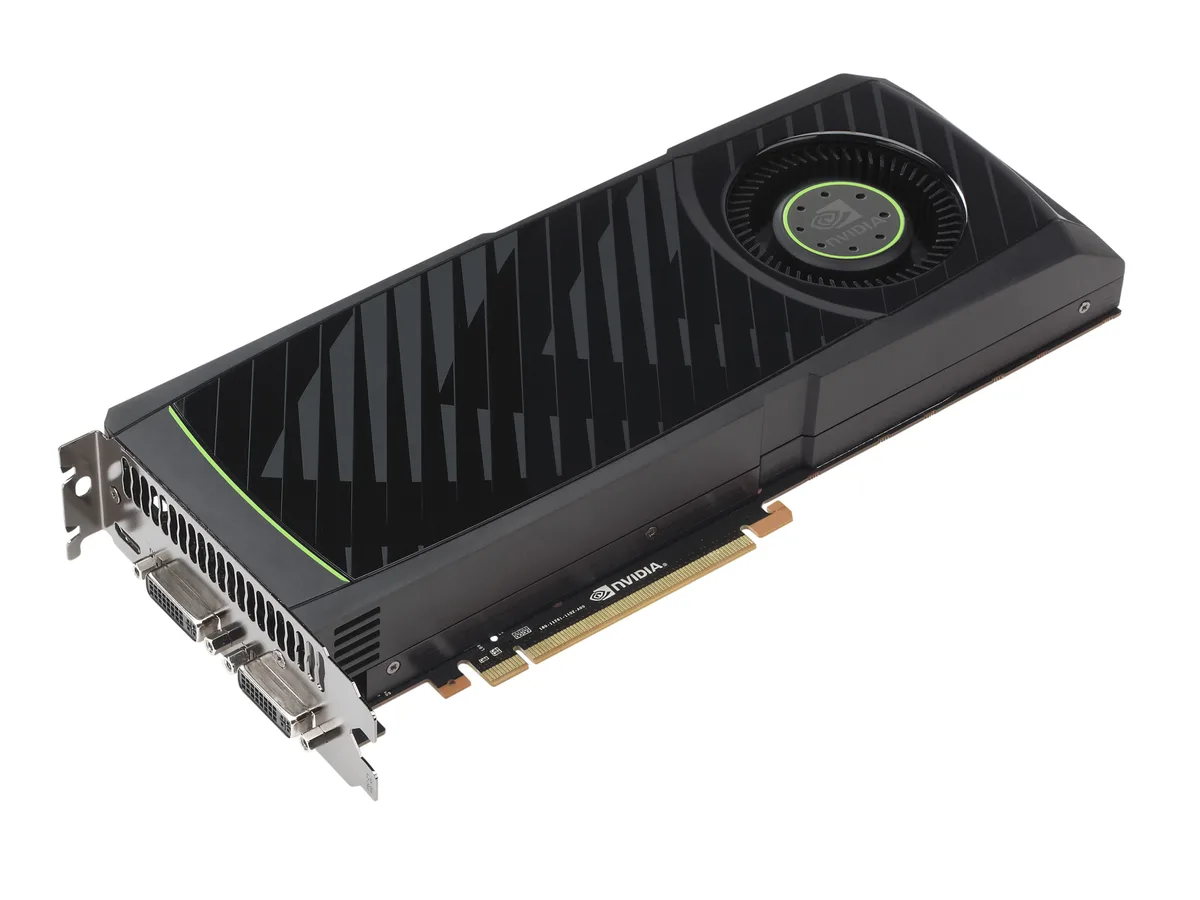
The NVIDIA GTX 580, a consumer-grade GPU released in 2010, played a pivotal role in the deep learning revolution. Researchers used two of these cards to train AlexNet, achieving a breakthrough in the 2012 ImageNet challenge and demonstrating the power of GPU acceleration for AI. (Source: techradar.com)
The Titans’ Race: Innovation Accelerates
AI demand grew quickly, leading to strong competition among chipmakers. NVIDIA still holds a strong position, with an estimated 80-90% market share in AI accelerators as of late 2023. Their H100 GPU, priced around $30,000-$40,000, became the industry standard. It offered very high performance for training complex AI models.
Other players quickly joined the competition. AMD launched its MI300X series of AI accelerators in December 2023. AMD CEO Lisa Su stated the MI300X offered competitive performance. It aimed to capture a large share of the growing market. Intel also promoted its Gaudi line of AI processors. They emphasized their lower cost for certain AI workloads.
Hyperscale cloud providers began designing their own custom Application-Specific Integrated Circuits (ASICs). Google built its Tensor Processing Units (TPUs) for its AI workloads. Amazon created Inferentia and Trainium chips for AWS customers. Microsoft unveiled its Maia 100 AI accelerator in November 2023. These companies aimed to reduce reliance on outside suppliers and tailor chips for their specific needs.
The competition extended beyond the chips themselves. Memory makers like Samsung and SK Hynix saw strong demand for High Bandwidth Memory (HBM). This specialized memory is essential for quickly feeding data to AI accelerators. Taiwan Semiconductor Manufacturing Company (TSMC), the world’s largest contract chipmaker, became crucial. It manufactured most of these advanced AI chips.
Market Projections: Billions at Stake
The AI chip market is growing rapidly. Research firm IDC reported in December 2023 that AI servers, including accelerators, reached $28.1 billion in 2023. This was a 36.3% increase from the year before. The forecast expects continued fast growth.
Another report, by Mordor Intelligence in January 2024, projected significant growth. The AI chip market is expected to grow from $25.46 billion in 2023 to $201.28 billion by 2029. This represents a compound annual growth rate (CAGR) of 41.25%. This rapid increase reflects the widespread use of AI across industries. Data centers remain the largest segment. Edge AI, autonomous vehicles, and healthcare also increase demand.

Taiwan Semiconductor Manufacturing Company (TSMC) is the world's largest contract chipmaker, crucial for producing most advanced AI chips like NVIDIA's H100 and AMD's MI300X. Its cutting-edge fabrication plants in Taiwan are the backbone of the global AI hardware industry. (Source: restofworld.org)
Gartner, a leading research company, forecast in April 2024 that worldwide AI chip revenue would reach $71.2 billion in 2024. This marks a 33% increase from 2023. They expect revenue to grow further to $92 billion in 2025. This growth is due to more demand for AI accelerators in servers. It also includes new designs for embedded AI in devices.
The sheer volume of data AI models generate and process requires this growth. Training large language models can cost hundreds of millions of dollars in compute power. This investment shows how valuable AI capabilities are. The AI chip market isn’t just expanding. It is changing the semiconductor industry at its core.
The Road Ahead: AI’s Silicon Future
AI chip development focuses on greater specialization and efficiency. Companies are exploring new designs beyond traditional GPUs. Neuromorphic chips, inspired by the human brain, target ultra-low power use. Quantum computing, though still new, offers the potential to significantly change certain AI tasks. These innovations will enable new possibilities for AI applications.
Geopolitical factors will also continue influencing the market. The United States has placed export controls on advanced AI chips to China. These policies aim to limit China’s AI development. This has prompted China to speed up its own chip manufacturing. The global AI chip supply chain remains a key area of strategic rivalry.
The environmental impact of AI computing is also gaining attention. Training and running large AI models use huge amounts of energy. Future chip designs will focus on energy efficiency as much as performance. Innovations in cooling and sustainable data centers will be essential.
The AI chip market will remain a center of innovation. It will determine AI’s pace and direction. The competition for more powerful, efficient, and specialized silicon shows no signs of slowing. This continuous effort will change industries and how we interact with computers for decades to come.
FAQ
Q: What is an AI chip? A: An AI chip, or AI accelerator, is a specialized processor. It is designed to handle the large-scale parallel calculations AI algorithms need. Unlike general-purpose CPUs, these chips are optimized for tasks like neural network training and inference. They often have thousands of cores working at once.

Neuromorphic chips, like Intel's Loihi or IBM's TrueNorth, are designed to mimic the human brain's neural networks, offering ultra-low power consumption for AI tasks by processing information in a highly parallel and event-driven manner. (Source: gigenet.com)
Q: Why are GPUs so dominant in the AI chip market? A: GPUs (Graphics Processing Units) were originally designed for parallel processing in graphics rendering. This design was well-suited for the math and parallel work deep learning needs. NVIDIA’s early CUDA investment also created a robust software environment, strengthening their market position.
Q: What is the main driver of AI chip market growth? A: The main driver is the rapid increase in demand for generative AI models, such as large language models (LLMs). These require very large amounts of computing power for training and deployment. The spread of AI across many sectors — autonomous vehicles, healthcare, and industrial automation — also contributes to this growth.
Q: What are custom AI ASICs? A: Custom AI ASICs (Application-Specific Integrated Circuits) are chips designed by companies like Google (TPUs) and Amazon (Inferentia) for their specific internal AI workloads. They are built for particular algorithms and tasks. This offers high efficiency and performance for those applications, often reducing reliance on outside chip vendors.
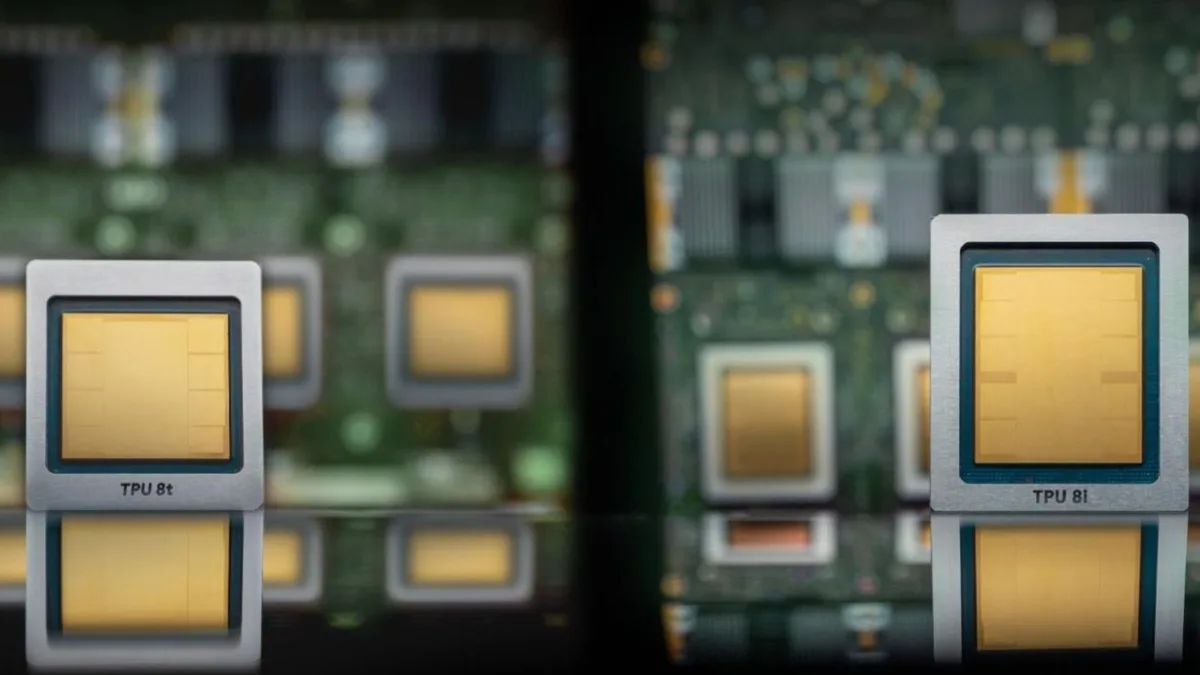
Google's Tensor Processing Units (TPUs) are custom-designed ASICs optimized for machine learning workloads, particularly neural networks. First unveiled in 2016, they power many of Google's AI services and are known for their high efficiency in training and inference. (Source: tomshardware.com)
You might also like:
👉 GSA: US Public Sector AI Use Jumped 30% in 2022
👉 Youth & AI: The Global Risks in Apps & Social Media
👉 How US Department of Labor Uses NLP for Real-Time Job Market Insights