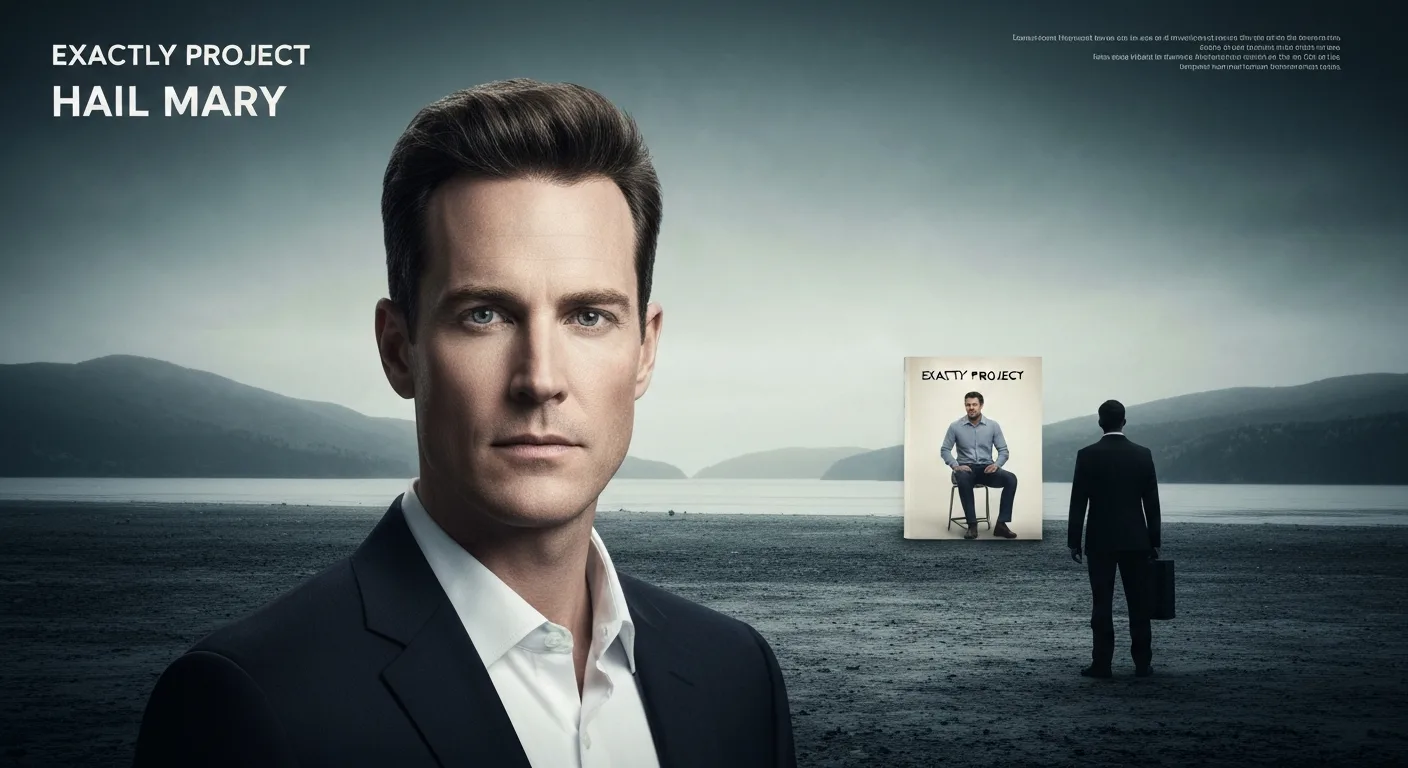
Project Hail Mary: Ryland Grace's Epic Space Survival & Mystery
Explore the thrilling world of Andy Weir's 'Project Hail Mary.' Follow Ryland Grace as he awakens on a mysterious spaceship with amnesia, tasked with saving humanity. A captivating journey of science, survival, and discovery.
The Last Gambit: An Account of Project Hail Mary a Novel
The cold, sterile hum of an unfamiliar ship was the first sensation, followed by the metallic tang of recycled air and the dull ache behind the eyes. Ryland Grace, a man whose very identity was a void, awoke to a stark reality: he was alone, yet not. Two inert bodies, human, lay beside him in suspended animation, their faces frozen in a grim testament to a journey he couldn’t recall. Above, a panoramic view of the universe, dazzling and indifferent, offered no comfort. His memory, a shattered mosaic, slowly began to reassemble, piece by agonizing piece, revealing not just his name, but the impossible, terrifying burden he carried: the survival of humanity rested on his shoulders, light-years from home, with no clear recollection of how he got there or what he was supposed to do. This was the opening act of Project Hail Mary, a novel that chronicles humanity’s most desperate, audacious gamble against the void.

Awakening to Oblivion: The Enigma of Project Hail Mary
Grace’s initial disorientation was not merely a literary device; it was the reader’s entry point into an unfolding crisis of galactic proportions. As his memory slowly returned, triggered by meticulously placed logs and instructional videos, the horrifying truth coalesced. He was the sole conscious survivor of a mission to Tau Ceti, a desperate last-ditch effort to save Earth from an existential threat. The sheer scale of the undertaking, coupled with the profound amnesia, imbued his struggle with a primal urgency. Every recovered detail, every scientific explanation, felt like a vital clue in a cosmic detective story, where the stakes were nothing less than the continuation of all life on Earth.
The initial days aboard the Hail Mary were a masterclass in scientific problem-solving under duress. Grace, a former molecular biologist turned middle school science teacher, found himself thrust back into the crucible of high-stakes research. His companions, two Russian cosmonauts, remained in their cryogenic sleep, their presence a constant reminder of the mission’s cost and the grim probability of failure. The ship itself was a marvel of speculative engineering, a testament to humanity’s collective will, yet its complexity demanded an understanding Grace was slowly, painfully reacquiring. He learned of the Astrophage, the microscopic alien life form consuming the Sun’s energy, and the chilling countdown to global extinction that had driven humanity to this ultimate venture.
The stark reality of his situation, the isolation, and the immense responsibility began to define him. Grace’s internal monologue, a blend of scientific reasoning, gallows humor, and profound anxiety, became the reader’s compass through this uncharted psychological and physical territory. He was not a hardened astronaut, but a reluctant hero, a man whose strengths lay in his intellect and adaptability, not his combat readiness or stoicism. This grounded perspective humanized the overwhelming scale of the mission, making the impossible relatable and the scientific challenges tangible.
The Blight on Sol: Earth’s Desperate Plea
The crisis that spawned Project Hail Mary was not one of war or pestilence, but of cosmic indifference. In the not-so-distant future, scientists detected an anomaly: the Sun was dimming. Rapidly. The culprit was soon identified as the Astrophage, a novel microorganism that fed on stellar energy, reproducing exponentially, forming vast, dark mats across the solar surface. This silent, invisible enemy heralded an inevitable ice age, a slow, agonizing death for Earth. The world’s scientific community, initially skeptical, quickly mobilized as the evidence became undeniable. The once vibrant yellow dwarf star began to fade into a sickly orange, then a dull red, casting an apocalyptic pall over terrestrial life.

The global response was one of unprecedented unity and desperation. Nations put aside millennia of conflict to form the International Astrophage Taskforce (IAT), pooling resources and intellect to confront the shared doom. Scientists, engineers, and strategists from every corner of the globe converged, driven by a singular, terrifying goal: survival. The initial efforts focused on understanding the Astrophage, its biology, its lifecycle, and, crucially, how to combat it. This era of frenzied research was characterized by both brilliant breakthroughs and crushing setbacks, each discovery a fleeting beacon in the encroaching darkness.
As the Sun continued to dim, plunging Earth into an ever-deepening twilight, the IAT’s focus shifted from defense to escape, then to a Hail Mary pass. Observations revealed that the Astrophage originated from a distant star system, Tau Ceti, a system whose star, unlike Sol, was not dimming. This discovery ignited a flickering ember of hope: perhaps Tau Ceti held the key, either a predator of the Astrophage or an environmental factor that rendered it harmless. The decision was made to build a starship, the Hail Mary, capable of interstellar travel, to send a small crew to Tau Ceti, and to bring back the solution. It was an undertaking of unimaginable complexity and expense, a final, desperate gamble with humanity’s last resources.
The Iron Will of Stratt: Forging Humanity’s Last Hope
Behind the monumental undertaking of Project Hail Mary stood one formidable figure: Dr. Eva Stratt. She was not a scientist in the traditional sense, but a logistical and strategic mastermind, a woman of unyielding resolve and ruthless pragmatism. Stratt possessed a singular, terrifying ability to cut through bureaucracy, inspire fanatical loyalty, and make impossible decisions with cold, calculating efficiency. Her methods were unconventional, often bordering on unethical, but in the face of global extinction, her singular focus on results was deemed not just acceptable, but essential. She was the architect of the Hail Mary, the general of humanity’s last war.
Stratt’s recruitment of Ryland Grace was characteristic of her approach. Grace, a brilliant but unassuming molecular biologist, had stumbled upon a crucial insight into Astrophage biology, proposing a theoretical solution involving microscopic organisms. His initial reluctance to join the program, his preference for teaching, was systematically dismantled by Stratt. She manipulated circumstances, created crises, and applied psychological pressure with surgical precision until Grace, stripped of other options, found himself indispensable to the project. “Time to be a hero,” she famously declared, a phrase that would haunt Grace throughout his journey. Stratt understood that intellect alone was insufficient; she needed individuals who could perform under unimaginable stress, and she was prepared to forge them.
The construction of the Hail Mary itself was an engineering marvel born of Stratt’s relentless drive. Every nation contributed, every resource was allocated with military precision. The ship was designed for maximum efficiency and survivability, a sleek, rotating vessel propelled by an Astrophage-fueled engine – a grim irony. Its systems were redundant, its design robust, and its mission parameters clear: reach Tau Ceti, find a solution, and return. The sheer scale of the project, from the rapid development of interstellar propulsion to the training of the hand-picked crew, spoke volumes about Stratt’s ability to bend the world to her will, transforming despair into a focused, albeit terrifying, purpose.
Across the Void: An Unlikely Rendezvous
The journey of the Hail Mary was long, arduous, and fraught with peril, a testament to the vastness of interstellar space and the fragility of human ambition. For years, the ship hurtled through the void, its crew in suspended animation, a silent arrow aimed at Tau Ceti. When Ryland Grace finally awoke, his amnesia only compounded the profound isolation of his situation. He was billions of kilometers from home, the last hope of a dying species, with only the cold comfort of scientific instruments and the ghostly presence of his deceased crewmates for company.
It was in the Tau Ceti system that the mission took an unforeseen, miraculous turn. Grace detected another ship, an alien vessel, orbiting the target star. This was the Blip-A, a ship of unknown origin, yet clearly piloted by an intelligent species. The encounter was not merely a scientific curiosity; it was a profound moment of first contact, an event that reshaped the entire mission. Grace, guided by his scientific curiosity and a desperate need for assistance, initiated communication. The language barrier was immense, the cultural chasm seemingly unbridgeable, yet both species shared a common enemy and a desperate need for solutions.
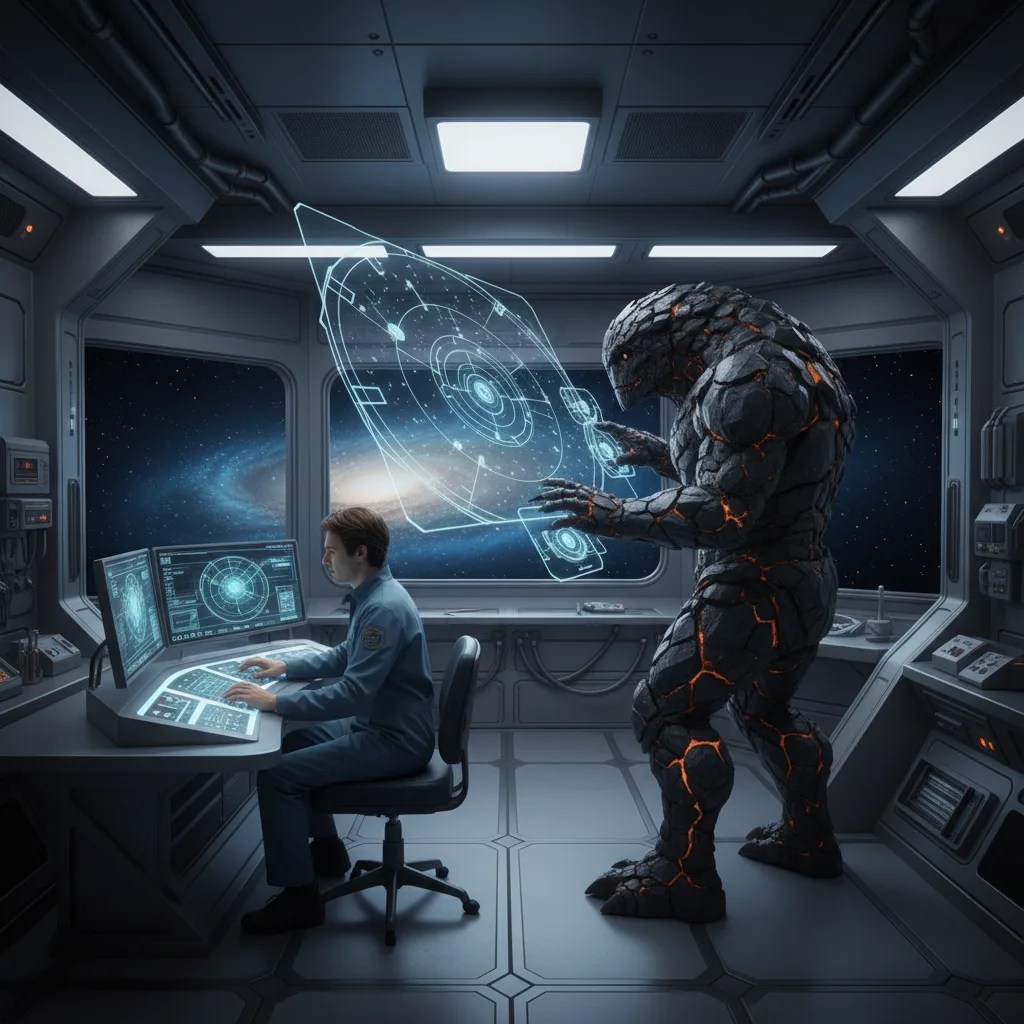
The alien, whom Grace affectionately named Rocky due to its silicon-based physiology and six-limbed, rock-like appearance, became not just an ally but a friend. Rocky’s species, the Eridians, hailed from a planet orbiting 40 Eridani, and they too were facing an Astrophage crisis, though their star was dimming at a slower rate. Their ship, like the Hail Mary, was a last-ditch effort to find a solution at Tau Ceti. The initial communications were arduous, a painstaking process of establishing common ground through mathematics, music, and shared scientific principles. Grace’s ingenuity, coupled with Rocky’s advanced engineering knowledge, slowly forged a bond, transforming two isolated missions into a cooperative venture, an interspecies alliance against a common cosmic foe.
Eridian Accord: The Collaborative Genius of Two Species
The alliance between Ryland Grace and Rocky was the beating heart of Project Hail Mary. It was a testament to the universal language of science and the innate drive of intelligent life to survive. Grace, with his biological insights into the Astrophage, and Rocky, with its unparalleled engineering prowess and understanding of exotic materials, formed a symbiotic partnership. Their shared objective – to find a solution at Tau Ceti and save their respective home worlds – transcended the vast differences in their biology, culture, and evolutionary paths.
Their collaborative efforts began with a meticulous investigation of Tau Ceti. The star was indeed Astrophage-free, but why? The answer lay in a unique, ammonia-based microorganism inhabiting Tau Ceti’s oceans, which consumed the Astrophage. This was the “Taumoeba”, the natural predator humanity had so desperately sought. The challenge, however, was not just identifying it, but cultivating it in sufficient quantities and finding a way to transport it across interstellar distances to combat the Astrophage on their respective stars. This required a level of scientific and engineering integration that pushed both Grace and Rocky to their absolute limits.
Their shared workspace, a hybrid environment aboard the Hail Mary, became a crucible of innovation. Grace learned to navigate Rocky’s alien technology, while Rocky adapted to Grace’s human-centric equipment. They brainstormed solutions, designed experiments, and built prototypes, their different perspectives often leading to breakthroughs neither could have achieved alone. The sensory details of their collaboration were vivid: the rhythmic clicking of Rocky’s speech, Grace’s muttered calculations, the alien smell of Rocky’s atmospheric preferences, the shared triumph of a successful experiment. Their bond deepened through shared meals – for Grace, nutrient paste; for Rocky, nutrient rocks – and discussions that ranged from the intricacies of Astrophage metabolism to the philosophical implications of existence. “We are a team,” Rocky’s clicking resonated, a simple truth in a complex universe.
The Sol System’s Fate: A Burden of Decision
As the solution to the Astrophage crisis began to materialize, a new, agonizing dilemma emerged, one that tested the very fabric of Grace and Rocky’s alliance. They had successfully engineered a method to cultivate and deploy the Taumoeba, but the resources required for a full-scale assault on both the Sun and 40 Eridani were finite. Specifically, the amount of fuel – the Astrophage itself – needed for the return journey to both systems was insufficient. A choice had to be made: save Earth, or save Erid.
This was the climax of Project Hail Mary, a moment of profound moral reckoning. Grace, driven by his mission to save Earth, naturally leaned towards his home world. Rocky, equally committed to its own species, argued for Erid. The discussions were intense, filled with scientific data and emotional pleas, highlighting the inherent bias of self-preservation. Grace’s internal struggle was immense: how could he choose one species over another, especially after forging such a deep bond with Rocky? The weight of billions of lives, both human and Eridian, pressed down on him.
The ultimate solution, a testament to Grace’s ingenuity and Rocky’s selflessness, was a desperate, heartbreaking compromise. A system was devised where one ship, the Hail Mary, would return to Earth with enough Taumoeba to save Sol, while the Blip-A would return to Erid. However, to ensure both ships had enough fuel, one of the ships would need to make an additional, dangerous fuel stop at a black hole, a journey that offered a high probability of failure and would delay its return significantly. Grace, understanding the dire need for speed back on Earth, ultimately volunteered for the black hole detour, accepting a near-certain death or permanent exile in exchange for Rocky’s swifter return to Erid. It was the ultimate sacrifice, a true act of interspecies heroism.
Beyond the Horizon: The Enduring Echoes of Project Hail Mary a Novel
The immediate aftermath of Grace’s sacrifice at the black hole was a somber triumph. Rocky, having successfully returned to 40 Eridani, deployed the Taumoeba, saving its home star. On Earth, the Hail Mary, guided by its automated systems, eventually arrived, its cargo of Taumoeba deployed into the Sun. The Astrophage retreated, the Sun slowly regained its brilliance, and humanity was saved, unaware of the full extent of the sacrifices made in the cold vacuum of space. The mission was a success, but the cost, particularly for Ryland Grace, remained a mystery to those on Earth.
However, the story of Ryland Grace did not end in oblivion. Through sheer scientific ingenuity and a stroke of luck, he survived the black hole maneuver, eventually making his way to Erid. There, he reunited with Rocky, becoming an integral part of Eridian society, a living bridge between two civilizations. His knowledge, particularly in biology, proved invaluable to the Eridians, who excelled in engineering. He found a new home, a new purpose, and a new family among the clicking, six-limbed beings he had once considered alien.
The lasting impact of Project Hail Mary a novel extends far beyond the immediate salvation of two star systems. It is a profound meditation on the power of interspecies cooperation, the universal drive for survival, and the quiet heroism of individuals. The novel champions scientific inquiry, problem-solving under duress, and the idea that humanity’s greatest strength lies not in aggression, but in empathy and collaboration. It leaves the reader with a sense of wonder at the vastness of the cosmos and a hopeful vision of a future where differences can be overcome for the greater good, a testament to the enduring spirit of life itself.
FAQ:
Q1: Is “Project Hail Mary” considered hard science fiction? A1: Yes, Andy Weir is known for his dedication to scientific accuracy, and “Project Hail Mary” largely adheres to principles of hard science fiction, grounding its fantastical elements (like Astrophage and Taumoeba) in plausible scientific theories and meticulous problem-solving.
Q2: Who is the author of “Project Hail Mary”? A2: “Project Hail Mary” was written by Andy Weir, an American novelist known for his science fiction novels The Martian and Artemis.
Q3: What exactly is Astrophage? A3: In the novel, Astrophage is a fictional, microscopic, single-celled organism that consumes electromagnetic radiation (light) as its primary energy source, reproducing exponentially and forming vast mats that dim stars.
Q4: Is there a movie adaptation of “Project Hail Mary” planned?
 A4: Yes, a film adaptation is in development. As of recent reports, Ryan Gosling is attached to star as Ryland Grace, and Phil Lord and Christopher Miller are set to direct.
Key Takeaways:
“Project Hail Mary” stands as a monumental work of speculative fiction, weaving together rigorous scientific problem-solving with a deeply human (and alien) narrative of survival. It underscores the fragility of existence, the boundless potential of intellect, and the profound strength found in unity, even across species. The tale of Ryland Grace and Rocky is a timeless reminder that when faced with the unimaginable, the most powerful force is not individual heroism, but collective endeavor.
You might also like:
👉 Latest Discoveries in Space Exploration: Unveiling the Cosmos
👉 Biggest Unsolved Mysteries in History: Ancient Enigmas & Modern Puzzles
👉 Most Mind-Blowing Universe Facts: Cosmic Wonders & Mysteries