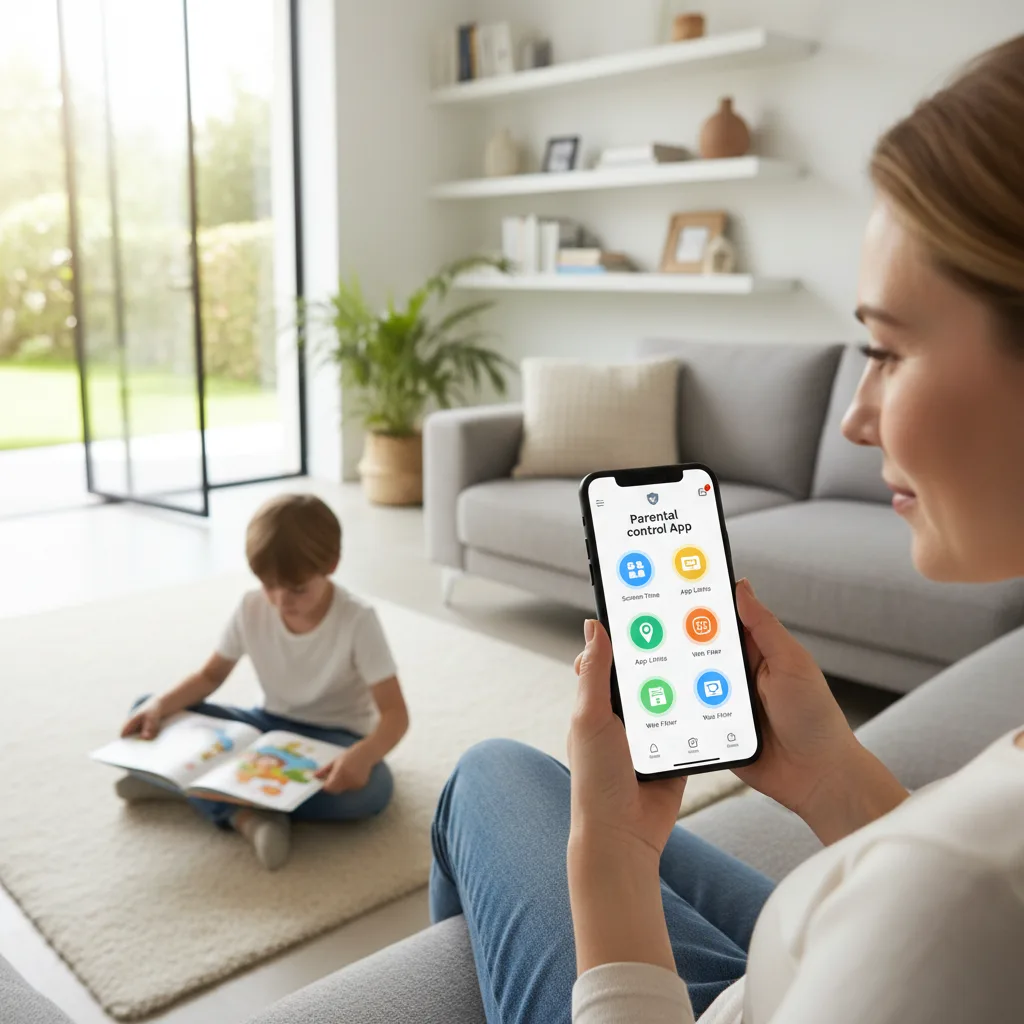
Parental Control & Digital Wellbeing: Navigating Kids' Screen Time
Explore the complex world of parental control and digital wellbeing. Understand the silent battles parents face with kids' screen time and discover strategies for a healthier digital life.
The Ghost in the Machine: When Parental Control Isn’t About Control At All
The soft, blue light from the tablet cast a pale glow on Leo’s face, turning his usually rosy cheeks a ghostly white. It was past midnight, well past his bedtime, and in the quiet suburban home in Plano, Texas, his mother, Sarah, stood frozen in the doorway. She’d woken to the faint hum, a sound that now filled her with dread – a quiet reminder of a battle she was steadily losing. Her son, just eleven, was lost, once again, in a Roblox world, his small fingers flying across the screen.
Sarah’s heart sank with a familiar ache. She felt the sting of betrayal, not just because he was defying the rules, but because she’d installed ScreenGuard, an app guaranteed to work, specifically to prevent this. Its timer should have locked him out an hour ago. The app had promised peace of mind, a digital boundary around her child. Instead, it felt like a silent war, an ongoing arms race where Leo, with his remarkable knack for all things digital, always seemed one step ahead. She watched him, a knot tightening in her stomach. What was she even seeing? And how had he bypassed the controls this time?

That night, as she gently disconnected the Wi-Fi router and watched the light drain from Leo’s screen, Sarah felt a deep exhaustion. It wasn’t just the late hour. It was the heavy burden of modern parenthood, the tightrope walk between protecting her child and preparing him for a screen-saturated world. Sarah would later discover her experience wasn’t unique. It was a story echoing in homes across the country, highlighting a harsh reality: strict parental controls often miss the point entirely.
Digital Boundaries and Their Unexpected Loopholes
For many parents, the first step into managing screen time starts with a simple idea: control. Parents hear the statistics – studies from the American Academy of Pediatrics show children aged 8-12 spend an average of 4-6 hours a day on screens, and teens up to 9 hours. They worry about privacy, exposure to inappropriate content, cyberbullying, and the relentless pull of endless scrolling. Naturally, parents turn to tools designed to create boundaries.
 Apps like ScreenGuard, Family Link, OurPact, and Qustodio offer what seems like a perfect fix. They promise to monitor activity, filter content, set time limits, track locations, and even block specific applications. It’s a tempting offer: a digital shepherd for their digital flock. In February 2022, a survey by the Pew Research Center indicated that nearly 70% of parents with children aged 12-17 reported using at least one parental control tool, a significant increase from five years prior. They're seeking safety, structure, and a way to mitigate the dangers they perceive online.
But relying on technology to manage technology often brings its own complications. Think about it. The moment you introduce a control, you introduce a challenge for a curious, intelligent child. As Dr. Anya Sharma, a child psychologist at the University of Toronto, explains, “Kids are incredibly skilled at finding loopholes. They’re digital natives. For them, bypassing a block isn’t just defiance; it’s often a puzzle they enjoy solving, a skill they hone.” She shared stories of children creating secondary accounts, using friends’ devices, or even exploiting obscure browser settings to regain access. That’s exactly what Leo had done, discovering a forgotten guest account on his tablet that ScreenGuard hadn’t been configured to monitor. These digital boundaries, it turns out, often have hidden gates.

A deeper, often unspoken issue, is the erosion of trust. When a child feels constantly monitored, constantly restricted, it can send a clear message: “I don’t trust you.” What happens then? Resentment builds, communication breaks down, and the very connection parents hope to safeguard can fray.
Beyond the App: Cultivating Digital Intelligence, Not Just Restrictions
Research reveals a surprising truth. While parental control apps offer a basic layer of protection for very young children, their effectiveness quickly diminishes as kids mature. For pre-teens and teenagers, in fact, relying too heavily on restrictive tools can actually backfire. A 2023 report titled “The Connected Child Report” by the Global Digital Literacy Foundation, based on a longitudinal study of over 5,000 families across the US and UK, revealed a clear correlation: adolescents whose parents relied mainly on restrictive software were more likely to engage in risky online behaviors – like sharing personal information with strangers or viewing inappropriate content – than those whose parents prioritized open communication and digital education.
Why? Because without understanding why certain boundaries exist, children don’t develop the critical thinking skills needed for self-regulation. They only learn that boundaries do exist. They learn to avoid the control, not to understand the danger. “We aren’t raising kids to live in a walled garden forever,” explains Michael Chen, author of “Raising Digital Natives” and a digital education consultant. “Our goal isn’t to shield them from the internet, but to equip them to thrive within it, safely and responsibly.” He advocates shifting from a “control” mindset to a “coaching” mindset.
This coaching involves active, ongoing dialogue. It means sitting down with your child, really watching what they’re doing online, and discussing it. Discussing not just potential risks, but also the good – creative projects, friendships, learning opportunities. When Sarah finally sat down with Leo, not to scold him about the Roblox incident, but to ask why he felt he needed to play past his bedtime, she learned something important. He wasn’t trying to be defiant; he was trying to connect with friends in different time zones, friends he’d made through the game. He felt left out when he couldn’t join their late-night sessions. This wasn’t about addiction; it was about belonging.

Understanding these underlying motivations changes everything. It shifts the conversation from “You broke the rules” to “How can we help you meet your social needs while also respecting your sleep and our family’s expectations?” This isn’t easy, requiring patience and for parents to become, to some extent, digitally literate themselves. But it’s far more effective in the long run than any app could ever be.
The Teenage Years: Autonomy, Privacy, and Self-Regulation
As children enter their teenage years, screen time management dynamics change significantly. This is a period marked by a strong drive for independence, identity formation, and peer connection. The idea of constant surveillance, or even strict time limits imposed by an app, often clashes with these developmental needs. What happens when a parent tries to maintain the same level of digital control they had when their child was seven?
 It usually doesn't go well. Teenagers, as research from the Center for Media and Child Health at Stanford University has consistently shown, view their digital spaces as extensions of their personal identity and social lives. Monitoring private messages or browser history can be perceived as a deep invasion of privacy, leading to secrecy, distrust, and strained family relationships. Dr. Ben Carter, a researcher at the Digital Wellbeing Lab at MIT, explains, "For a teen, their phone isn't just a device; it's their social lifeline. Restricting it without discussion, or worse, covertly monitoring it, can feel like you're cutting off their arm."
Instead, the focus must shift towards empowering teenagers with self-regulation. This means involving them in the decision-making process. A family media plan, collaboratively developed, can be highly effective. It outlines agreed-upon screen time limits, appropriate content, privacy expectations, and consequences for breaches – all decided together. This approach respects their growing autonomy while still establishing necessary boundaries. For example, a teen might agree to put their phone away an hour before bed, not because an app forces them to, but because they understand the impact on their sleep and mental health, a discussion their parents helped facilitate.
It’s also about modeling. What kind of digital habits do parents display? Are they constantly checking their phones at dinner? Do they scroll endlessly before bed? Teens are observant. They see the disconnect between what parents say and what they do. Genuine digital wellbeing, then, requires parents to look inward as much as they scrutinize their children’s screens. It’s a shared journey, not a dictatorial decree.
Building a Digital Future: Collaboration, Communication, and Continuous Learning
So, if parental control extends beyond just installing an app, what does it truly involve? It’s about building a foundation of digital citizenship and resilience. It’s about teaching critical thinking, media literacy, and empathy in online spaces. It’s about preparing young people to be responsible, discerning, and kind participants in the digital world, rather than just passive consumers or rule-followers.
This means shifting from reactive policing to proactive education. It means understanding that technology changes at a rapid pace, and what was relevant last year might be obsolete today. Parents and children alike need to be lifelong learners in this space. Regular check-ins, discussions about new apps, online trends, and challenges – these are the conversations that truly protect children. They build trust, open lines of communication, and empower kids to make smart choices even when parents aren’t directly supervising. Because, let’s be honest, we can’t always be there.
Digital wellbeing, then, isn’t a destination; it’s an ongoing process, a continuous dialogue, and a shared responsibility. It’s messy. It’s challenging. But it’s also a powerful opportunity to connect with our children on a deeper level, to guide them through a world we ourselves are still trying to understand. The “ghost in the machine” isn’t the app itself, or even the lurking dangers online. It’s the silent, often unacknowledged space where genuine connection, open dialogue, and mutual trust should reside.
Frequently asked questions about digital wellbeing and parental control
At what age should I start using parental controls? For very young children (under 7), basic content filters and screen time limits can be useful for initial boundaries. However, the focus should quickly shift to supervision, co-viewing, and conversation as they grow.
Are parental control apps useless then? Not entirely. They can provide a starting point for setting boundaries and may offer some security, especially for younger children. However, they are most effective when used alongside open communication, education, and trust-building, rather than as a standalone solution.
How can I talk to my child about screen time without it feeling like a lecture? Frame it as a collaborative problem-solving discussion. Share your concerns, but also ask about their experiences. Focus on the why behind your rules (e.g., “Too much screen time affects your sleep,” “This game might be too intense for your age”) and involve them in creating a family media plan.
My teenager is very private. How can I balance their need for privacy with my need to keep them safe? Establish clear expectations and boundaries upfront, preferably through a co-created family agreement. Respect their digital privacy as much as possible, but also ensure they know you’re available if they encounter something troubling. Focus on teaching them critical thinking and self-protection skills, rather than relying solely on surveillance.
You might also like:
👉 VR in Education: Revolutionizing Learning & Classrooms
👉 Virtual Reality: Revolutionizing Autism Inclusion & Social Skills
👉 Sustainable Futures: Investment, Cybersecurity & Future of Work